First: establish the current baseline
Record Search Console, GA4, Google Business Profile, a crawl, rankings and leads before you change pages or listings.
You need a before-state: which URLs receive clicks, which convert, which listings are live, and whether tracking still works. Without that, cleanup looks like a traffic drop you caused. A commercial audit of opportunity is a different job — see Local SEO audit. Sudden unexplained drops are covered in why local rankings and leads suddenly dropped.
Is there a manual action?
Check Search Console Manual actions. A manual action is a human review outcome for spam-policy problems, not the same thing as an algorithmic ranking change.
Google currently says sites that violate spam policies may rank lower or not appear, and that human review can result in a manual action. If a manual action exists, follow the report’s instructions and Google’s reconsideration process after you fix the issues. If no manual action exists, do not invent one as the explanation for every weak page. Sources: Manual Actions report and Spam policies for Google web search.
Is there an actual spam-policy issue?
Compare the inherited work to Google’s current spam policies, not to a list of tactics that merely look dated.
Policies that often show up in old Local SEO work include doorway abuse (including substantially similar city/region pages that funnel users), scaled content abuse, keyword stuffing, link spam, sneaky redirects and cloaking. Scaled content abuse is generating many pages primarily to manipulate rankings, with little value, no matter how the pages were created. Doorway abuse includes multiple pages targeted at cities that funnel users to one page, and substantially similar pages closer to search results than a clear site hierarchy. Source: Spam policies for Google web search. Owner-facing diagnostics for stuffed copy and cloned location FAQs are over-optimised Local SEO copy and whether every location page should use the same FAQs.
Are bad backlinks actually causing a problem?
Do not run a mass disavow because a report listed “toxic” links. Use disavow when you have a link-related manual action or a clear, large-scale spam problem you cannot get removed.
Google’s spam policies describe buying or selling links for ranking purposes as link spam, and they also describe legitimate paid links that are qualified with rel="sponsored" or rel="nofollow". Most sites have some low-quality links they did not create. Google’s systems already ignore many of them. A disavow file is a targeted tool, not a monthly hygiene task. If you do disavow, understand you are asking Google to ignore those links; it is not a ranking guarantee. Source: Spam policies — link spam.
Are city pages doorway pages?
They are doorway-like when they exist to rank for similar city queries and do not help more than the page they send people to.
Useful location pages remain legitimate. Cleanup of thin templates is a separate decision tree in whether you should delete thin or duplicate city pages.
Is AI content low value?
AI assistance is not automatically a violation. Large numbers of unoriginal pages created mainly to manipulate Search can be scaled content abuse regardless of the tool.
Google’s February 2023 guidance says appropriate use of AI or automation is not against the guidelines when it is not used primarily to manipulate rankings. Do not say “Google penalises AI content.” Detail is in whether AI-generated location pages can hurt Local SEO. Sources: Google Search’s guidance about AI-generated content and Spam policies — scaled content abuse.
Are fake Business Profiles involved?
Fake or ineligible locations, keyword-stuffed names and extra pins for cities you do not occupy are representation problems, not a reason to create still more listings while you clean up.
Work through Google Business Profile suspension, duplicate profiles and Guidelines for representing your business on Google. Inherited fake five-star reviews are a reputation-policy problem, not a second pin: what to do if a previous SEO agency added fake positive reviews.
Should everything be deleted at once?
No. Bulk deletion hides which URLs still convert, which links still help, and which changes caused a new drop.
Google’s site-move guidance to change one major thing at a time is useful here even when you are not moving domains: isolate batches so you can monitor. Source: How to move a site.
Create a remediation priority matrix
| Issue | Evidence | User harm | Search risk | Business impact | Action | Priority |
|---|---|---|---|---|---|---|
| Fake GBP location | Ineligible address on Maps | High — customers sent to the wrong place | Policy / suspension risk | Leads and trust | Correct or close the listing; do not add another pin | 1 |
| Manual action | Search Console report | Varies | Documented | Visibility | Fix listed issues; reconsider after | 1 |
| Broken canonicals / bad redirects | URL Inspection, crawl | Wrong page or errors | Indexing confusion | Key URLs | Repair mapping | 1–2 |
| Doorway city set | Near-duplicate templates, funnel to one page | Thin experience | Doorway / scaled content policies | Depends on traffic quality | Audit; improve or consolidate | 2 |
| Keyword stuffing / title stuffing | Unnatural repeated phrases | Hard to read | Keyword stuffing policy | CTR and trust | Rewrite for people | 2 |
| Purchased links | Invoices, identical anchors, networks | Low | Link spam if unpaid/unqualified | Uncertain | Stop buying; remove what you control; disavow only with cause | 2–3 |
| Incorrect citations | Wrong NAP | Wrong calls | Entity confusion | Leads | Fix high-impact listings | 2 |
| Tracking broken | GA4 / GTM / forms | You cannot see harm | None directly | Decisions go blind | Repair before more content work | 1 |
| Mass AI location pages | City-name swaps | Unhelpful | Scaled content if manipulative scale | Depends | See AI location-page guide | 2 |
Recovery sequence
1
Baseline Record Search Console, GA4, GBP, crawl, rankings and leads before changing pages.2
Identify proven problems Separate evidence-backed issues from tactics you merely dislike.3
Prioritise Weight user harm, search risk and business impact, not only how spammy a page looks.4
Correct Fix one cluster at a time so you can see what changed.5
Monitor Watch indexing, errors, visibility and enquiries after each batch.6
Reassess Decide the next batch from new evidence, not from a leftover punch list.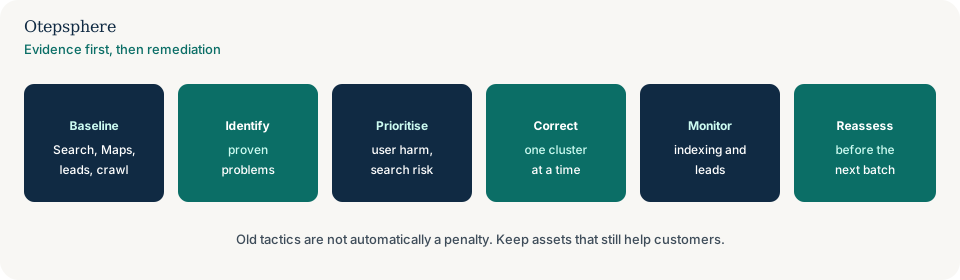
Baseline → identify proven problems → prioritise → correct → monitor → reassess. Repeat. Do not run a year of unpaid cleanup in a weekend.
What not to assume
Do not assume a ranking decline is a penalty. Do not assume every backlink from a directory is paid spam. Do not assume Google will restore traffic after a cleanup. Do not assume Otepsphere or any agency has special Google access.
What not to do
Practical action plan
- Export Search Console, GA4, GBP insights, a crawl and a lead log.
- Check manual actions and security issues.
- Fill the priority matrix with evidence, not rumours.
- Fix tracking and ineligible listings first.
- Remediate page sets in batches; watch indexing after each batch.
- Reassess in 30–60 days of data, not overnight.
When professional help makes sense
Help is useful when doorway sets, link networks and duplicate GBPs are mixed together, or when a manual action needs a careful cleanup log. Recovery is not guaranteed. If the previous vendor left a written list that never shipped, that is an implementation gap, not inherited harm: what happens when Local SEO recommendations never get implemented.
Sources and further reading
- Google Search Central: Spam policies
- Search Console Help: Manual Actions report
- Google Search Central Blog: Guidance about AI-generated content
- Google Business Profile Help: Guidelines for representing your business on Google
Inherited questionable SEO work and unsure what to keep?
Otepsphere can audit the current setup, separate evidence-backed problems from assumptions and prioritise remediation without changing everything at once.
Contact OtepspherePublished by Otepsphere
Published by Otepsphere, founded by Joseph Enmanuel. Learn about Otepsphere and its approach to local SEO.