What does this problem actually mean?
It means the business keeps repeating a class of Local SEO error because it is treating every issue as a missing tactic.
Typical pattern: someone reads a “ten common mistakes” article and orders more citations, more city pages, or more reviews, while the live problem is an ineligible listing, a form that never arrives, or an audit that never shipped. The useful job is classification. A ranked list of tactics is not a diagnosis.
Is this the same as the Local SEO checklist?
No. The checklist is what a healthy setup should include. This page names which class of error you already have.
Use the Local SEO checklist when you need a structured review of identity, profile, pages and measurement. Come here when work is already happening and it keeps missing the actual failure.
Evidence
What can you show, not guess? Live listing, live URLs, reports, or a missing enquiry path.Class
Representation, doorway, measurement, operations, conversion Most “mistakes” sit in one of these jobs.Route
Open the matching diagnostic Do not add citations to fix a form, or city pages to fix a closed listing.Sibling
Inherited harmful work is different Recovery after a previous vendor is its own sequence.Next
A top-ten list is not a diagnosis Classify first, then change one class at a time.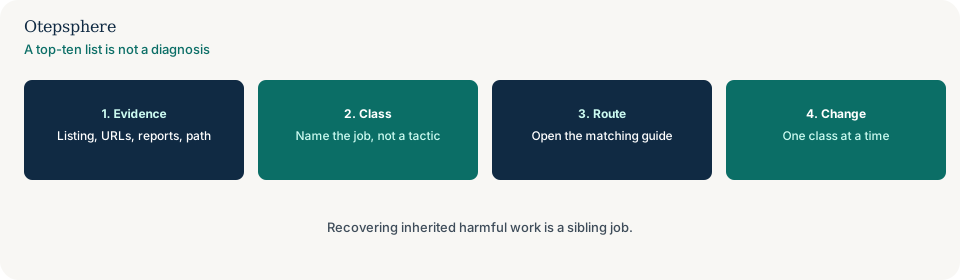
Is this recovering from bad Local SEO?
No. Recovery is for inherited risky work that is already live: doorway farms, spam links, or policy-violating listings.
Classification comes first if you are not sure whether the current work is merely unfinished or actually harmful. If a previous vendor already published that kind of work, use how to recover from bad Local SEO and do not delete everything at once.
What are the mistake classes?
Most Local SEO mistakes sit in one of five classes: representation, doorway content, measurement, operations, or conversion.
Representation is “Google is being told the wrong business.” Doorway content is “we published URLs that do not help a person.” Measurement is “we are scoring the wrong number.” Operations is “nobody can ship the change, or two people undo it.” Conversion is “people find us and still cannot contact the right place.” If you cannot say which class matches the evidence, you do not yet have a next action.
When is it a representation mistake?
It is a representation mistake when the public listing or the name–address–phone record does not describe the real operation.
Evidence: keyword-stuffed profile name, a pin at an address the business does not occupy, a service-area business shown as a shopfront, hours that do not match the door, or two listings for one operation. Google’s representation guidelines require the listing to reflect the real-world business. Source: Guidelines for representing your business on Google. Start with inconsistent business information online or whether an online-only business can have a Google Business Profile.
When is it a doorway or content mistake?
It is a doorway or content mistake when location or service URLs exist to capture city names rather than to help a customer choose.
Evidence: interchangeable suburb pages, the same service copy on every location, or a one-page site asked to rank for every local service. Google’s spam policies treat doorway pages as a problem because they funnel people to the same destination with little unique value. Source: Google Search spam policies. Decide whether a location URL should exist with when to create location pages and clean thin city URLs with how to clean up thin location pages.
When is it a measurement mistake?
It is a measurement mistake when the number you are managing does not match the customer outcome you care about.
Evidence: monthly rank tables that cannot be compared because the grid changed; call clicks that do not match the phone system; branded search growth hiding a decline in service queries; a report that scores an audit nobody implemented. Rankings help; they are not the only KPI. See how to measure Local SEO and why monthly local ranking reports are impossible to compare.
When is it an operations mistake?
It is an operations mistake when the correct recommendation exists and the live site or listing still has not changed — or two writers undo each other.
Evidence: an audit PDF with no owner; a CMS update that wipes titles; a deploy that drops location links; two agencies editing the same profile. The class is access and shipping, not a new strategy. Use what happens when Local SEO recommendations never get implemented or what happens when multiple agencies make conflicting changes.
When is it a conversion mistake?
It is a conversion mistake when people can find the business and still cannot complete a useful enquiry.
Evidence: traffic on the location page and almost no calls; click-to-call that fails on mobile; a form that never arrives; a map embed that sends people to the wrong shop. That is not proof the URL should be unpublished. Start with why visibility does not become customers or why a local page gets traffic but almost no calls.
Mistake-class decision table
| What you can show | Class | First guide | What not to add |
|---|---|---|---|
| Profile name, address, pin or eligibility does not match the real operation | Representation | Inconsistent listings, or GBP eligibility | More city pages to “cover” a false address |
| Suburb URLs differ only by the place name; customers would not choose between them | Doorway / content | When to create location pages; thin-page cleanup | Another suburb URL for leftover keywords |
| The report cannot be compared month to month, or ranks are the only KPI | Measurement | How to measure Local SEO; report-settings diagnostic | A second rank tool treated as a new strategy |
| The recommendation is written; the hours, title or redirect did not change | Operations | Recommendations never implemented; conflicting agencies | A new audit PDF with the same unread items |
| Impressions or visits exist; calls, forms or bookings do not reach the right place | Conversion | Visibility without leads; local page traffic with no calls | A second listing to “catch more phone calls” |
| Spammy links, doorway farms or policy-violating listings are already live from a previous vendor | Inherited harm — not this page | Recover from bad Local SEO | Deleting everything before a baseline exists |
What should I not do?
Action checklist
- Write one sentence for the live evidence: listing, URL, report, or enquiry path.
- Assign that evidence to one class. If two classes apply, pick the one that blocks the customer first.
- Open only the matching diagnostic. Do not start a general “mistakes” sprint.
- Give that class an owner who can change the site or the listing.
- If the work was never shipped, treat it as operations, not as a missing tactic.
- Re-check the same evidence. There is no published ranking timetable.
When professional help makes sense
Help is useful when several classes are present at once, when a proposal answers every class with more directories, or when inherited harmful work is being mixed with ordinary unfinished tasks. It cannot guarantee that fixing a class will move a Local Pack position.
Sources and further reading
- Google Business Profile Help: Guidelines for representing your business on Google
- Google Search Central: Spam policies
- Google Search Central: Creating helpful, reliable, people-first content
- Google Business Profile Help: Tips to improve your local ranking on Google
Stuck repeating the same Local SEO work?
Otepsphere can classify which mistake class the evidence matches before more citations or city pages are added — a diagnosis, not a ranking promise.
Contact OtepspherePublished by Otepsphere
Published by Otepsphere, founded by Joseph Enmanuel. Learn about Otepsphere and its approach to local SEO.