Are city pages inherently bad?
No. A location page is useful when it describes a real presence or real coverage and helps a customer decide or arrive.
Google’s spam policies target doorway abuse and scaled unoriginal pages, not the idea of a branch URL. A clinic with three genuine sites should have three honest pages. A plumber who attends two named regions can explain that coverage without 200 near-identical landing pages.
What makes a location page useful?
A useful location page adds information that is true for that place and is not already on another URL.
Typical facts: services this site actually offers, hours, parking, team, travel notes, photos of this premises, and booking rules. The creation framework is in when you should create location pages for Local SEO. Identical service body copy across branches is whether using the same service content on every location is a problem.
What makes a page look like doorway content?
Doorway abuse, in Google’s current wording, is when sites or pages are created to rank for specific similar queries and lead users to intermediate pages that are not as useful as the final destination.
Documented examples include multiple domain names or pages targeted at specific regions or cities that funnel users to one page, generating pages to funnel visitors into the usable part of a site, and creating substantially similar pages that are closer to search results than a clearly defined, browseable hierarchy. Scaled content abuse separately covers many pages generated primarily to manipulate rankings with little original value, including via generative AI. Empty or placeholder city URLs can also be classified as soft 404s when they return 200 with almost no useful content: why Google treats a local page as a soft 404. Source: Spam policies for Google web search.
How do I audit 100+ city pages?
Use a spreadsheet so every URL gets the same columns, then sample the worst and best rows before you decide the whole set.
| Column | What to record |
|---|---|
| URL | The live path |
| Index status | Search Console: indexed, excluded, crawled not indexed, duplicate |
| Clicks / impressions | 16 months if available, not one week |
| Leads | Forms, calls or bookings attributable to that URL, even if imperfect |
| Backlinks | Whether any unique links point here |
| Internal links | Is it in the locator, or an orphan? |
| Unique local value | Yes / partial / city-name only — judged by a human |
| Decision | Keep, improve, consolidate, redirect, remove |
For very large sets, cluster by template. If 80 pages share the same three paragraphs, you do not need 80 unique essays to know the pattern. You still check the handful with links or conversions individually.
Which pages should be improved?
Improve pages where the place is real or the coverage is honoured, but the copy does not yet help a customer.
Add true local facts. Remove stuffed city lists. Align the Business Profile landing page if this URL is the right destination. Do not “improve” a page for a city you will not serve.
Which pages could be consolidated?
Consolidate when several URLs answer the same job with near-duplicate content, such as adjacent suburbs that share one genuine coverage story.
Put the useful sentences on the strongest relevant page. Then decide redirects. People-first guidance still asks whether the remaining page would be useful without search traffic. Source: Creating helpful, reliable, people-first content.
When should a redirect be used?
Use a redirect when there is a genuinely relevant replacement — the page that now does that job for the same user.
Google lists consolidating several pages into one as a legitimate reason to redirect. A redirect to an unrelated homepage or a different service is a poor equivalent. Source: How to move a site.
When should a page return 404 or 410?
A 404 or 410 is appropriate when the content is actually gone and there is no useful equivalent URL, after you have chosen not to keep a closure or coverage explanation.
Google’s site-move documentation says to provide 404 or 410 for deleted or merged content you are not moving. Treat this cautiously. Removing a URL that still has links or conversions without a replacement can surprise both users and reporting. Source: How to move a site.
Should all zero-traffic pages be deleted?
No. Traffic alone is insufficient. A new genuine branch page can have zero clicks and still be the right URL.
Conversely, a doorway page with a few vanity impressions is not worth keeping. Use unique local value, links, conversions and honesty together.
What if Google chose another canonical?
If Search Console says Google selected a different canonical, treat that as a duplicate-cluster diagnosis, not as a reason to delete first.
See why Google chose a different canonical for a location page.
What if they are not indexed?
Not indexed can mean Google has not crawled yet, has chosen another canonical, has found duplicate or low-value content, or is blocked.
Indexed-but-not-ranking is a different status. Use why a location page is indexed but not ranking and the indexing sections of Local SEO after a website redesign. There is no dedicated “not indexed” resource on this site yet; do not invent crawl-budget folklore as the cause.
City page cleanup decision tree
KEEP
Unique and useful The page describes a real presence or coverage and answers a local question another URL does not.IMPROVE
Real presence, thin copy The place is genuine but the page is a template. Add true local information rather than deleting first.CONSOLIDATE
Near-duplicates Several URLs say the same thing. Combine the useful facts onto the strongest relevant page.REDIRECT
Relevant replacement exists Send the old URL to the page that now does that job. Do not dump everything to the homepage.REMOVE
No useful destination If the content is gone and no equivalent remains, a 404 or 410 can be appropriate. Treat this cautiously.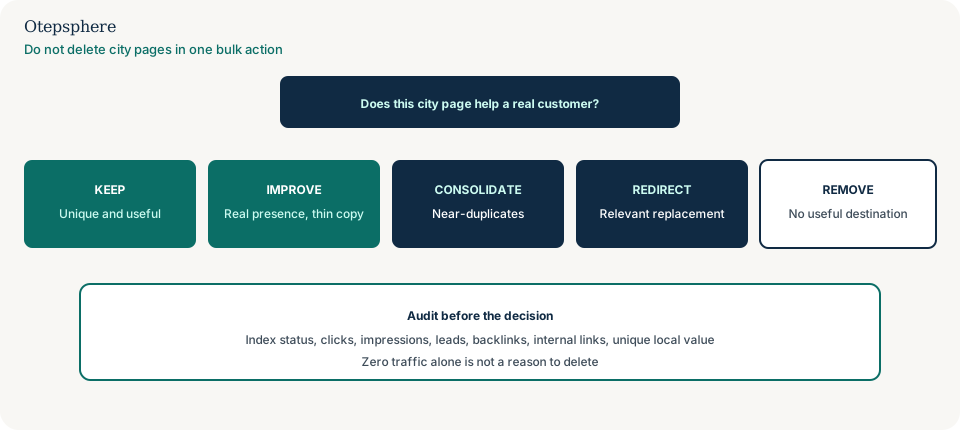
What not to assume
Do not assume every city URL is spam. Do not assume Google will reward a mass prune with a ranking bounce. Do not assume impressions equal customers.
What not to do
Practical action plan
- Inventory URLs and fill the spreadsheet columns.
- Tag obvious fakes and city-name-only templates.
- Protect URLs with conversions or unique links.
- Improve or consolidate in batches of a size you can monitor.
- Redirect only to relevant replacements; 404/410 where content is gone.
- Update internal links and sitemaps to match the surviving set.
When professional help makes sense
Help is useful when hundreds of URLs mix a few genuine branches with a doorway set, or when canonicals and redirects already conflict. Cleanup is not a ranking guarantee.
Sources and further reading
- Google Search Central: Spam policies
- Google Search Central: Creating helpful, reliable, people-first content
- Google Search Central: How to move a site
Hundreds of city pages and no idea which ones should stay?
Otepsphere can audit the page set using search performance, technical signals and actual user value before consolidation decisions are made.
Contact OtepspherePublished by Otepsphere
Published by Otepsphere, founded by Joseph Enmanuel. Learn about Otepsphere and its approach to local SEO.