Does Google ban AI-generated content?
No. Google’s current guidance is that appropriate use of AI or automation is not against the guidelines when it is not used to generate content primarily to manipulate search rankings.
The February 2023 Search Central post states that ranking systems aim to reward original, high-quality content, and that the focus is on quality rather than how content is produced. It also states that using automation, including AI, to generate content with the primary purpose of manipulating ranking is a violation of spam policies. FAQ wording: “Is AI content against Google Search’s guidelines? Appropriate use of AI or automation is not against our guidelines.” Do not summarise this as “Google penalises AI content.” That is inaccurate. Source: Google Search’s guidance about AI-generated content.
How local businesses should think about AI features in Search — Overviews, AI Mode — is a different topic from the quality of your own location URLs. See Local SEO and AI search and how Otepsphere uses AI in Local SEO.
When does AI-assisted content become problematic?
It becomes problematic when the output is unoriginal, inaccurate, or published at scale mainly to capture search queries rather than to help a local customer.
Hallucinated hours, invented parking, fake testimonials and city pages for places you do not serve are business problems even when no spam classifier is involved. A kept URL whose AI draft contradicts the shop is what happens when AI-generated website content contradicts real business information. People-first guidance asks whether content is created for people first. Source: Creating helpful, reliable, people-first content.
What is scaled content abuse?
Scaled content abuse is generating many pages for the primary purpose of manipulating search rankings and not helping users, typically large amounts of unoriginal content with little or no value, no matter how it is created.
Google’s examples include using generative AI or similar tools to generate many pages without adding value, scraping or transforming content to make many low-value pages, stitching pages without adding value, creating multiple sites to hide scale, and creating many pages that make little sense but contain search keywords. If you host such content, Google currently says to exclude it from Search. Source: Spam policies — scaled content abuse.
What if each page only swaps the city name?
City-name-only pages are a strong signal of doorway-like or scaled unoriginal content, whether a person or a model produced them.
Doorway examples include substantially similar city or region pages and pages that funnel users to one destination. A find-and-replace of “Parramatta” for “Penrith” with the same plumber story does not become original because a chatbot wrote it. Source: Spam policies — doorway abuse.
What should a useful location page add?
It should add truthful, locally specific information a customer can use.
- Services actually available there
- Location or coverage facts
- Local operational details: hours, access, parking, after-hours rules
- Customer considerations that are real for that area
- Team who work there, named only if true
- Real examples from that site, not stock interiors labelled as the clinic
- Travel and directions that match the entrance
- Original photos or data you own
Only include fields that are true. Empty or invented sections are worse than a shorter honest page.
Should hundreds of pages be created because keyword software found searches?
No. Search volume is not a publishing brief.
Keyword tools surface queries. They do not prove you operate in that city or that a page would help. Most of those ideas belong as a sentence on a service or coverage page, or they should not be published.
Can AI still be useful?
Yes. AI can help with outlines, editing, content QA, entity consistency checks, first-draft support from first-party notes, and summarising operational facts a human already collected.
Human verification is required before local facts go live. Otepsphere’s public position is that unreviewed bulk publishing is a quality failure. That is a process choice, not a Google ranking factor.
How do I audit existing AI location pages?
Score each page, or a template sample, against a quality framework rather than against “was AI used?”
| Criterion | Pass looks like | Fail looks like |
|---|---|---|
| Real local purpose | Customers from this place can use the page | URL exists because a tool listed the city |
| Unique information | Facts that differ from sibling pages | City-name swap |
| First-party evidence | Hours, photos, team, coverage you can verify | Generic skyline and invented parking |
| Business accuracy | Matches GBP and operations | Contradicts the listing |
| Customer usefulness | Helps choose, book or arrive | Only restates the service + city |
| Duplication | Distinct primary content | Google clusters them |
| Index performance | Intended URL is the canonical | Excluded, duplicate, or another URL chosen |
What should happen to low-value AI pages?
Improve, consolidate or remove them based on evidence, using the same cleanup tree as other thin city pages.
See whether you should delete thin or duplicate city pages. Identical service copy across locations is whether using the same service content on every location is a problem.
AI local content decision framework
Allowed use
AI assistance Outlines, editing, QA, entity checks and drafts from first-party notes, with human verification.Spam-policy risk
Scaled content abuse Many pages created mainly to manipulate Search, with little original value, however they were produced.Quality test
Real local purpose Why this city page exists for a customer, not only for a keyword tool.Quality test
Unique information More than a city-name swap of the same paragraphs.Then
Improve, consolidate or remove Use search performance and duplication evidence, not a blanket delete of “AI pages.”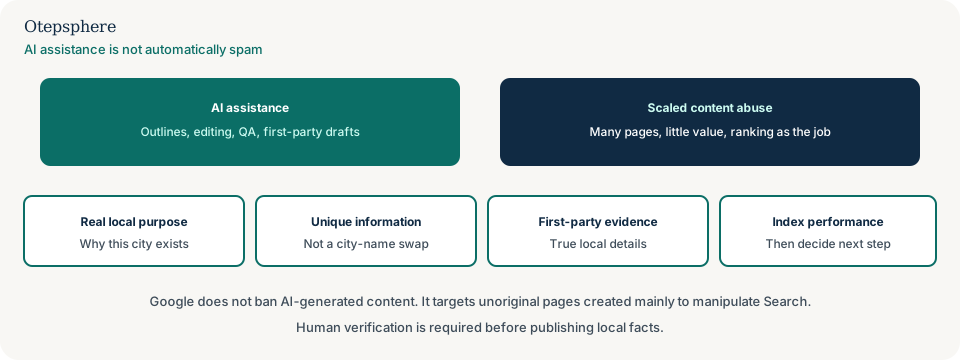
What not to assume
Do not assume disclosing “written with AI” fixes thin pages. Do not assume E-E-A-T is a score you can add as a ranking factor — Google discusses quality characteristics; it does not sell an E-E-A-T toggle. Do not assume unindexed AI pages are “waiting for a penalty.”
What not to do
Practical action plan
- Stop new mass generation.
- Sample the set against the quality table.
- Verify remaining pages against operations and the Business Profile.
- Improve genuine locations; consolidate or remove the rest.
- Use AI later only on first-party notes with human review.
When professional help makes sense
Help is useful when a vendor already published hundreds of AI location URLs and you cannot tell which still convert. More content is not the default next step.
Sources and further reading
- Google Search Central Blog: Guidance about AI-generated content
- Google Search Central: Spam policies
- Google Search Central: Creating helpful, reliable, people-first content
Generated large amounts of local content and unsure whether it’s helping?
Otepsphere can review the pages for genuine user value, duplication, search performance and Local SEO purpose before more content is produced.
Contact OtepspherePublished by Otepsphere
Published by Otepsphere, founded by Joseph Enmanuel. Learn about Otepsphere and its approach to local SEO.