Shared templates versus interchangeable pages
Each location URL is supposed to be a separate document. A shared template is fine when it binds true local data. Interchangeable pages are not: the service explanation becomes the same paragraph with a different suburb token, and the FAQ block repeats answers that are not true for that site.
A dental group can share a true description of how an examination works. It cannot pretend three clinics are distinct by pasting that paragraph under three city headings. Identical body text is a thin pattern. It is not evidence that you cover those places well. Open two location URLs. Aside from the suburb name, does the service copy change? Would a customer at that site learn anything operationally true that the other page does not say?
SERP overlap is a different problem. Nearby locations can both appear in Maps because of proximity even when the copy is unique. Diagnose ranking overlap on why locations compete with each other in search. A location page that never proves it operates there is why a location page is not convincing that you operate there. If the pages are thin city templates, cleanup may be the better first job: how to clean up thin location pages.
Same
What is genuinely identical? Warranty terms or a national process can be the same at every branch.Different
What changes by site? Parking, catchment, equipment, staff and local examples.Policy
Primary purpose of the set? Many near-duplicate city pages to rank is scaled content abuse, not localisation.Yes
Write the differences Keep shared blocks short. Do not clone 800 words of filler.Next
FAQs are a separate job Identical Q&A blocks have their own diagnostic.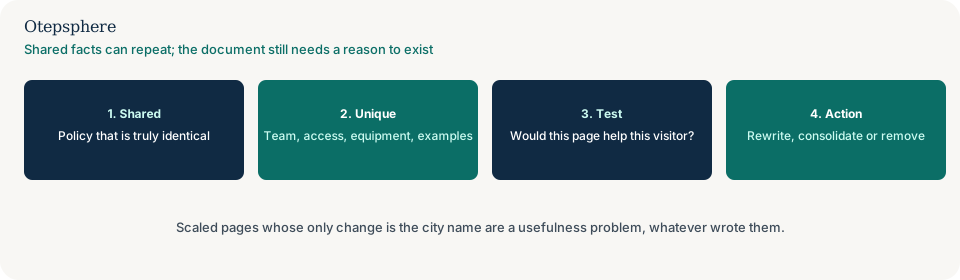
Service copy that can be shared
Keep shared facts that are truly the same — a group-wide hygiene policy, a standard examination process, a warranty that does not change by branch. Reuse of facts that are truly identical is not automatically spam. Google does not ban AI-generated content. The issue is purpose and value.
Pages produced primarily to manipulate rankings, with little original help for the reader, can fall under spam policies however they were written — by hand, by template, or with AI. Method-agnostic means the tool is not the test. Scaled content abuse is creating many pages whose primary purpose is to manipulate search rankings, not to help people. City-name swaps at scale, with the same service essay on every URL, fit that pattern when the set exists to occupy search results rather than to inform a customer at that site. It is not a ban on templates, CMS blocks, or AI used to outline or edit useful pages. Source: Google Search spam policies. AI-assisted location pages are discussed further in AI-generated location pages and Local SEO.
People-first guidance asks whether the content is helpful and reliable for the person who would use it. Each location URL should help someone decide about that place: whether they can visit, what is offered there, and how to enquire. Do not spin unique-looking paragraphs that still say nothing location-true. Source: Creating helpful, reliable, people-first content.
| Content type | Usually fine to share | Should differ by location | What not to assume |
|---|---|---|---|
| How the service works | A true, identical process (how a standard dental exam runs) | Eligibility, equipment or aftercare that only this site provides | That rewriting the same process in new adjectives makes it unique |
| Offer and boundaries | Group-wide policies that are actually the same | Services this site does not do; hours; emergency cover | That listing every company service on every URL is more complete |
| Place facts | — | Address, parking, access, photos, team at this premises | That a swapped suburb in an otherwise identical paragraph is local proof |
| Why the page exists | A real branch that a customer might choose | Anything that would change their decision to visit this site rather than another | That more unique words guarantee rankings |
Facts that must be accurate for each location
Write what differs: team, access, equipment, hours, parking, and services this site does not offer. Address, photos and the people who work at this premises are local facts. Copying another branch’s parking instruction, opening hours, on-site equipment or booking destination is the same class of error as putting the wrong suburb in the heading.
If the template is printing headquarters hours or services because fields fall back to a parent record, that is data binding, not cloned marketing copy: why shared location templates show the wrong services or hours. A customer should be able to check the claim at that site. If a URL has no genuine difference and no real premises, treat it as a thin-page cleanup candidate rather than a synonym-spinning job.
Which FAQs can stay the same?
Share an answer when the underlying fact is genuinely identical at every location where it appears. A company-wide cancellation policy may qualify. A parking instruction copied from another branch usually does not. Check exceptions before labelling a policy as universal.
For each FAQ, record whether the answer belongs to the whole organisation or to one branch. Bind local answers to that branch's actual data and omit questions that cannot be answered accurately. Useful examples include the entrance customers should use, available services, access arrangements and the correct booking destination.
Keep helpful questions and answers visible in ordinary HTML. Google's documentation updates confirm that FAQ rich results are no longer shown in Google Search; adding FAQPage markup will not restore that feature. Preserve the official source link and recheck it when publishing. Do not remove useful Q&A merely because a search feature was retired.
Typical shared answers: payment methods if they are identical, cancellation or deposit rules that apply company-wide, warranty or insurance wording that does not change by branch. Even then, one sentence of confirmation (“this applies at all our sites”) is clearer than hoping the reader notices the template. If a policy differs at one clinic or depot, that question is no longer shareable. Shared questions are fine when the answer is company-wide and accurate. Copied parking, hours or “do you serve [this suburb]” answers that only swap the city name send people to the wrong site.
Same
Is the answer identical everywhere? A national warranty can be the same. Parking almost never is.Local
What must change by site? Hours, access, who is on site, which services this branch offers.Rich
FAQ rich results in Search? Google’s May 2026 changelog: the FAQ rich result is no longer shown.Yes
Write useful visible Q&A Ordinary HTML is enough. Do not add FAQPage markup to chase snippets.Next
Do not clone 20 generic questions Volume is not evidence the page helps this visitor.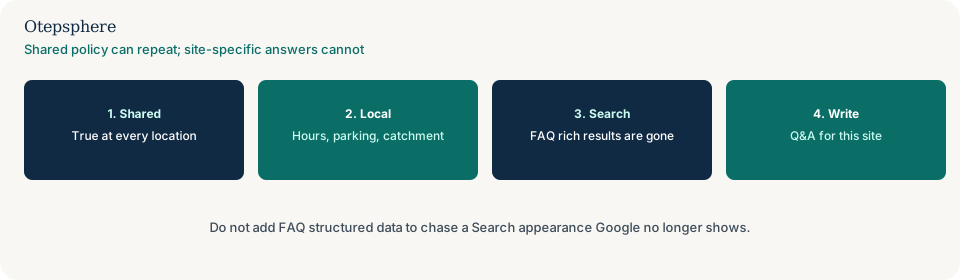
| Question type | Can it be identical? | What must be true | Typical mistake |
|---|---|---|---|
| Payment, deposits, company cancellation policy | Yes, if the rule is the same everywhere | The policy really does not vary by site | Copying it when one branch takes cash only |
| Parking and access | No | The answer matches that building | Reusing another site’s car-park instructions |
| Hours and how to book this site | No | Hours and booking path for that location | One set of hours pasted on every URL |
| Catchment / “do you come to…?” | No, unless every site has the same travel rule | What that team actually covers | Every page claiming the same list of towns |
| On-site equipment or rooms | No | What exists at that premises | Advertising a scanner or bay that is only at head office |
Rewrite location-specific FAQs with real answers
Any answer that depends on the building, diary, catchment or equipment at that site must be written for that site. Parking, public-transport access, opening hours, which postcodes that team covers, whether a treatment room or a particular machine exists on site, and how to find the entrance are local facts. Copying another branch’s parking answer is the same class of error as putting the wrong hours on the page. Write the true answer or omit the question.
Identical Q&A about parking, hours or “do you bulk bill” can still be wrong when the answers are not true for that site. Make sure hours, parking and catchment in the FAQs match the visible page body and the Business Profile. Re-read each location URL as a customer. Identical questions are fine; identical untrue answers are not. Do not treat identical Q&A as a substitute for local proof on the rest of the page.
Visible Q&A and current Google rich-result limits
Google no longer shows the FAQ rich result feature in Google Search. Search Central’s documentation updates record that the FAQ rich result feature was deprecated in the changelog in May 2026 (no longer appearing in Search from 7 May 2026), and that the FAQ rich result documentation was later removed because the feature is no longer shown. FAQPage markup is not documented as a ranking factor. Do not add Q&A blocks, or structured data, to chase a snippet Google has retired. Sources: Google Search documentation updates and FAQ structured data. Recheck those official pages when publishing.
Visible Q&A that helps a customer can stay on the page as ordinary HTML. This article does not add FAQPage structured data. If leftover FAQ markup exists from when the rich result still appeared, removing it is an implementation choice; unused structured data is not documented as a ranking penalty, and adding new FAQ markup will not restore a feature Google has withdrawn. Do not remove useful questions merely because that Search appearance was retired.
Audit shared components before publishing more pages
Inventory FAQ blocks and service essays on location URLs. Split company-wide policies from site-specific facts. Highlight every sentence that is identical except the place name. Rewrite the body so a customer at that location learns something they could check. Rewrite or remove answers that would be false for that premises. Keep shared policy answers only where they are identical and labelled as such.
If a CMS injects one FAQ component onto every location template, fix the component before you add more paths. If a URL has no genuine difference and no real premises, treat it as a thin-page cleanup candidate rather than publishing another hundred city variants. Do not add more location URLs until the existing set is useful as separate documents. Unique copy is not a ranking promise.
- Compare two or three location URLs. Highlight every sentence that is identical except the place name.
- List facts that are truly the same across the group. Those may stay shared.
- List facts that differ: team, hours, access, equipment, photos, services this site does not offer.
- Split company-wide FAQ answers from site-specific questions. Bind local answers to that branch’s data.
- Rewrite or omit parking, hours, catchment, equipment and booking answers that would be false.
- Keep helpful Q&A as ordinary HTML. Do not add FAQPage markup to restore a retired Search appearance.
- If a URL has no genuine difference and no real premises, treat it as a thin-page cleanup candidate.
- Do not add more location URLs until the existing set is useful as separate documents.
Sources and further reading
- Google Search Central: Spam policies
- Google Search Central: Creating helpful, reliable, people-first content
- Google Search Central: How Search works
- Google Search Central: Google Search Essentials
- Google Search Central: Search documentation updates (FAQ rich result no longer shown)
- Google Search Central: FAQ structured data
Same service copy and FAQs on every location page?
Otepsphere can review which facts and questions are genuinely company-wide and which must be written per site — without treating unique wording as a ranking guarantee, and without adding FAQ markup to chase a Search feature Google no longer shows.
Contact OtepspherePublished by Otepsphere
Published by Otepsphere, founded by Joseph Enmanuel. Learn about Otepsphere and its approach to local SEO.