What does this problem actually mean?
It means the URL names a place, but a customer — or Google — cannot check that the business actually operates there.
A dentist “Parramatta” page that never lists that clinic’s address, parking or practitioners is a label, not proof. A plumber “Bondi” page that repeats the homepage with a swapped suburb is the same pattern. Local proof is specific and checkable. A city token in the H1 is not.
Is this the same as indexed but not ranking?
No. Indexed-but-not-ranking asks whether Google stored the URL and then preferred it for local queries. Local proof asks whether the document can evidence the place at all.
A page can be indexed and still be unconvincing. Ranking diagnosis lives on why a location page is indexed but not ranking. Use this article when the page reads like a template even if it is in the index. Indexing is not a usefulness test. Source: How Search works.
Fact
Can a visitor verify the site? Street address, phone and hours that match the Business Profile.People
Who is at this location? Named clinicians or technicians beat a stock paragraph.Media
Do photos show this place? Unique interiors and street context, not a reused hero across towns.Yes
Add what is actually true Do not invent a team or a postcode you do not serve.Next
Do not stuff more suburbs Keyword lists are not local proof.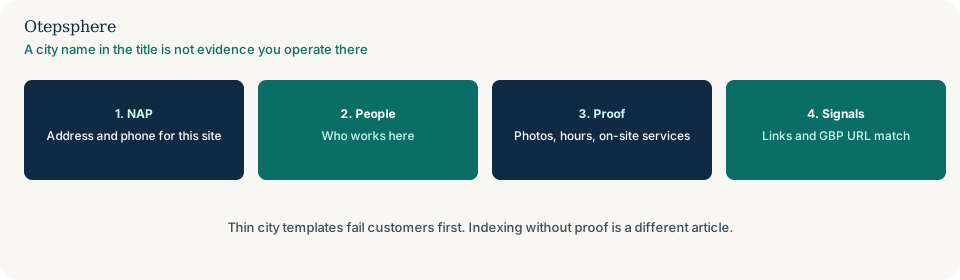
Is this the same as cleaning up thin city pages?
Related, but not the same job. Thin-page cleanup is a keep, improve, consolidate or remove decision across a set. Local proof is what a genuine location URL should contain.
If you inherited a city-page factory, start with how to clean up thin location pages. If the location is real and the URL should stay, the question here is evidence: NAP, people, photos, services and links that match that site. Creating useful location pages is the broader decision on when a location deserves its own page.
What counts as local proof?
Facts a customer could verify: this address, this phone, these hours, these services at this site, these people, these photos, this access note.
People-first content should help the person who would use the page. A location URL that only interpolates a city name does not. Shared template chrome is fine; identical body paragraphs with a swapped suburb are not proof of presence. Source: Creating helpful, reliable, people-first content. If the premises facts are already on the page and visitors still will not enquire, that is why visitors find the business but still do not trust it enough to contact.
Should the Business Profile URL match this page?
Yes, when this URL is the page for that premises. The profile and the page should tell the same story.
If the Bondi profile points at the homepage while the Bondi URL exists, customers and Google are sent to a generic document. Align name, address, phone, hours and services. Mismatches are a trust problem, not a trick to “boost” Maps.
Local-proof checklist
| Proof to check | What “present” looks like | What “missing” looks like | What not to assume |
|---|---|---|---|
| NAP and hours | Address, phone and hours for this site, consistent with the Business Profile | No address, a head-office number only, or hours copied from another branch | That stuffing the suburb into the title replaces a checkable address |
| People | Practitioners or managers who work at this site, named where that is true | A generic “our team” block reused on every city URL | That inventing staff names will help |
| Photos | Photos of this premises, waiting room, shopfront or team at this location | Stock images, another branch, or no photos at all | That any image with a city filename is local proof |
| Services at this site | What this location actually offers, including services it does not do | The full company menu pasted onto every suburb page | That listing every service everywhere is more complete |
| Internal links | Links from the homepage, store locator and other location pages to this URL | An orphan city URL only listed in a sitemap | That a sitemap entry proves the location is real |
| GBP website URL | The profile for this location points at this page | Every profile points at the homepage, or at the wrong branch | That a mismatched URL is a ranking tactic |
What should I not do?
Action checklist
- Walk the page as a stranger. List every fact you could verify in the real world.
- Match address, phone, hours and services to the Business Profile for that location.
- Replace stock or reused images with photos of this premises where you have them.
- Name people and services that are true here; remove claims copied from other sites.
- Confirm internal links and the profile website URL point at this page.
- If the location is not real, do not try to “prove” it — that is a different cleanup job.
When professional help makes sense
Help is useful when location pages name a city but do not evidence the premises, when profiles and URLs disagree, or when a template set needs a proof audit before more city pages are published. It cannot guarantee that adding facts will create rankings.
Sources and further reading
- Google Search Central: How Search works
- Google Search Central: Creating helpful, reliable, people-first content
- Google Search Central: Google Search Essentials
Location pages that name a city but do not evidence the premises?
Otepsphere can audit location URLs for checkable local facts — address, team, photos, hours and services — before more city-name templates are published.
Contact OtepspherePublished by Otepsphere
Published by Otepsphere, founded by Joseph Enmanuel. Learn about Otepsphere and its approach to local SEO.