What does indexed actually mean?
Indexed means Google has stored the URL in its search index. It is a crawl and storage status, not a ranking.
Google Search works by crawling, indexing, then ranking. Google does not guarantee that it will crawl, index or serve a page even when the page follows Search Essentials. Search Console can say a page is indexed when you still do not see it for the queries you have in mind. Source: How Search works.
Does indexing guarantee rankings?
No. Indexing does not guarantee rankings for any query.
Google currently documents that Search Console might tell you a page is indexed when you do not see it in results because the content is irrelevant to users’ queries, the quality is low, or robots rules prevent serving. Crawling is necessary for a page to be in results; Google’s crawling documentation also states that crawling is not a ranking signal. Sources: How Search works and Myths and facts about crawling.
Indexed
Google stored the URL That is not a ranking for any particular local query.Intent
Does the page answer a real local need? A city-name template with no local facts rarely does.Architecture
Canonical and internal links Another URL on the same site may be the one Google prefers.Profile
Does GBP point to this page? The listing and the location URL should describe the same place.Evidence
Impressions versus clicks No impressions is a ranking or intent problem. Impressions without clicks is a different job.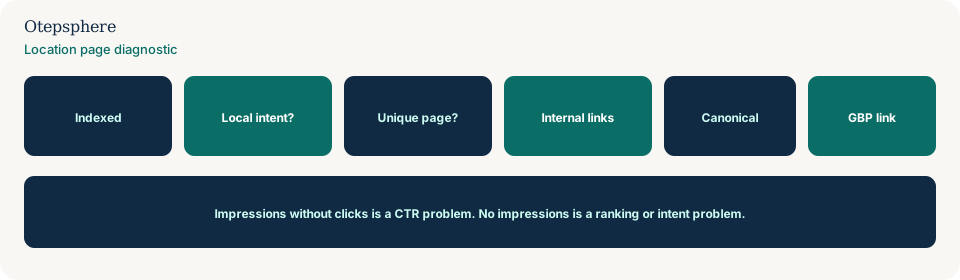
Does the page satisfy the local intent?
If the page does not help someone choose a local provider in that place, it can be indexed and still fail to rank for local searches.
Local intent is a person looking for a business, service or place they can use nearby. A page that only repeats a service blurb and a city name often fails that job. Match the page to the query type: a branch page, a coverage explanation, or a service page with a true catchment — not all three stuffed into one URL.
Is the page targeting a real location the business serves?
The page should describe a location the business actually operates from or honestly serves. Invented city pages can be indexed and still be poor candidates for local ranking.
Decision rules for when a location URL is justified are in when to create location pages.
Is it just a city-name template?
If the only unique string is the city name, the page is a template, not a local resource.
Interchangeable copy is how doorway pages get built. Google’s people-first guidance asks whether the content is helpful and reliable. A find-and-replace suburb is rarely either. Source: Creating helpful, reliable, people-first content.
Does it contain genuinely local information?
Genuinely local information is detail a customer in that place can use, not a keyword in a heading.
Useful information can include location or service availability, team details where they are real, directions and access, operating details, local proof, and locally specific FAQs only when they answer questions people actually ask. Do not prescribe every field on every page. A clinic and a plumber need different facts. Empty “serving [city]” paragraphs do not count.
Does the page compete with another URL?
Yes. Another service page, coverage page or second location URL can be the one Google ranks while this indexed page sits unused.
Check Search Console: which URL gets impressions for the query? If two pages share the same job, consolidate or differentiate. If the competing URL is a service page rather than another location, use why a service page is indexed but not ranking for the service. Multi-location overlap is covered in why business locations compete with each other in Google Search.
Are internal links supporting the page?
If important pages never link to the location URL with a descriptive anchor, people and crawlers may never treat it as a primary local page.
Link from the location hub, relevant services and a small number of supporting articles. Do not mesh every URL to every suburb. See internal linking for Local SEO.
Is the canonical correct?
If the canonical points at another URL, Google may index the page in a limited way while ranking the canonical URL instead.
Confirm the HTML canonical, any HTTP header, and Search Console’s “Google-selected canonical.” Parameterised duplicates, HTTP/HTTPS pairs and printer-friendly copies are common accidents. The visible page and the canonical should be the same intended location URL. If Google selected a different URL than you declared, that is a canonical-cluster diagnosis, not proof the page cannot rank: why Google chose a different canonical for a location page.
Is the GBP linked to the correct location page?
If the Business Profile points at a different URL, customers and Google are being sent to a different local document than the indexed location page you are watching.
Align the profile website field with the page that represents that location. That is representation and usability work, not a ranking guarantee.
Does the page receive impressions but few clicks?
Impressions with few clicks are a title, snippet and intent-match problem. No impressions is a ranking or query- targeting problem.
Do not rewrite the whole page for CTR if Search Console shows almost no impressions. Do not keep adding location pages if the existing ones already appear and are ignored. On-page usefulness is covered in local on-page SEO.
Could competitors simply be stronger?
Yes. Other businesses can have more useful local pages, stronger local presence, or simply be closer to the searcher.
Indexing your URL does not entitle it to outrank a better local result. Improving uniqueness and accuracy is still the honest response. Publishing twenty more templates is not.
Location Page Diagnostic Checklist
- Search Console says indexed, and you have checked the Google-selected canonical.
- The page answers a real local job for a place you actually serve.
- Copy is not a city-swapped duplicate of another URL.
- Local facts on the page are true and useful to a visitor.
- No other URL on the site is a better match for the same query.
- Internal links from services and the location hub exist.
- The Business Profile for that location uses this URL if the page is the public landing page.
- You have separated “no impressions” from “impressions, no clicks.”
What not to assume
Do not assume indexed means page-one. Do not assume a sitemap ping creates rankings. Do not assume more city URLs will fix a weak template. Do not assume structured data forces local pack placement.
What not to do
Practical action plan
- Inspect the URL in Search Console. Note canonical, last crawl and whether it is served.
- Pull queries and impressions for that URL. Split zero impressions from weak CTR.
- Read the page as a customer. Remove interchangeable copy. Add only true local facts.
- Resolve internal competition. Support the surviving URL with internal links.
- Align the Business Profile landing page if this is the location’s public page.
- Re-measure after the page has had time to recrawl. Do not expect a published ranking timetable.
When professional help makes sense
Help is useful when a location template is rolled out at scale, when several URLs share one intent, or when canonicals and profile links disagree. It cannot guarantee local rankings.
Sources and further reading
- Google Search Central: How Search works
- Google Crawling Infrastructure: Myths and facts about crawling
- Google Search Central: Google Search Essentials
- Google Search Central: Creating helpful, reliable, people-first content
Location pages indexed but generating no local visibility?
Otepsphere can review their intent, architecture, internal links and local relevance before more pages are created.
Contact OtepspherePublished by Otepsphere
Published by Otepsphere, founded by Joseph Enmanuel. Learn about Otepsphere and its approach to local SEO.