What does this problem actually mean?
It means Google has stored the service URL, but that URL is not the result Google prefers — or is not visible enough — for the service searches you are watching.
This is not the same job as a location page that is indexed but weak in local search. That diagnosis lives on why a location page is indexed but not ranking. It is also not the same as ranking for the business name while service queries fail; that comparison is in why a business ranks for its name but not its services. This page is about one specific service URL.
Does indexed mean it should rank for the service?
No. Indexed means Google stored the URL. Ranking for a service query is a later decision about relevance, usefulness and competition.
Google Search crawls, then indexes, then ranks. Google does not guarantee that it will crawl, index or serve a page even when the page follows Search Essentials. Crawling is not documented as a ranking signal. Sources: How Search works and Myths and facts about crawling.
Status
Indexed Google stored the service URL. That is not a ranking for the service query.Evidence
Impressions for the service? Search Console shows whether this URL appears for the service searches you care about.Winner
Which URL ranks instead? Homepage, another service page, a location URL or a competitor may be the result Google prefers.Fit
Does this page do the service job? The page should explain the service a customer would actually book, not a keyword list.Next
Fix the cause you confirmed Relevance, internal competition and snippets are different jobs from “not indexed.”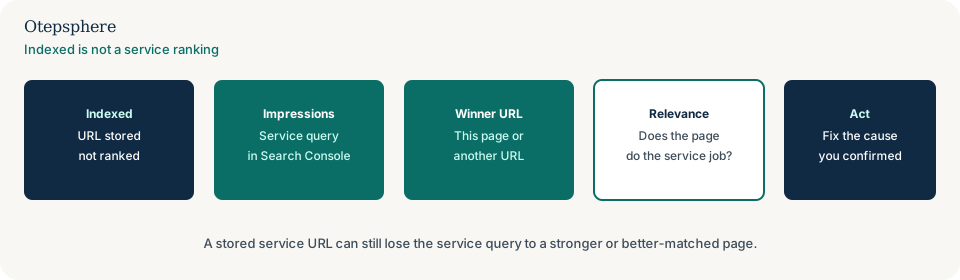
How do I confirm the cause?
Confirm it in Search Console on that URL, not from a single incognito screenshot.
Inspect the service URL. Note index status, the Google-selected canonical, last crawl and whether the page is served. Then open the page’s Performance report and filter to the service queries you care about. Split three outcomes: no impressions, impressions on this URL, or impressions on a different URL for the same query.
Which URL is ranking instead?
Another URL on your site — or a competitor — may be the document Google associates with the service query.
Typical winners: the homepage if it is the only substantial service explanation; a location page that names the service in the title; a blog post; or a second service URL that overlaps (“emergency plumbing” versus “blocked drains”). Export the query and see which page receives the impressions. If two of your URLs share the job, consolidate or differentiate rather than publishing a third. That mapping is why service pages compete with each other.
Does the page match the service intent?
The page should help someone decide whether you provide that service, on what terms, and how to enquire. A keyword-stuffed heading with a generic paragraph usually does not. Stuffed local copy has its own diagnostic: can over-optimised Local SEO copy hurt page quality.
People-first guidance asks whether the content is helpful and reliable for the person who would use it. A dentist “Invisalign” URL that never explains the treatment, eligibility or how to book is a weak candidate even if it is indexed. Source: Creating helpful, reliable, people-first content.
Are other pages taking the query?
Yes. Internal competition is a common reason an indexed service URL sits unused.
Check titles, H1s and internal links. If the navigation calls every service “services” and the only unique string is in the meta title, Google has little to separate the URLs. Keyword mapping should assign one primary URL per service job: how to map local keywords to services and locations.
Is this an organic problem or a Maps problem?
Organic service rankings and Google Maps rankings are different surfaces. An indexed website service page can fail while the Business Profile still appears in the Map Pack, or the reverse.
If the complaint is “we do not appear in the local pack,” diagnose the profile, category and distance path on why a website can rank in Search but not on Maps. This article stays with the website service URL.
Service ranking evidence table
| What you see | What it usually means | What to do next | What not to assume |
|---|---|---|---|
| Indexed, zero impressions for the service | Google stored the URL but is not showing it for those queries | Check canonical, intent match and which other URL ranks | That a sitemap ping will create rankings |
| Impressions on a different site URL | Internal competition or a stronger on-site match | Differentiate or consolidate to one primary service URL | That you need a new URL for every synonym |
| Impressions, few clicks | Title, snippet or intent mismatch | Rewrite the title and opening answer; keep the URL | That the page is “not indexed” |
| Competitors occupy the results | The page may be relevant but not competitive enough | Improve usefulness; do not mass-produce extra service URLs | That indexing entitles you to page one |
What should I not do?
Action checklist
- Inspect the service URL. Record index status and Google-selected canonical.
- Pull queries and impressions for that URL. Split zero impressions from weak CTR.
- Note which URL, if any, currently receives the service-query impressions.
- Read the page as a customer. Make the service, process and enquiry path explicit.
- Resolve overlapping service or location URLs. Support the surviving URL with internal links.
- Re-measure after recrawl. There is no published ranking timetable.
When professional help makes sense
Help is useful when several service templates overlap, when Search Console shows a different winner URL than the one the business is watching, or when organic and Maps symptoms are being mixed. It cannot guarantee service rankings.
Sources and further reading
- Google Search Central: How Search works
- Google Crawling Infrastructure: Myths and facts about crawling
- Google Search Central: Creating helpful, reliable, people-first content
- Google Search Central: Google Search Essentials
Service pages indexed but not winning the service query?
Otepsphere can review which URL Google is associating with the service, how those pages overlap, and what evidence in Search Console supports a change — before more service URLs are published.
Contact OtepspherePublished by Otepsphere
Published by Otepsphere, founded by Joseph Enmanuel. Learn about Otepsphere and its approach to local SEO.