What's the difference between organic rankings and Maps rankings?
Organic rankings are positions for website pages in traditional Search results. Maps and Local Pack rankings are positions for Business Profiles in Google’s local results.
Google Search crawls and indexes pages, then ranks them for a query. Google’s local ranking help says local results are mainly based on relevance, distance and prominence, and that complete, accurate business information makes a business more likely to show up. The systems can share supporting information — the website is one prominence-related example Google names — but a blue-link ranking is not a Map Pack ranking. Source: Tips to improve your local ranking on Google.
Organic Search
Website pages Crawl, index and rank URLs in traditional results, including cases with no Map Pack.Maps / Local Pack
Business Profiles Local results use relevance, distance and prominence around an eligible listing.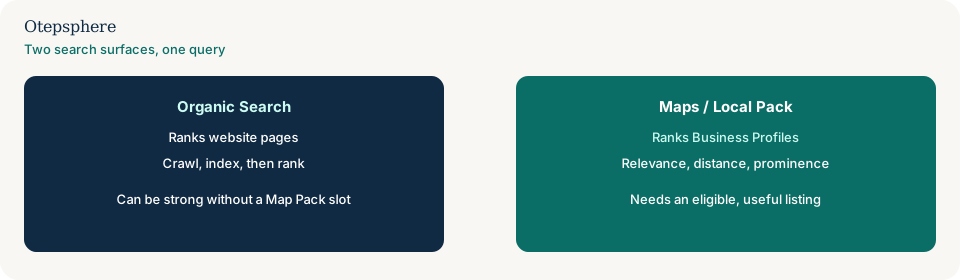
Can a business rank organically without ranking in the Map Pack?
Yes. A website can rank in organic results for a query while the Business Profile is absent or weak in the Map Pack for the same query.
That can happen when the page matches informational or commercial intent well enough to appear as a blue link, while nearby listings, distance, category match or profile completeness favour other businesses in the local feature. It can also happen when the query does not show a local feature at all. Do not treat the two results as completely independent: Google still uses website-related information among other signals for local prominence. Do not treat them as one score either. The inverse problem — a strong Maps listing with a weak website — is covered in why a business can rank in Google Maps while the website does not rank organically. Maps visibility without a Search local shortlist is a third diagnosis: Maps visible but not in the local pack.
Is the Business Profile eligible and verified?
If the profile is ineligible, unverified, duplicate, suspended or not public, Maps visibility can fail while the website still ranks.
Confirm the listing opens on Maps, is claimed on an account you control, and is not restricted. A strong service page cannot substitute for a listing Google will not show. Start with why a business is not showing on Google Maps if the profile itself is missing, and Google Business Profile suspended if it has been disabled.
Does the GBP category represent the business?
If the primary category does not describe what the business is, Maps can under-represent you for the queries customers use, even when a website page targets those words.
Google asks businesses to choose categories that complete “this business IS a,” not a wish-list of keywords. Category choice is covered in how to choose Google Business Profile categories.
Does location matter?
Yes. Maps results can change from one street to the next because distance and searcher location are part of local ranking.
A website ranking checked from the office, or in an incognito window without location context, can look healthy while customers a few kilometres away never see the pack. Geographic variation is explained in why Google Maps rankings change by location and why a business ranks in one area but not another.
Is the website relevant to the service?
The website can rank for a query that is only loosely related to the local service the profile is trying to win.
A national guide, a blog post, or a product page can outrank local competitors in organic results while the Business Profile is still being compared as a nearby provider of a different category. Check that the URL people would choose from Maps describes the same service, location model and offer as the listing.
Does GBP link to the correct page?
If the profile website field points at a homepage, a different location, or a broken URL, Maps users get a worse path than Search users who already landed on the ranking page.
Google asks for a website that represents the individual business location. That is a representation rule, not a published ranking formula. Matching the listing to the useful location or service page still helps customers. Link failures are diagnosed in why a Business Profile website or booking link is missing.
Could stronger local competitors explain the difference?
Yes. Nearby businesses can occupy the Map Pack through relevance, distance and prominence even when your website outranks their pages in organic results.
Compare the listings that actually appear for the query from customer locations. Do not copy keyword-stuffed names. Competitor diagnosis is in why a competitor ranks higher on Google Maps and how to find real Google Maps competitors.
Is the search query actually triggering local results?
No. Not every query produces a Local Pack or Maps-heavy results page.
Informational queries, some product queries, and some national research queries show websites without a local feature. A brand query may show a knowledge panel. If there is no pack to rank in, “not ranking on Maps” is the wrong diagnosis. Look at the live SERP from a realistic device and location before changing the profile.
How should Maps visibility be measured?
Measure Maps from multiple points across the area customers search from, and keep those scans separate from organic rank-tracking of URLs.
One screenshot from head office is not the ranking. Method is in how to track Google Maps rankings and how to measure Google Maps visibility.
Organic vs Maps Diagnostic Table
| Signal / area | Organic Search | Maps / local | What to check |
|---|---|---|---|
| What is ranked | A URL | A Business Profile | You are not comparing the same object |
| Eligibility | Indexable page | Eligible, verified listing | Profile status on Maps |
| Query type | May show blue links only | Needs a local feature | Live SERP, not an assumed pack |
| Geography | Less pin-sensitive | Distance and searcher location | Grid or multi-point checks |
| Category / relevance | Page content and intent | Primary category and profile facts | Whether the listing describes the same job as the page |
| Landing page | The ranking URL | The website field on the profile | Broken, generic or wrong-location links |
| Competition | Other websites | Other nearby listings | Who occupies the pack from customer locations |
Google does not publish a complete Maps ranking formula. This table is a diagnostic split, not a confirmed factor list. Broader context is in Local SEO ranking factors and how Google local search works.
What not to assume
Do not assume organic #1 produces a Map Pack slot. Do not assume the systems are sealed off from each other. Do not assume a missing pack means the website should be rewritten first. Do not treat a single rank-check tool that blends “Google” into one number as proof of either surface.
What not to do
Practical action plan
- Capture the query, device and search location. Confirm whether a local feature appears.
- Open the public Business Profile. Confirm eligibility, verification and restrictions.
- Compare primary category, services and address model with the ranking page.
- Measure Maps from customer geography, separately from organic URL ranks.
- Fix profile accuracy and landing-page match before changing the whole site.
- Only then look at competitor gaps you can close without breaking policy.
When professional help makes sense
Help is useful when organic and Maps tell different stories across several locations, or when you cannot tell whether the query is local at all. It cannot guarantee a pack position.
Sources and further reading
- Google Business Profile Help: Tips to improve your local ranking on Google
- Google Search Central: How Search works
- Google Business Profile Help: Guidelines for representing your business on Google
Ranking organically but missing from Maps?
Otepsphere can review your website, Business Profile and geographic local visibility to identify where the two search experiences diverge.
Contact OtepspherePublished by Otepsphere
Published by Otepsphere, founded by Joseph Enmanuel. Learn about Otepsphere and its approach to local SEO.