Can I rank in Maps without ranking organically?
Yes. Maps and the local pack rank Business Profiles. Traditional organic results rank web pages. Those systems can diverge.
This is the inverse of ranking in Google Search but not in Google Maps. That guide is for a strong website and a weak listing. This guide is for a visible listing and a weak website. Do not treat them as the same article.
Is Maps visibility the same as website SEO?
No. They are different search experiences that can share some supporting information, including the website URL on the profile.
Google documents local ranking as relevance, distance and prominence for local results. Organic ranking is a separate process of crawling, indexing and ranking URLs. A complete Business Profile can appear locally while the connected website still fails to compete for the service query in the blue links.
Is the website page indexed?
If the URL is not indexed, it cannot rank organically, regardless of how well the Business Profile performs.
Check Search Console for the service or location URL you expect to rank. A Maps listing does not index a website. If a location page is indexed but still not ranking, use why a location page is indexed but not ranking. The same diagnostic pattern applies to a service URL: confirm indexation, intent match and internal links before changing the Business Profile.
Does the website clearly satisfy the service intent?
Often no. Maps can match a category and a nearby pin while the website still talks about the company in general terms.
A plumber whose profile category is “Plumber” can appear for “plumber near me” in Maps. The website might only say “quality workmanship since 2004” on a thin homepage. Organic results need a page that is actually about the service the query asks for.
Is Google ranking the homepage instead?
Sometimes. The homepage can be the only indexed, internally linked URL with any relevance, so Google uses it even when it is a poor answer.
That is not a Maps problem. It is an information-architecture problem. If the homepage tries to rank for every service and every suburb, it will usually lose to competitors with clearer service URLs.
Is internal linking weak?
Weak internal links make it harder for users and Google to treat the important service or location URL as a primary page.
Google’s sitelinks documentation also treats internal links and site structure as signals of important pages. The same architecture work helps organic rankings. See internal linking for Local SEO.
Does the service have a dedicated useful page?
If it does not, organic rankings for that service usually lag Maps, because Maps can use the profile while Search still has no adequate URL.
A dedicated page is useful when the business actually offers that service and the page contains unique, accurate information. It is not useful as a doorway clone. Create the page because customers need it, then measure whether it can compete.
Is the Maps query different from the organic query?
Frequently. People compare “plumber” in Maps with “emergency boiler repair [city]” in Search Console and conclude the website is broken.
Local pack queries, branded queries and detailed service queries are not interchangeable. Confirm you are measuring the same intent on both surfaces before changing the site.
Are competitors stronger organically?
They can be. A competitor with a weaker Maps listing can still outrank you in the blue links with better pages, links or topical coverage.
That does not mean your Business Profile is a waste. It means website competitiveness is a separate job.
Could the website have technical issues?
Yes. Crawl blocks, noindex, canonical conflicts, slow mobile pages and thin templates can suppress organic visibility while Maps is unaffected.
Maps does not need the website to pass Core Web Vitals. Organic ranking does need a crawlable, indexable, useful URL. A Local SEO audit should inspect the site and the profile as separate systems that ought to agree on facts.
Maps vs organic diagnostic table
Maps / GBP
Can be strong on its own Eligible profile, local pack or Maps, category, proximity, reviews and prominence.Organic website
A different ranking surface Indexed useful URL, service intent match, internal links and technical health.What to check
Do not treat Maps as website SEO Indexation, homepage versus service URL, query type and competitor organic pages.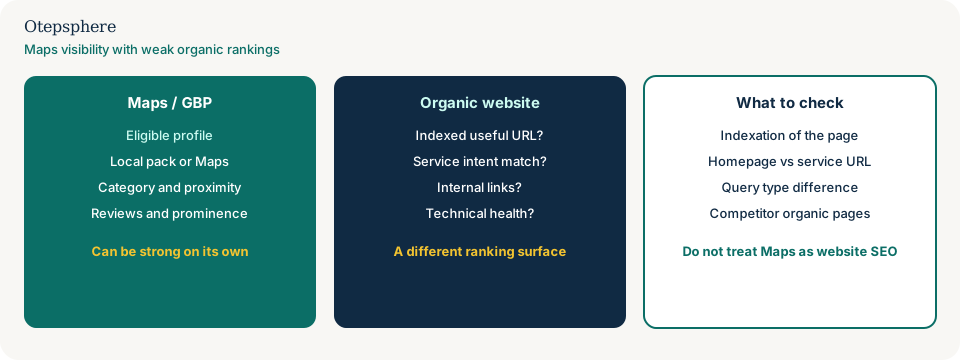
| Area | Maps / GBP | Organic website | What to check |
|---|---|---|---|
| What is ranked | Business Profile | A URL | Are you looking at the same intent? |
| Indexation | Listing is public | Page must be indexed | Search Console URL inspection |
| Relevance | Category and profile completeness | Page content and intent match | Does a service URL exist? |
| Internal links | Not a website crawl graph | Links to the money page | Orphan or weakly linked service URL |
| Technical | Profile eligibility and verification | Crawl, index, speed, canonicals | Issues that Maps cannot compensate for |
What not to assume
- That a top-3 Maps position means the website is “already ranking.”
- That adding more GBP categories will fix organic service queries.
- That schema on the homepage will replace a missing service page.
- That Maps and organic should always move together.
What not to do
- Do not stuff the Business Profile name with keywords to “help the website.”
- Do not create thin city pages to chase organic rankings you have not diagnosed.
- Do not noindex useful pages because Maps already sends calls.
- Do not pause profile maintenance because organic is the current worry — keep both accurate.
Practical action plan
- Write the query you care about and capture both the Maps result and the organic result.
- Identify the URL you believe should rank. Confirm indexation.
- If no adequate URL exists, create a useful service or location page — not a doorway.
- Strengthen internal links and titles so that URL is the obvious answer.
- Fix technical blockers. Re-measure organic separately from Maps.
When professional help makes sense
Help is useful when Maps is sending calls while Search Console shows almost no non-branded organic clicks, or when the site has many overlapping service URLs. It cannot promise that organic rankings will catch Maps, and it should not treat the profile as a substitute for website work.
Sources and further reading
- Google Search Central: How Search works
- Google Business Profile Help: Tips to improve your local ranking on Google
- Google Search Central: Google Search Essentials
Strong Maps visibility but weak organic search performance?
Otepsphere can review the Business Profile and website separately to determine where organic relevance, architecture or technical performance is lagging.
Contact OtepspherePublished by Otepsphere
Published by Otepsphere, founded by Joseph Enmanuel. Learn about Otepsphere and its approach to local SEO.