What does this problem actually mean?
It means the business is applying, or paying for, the wrong search playbook for the surface that is actually failing.
Typical pattern: an agency writes blog posts while customers search on Maps and never see the listing; or a Local SEO retainer fills directories while Search Console shows the service URL is blocked, thin, or losing to the homepage. Local SEO and traditional (organic website) SEO share a website and a business entity. They are not the same job.
Is this the same as asking what Local SEO is?
No. That page defines the discipline. This page decides which playbook the current evidence needs.
If you still need the systems named, start with what Local SEO is and how Google local search works. Come back here when someone is about to buy more of one kind of work.
Surface
Which result is failing? Maps, Local Pack, or a website URL.Local
Listing, distance, category, reviews Google documents relevance, distance and prominence for local results.Traditional
Crawl, useful pages, internal links Organic Search ranks documents, not pins.Sibling
Search ranks, Maps does not That single symptom has its own guide.Next
Do not buy the other playbook first Name the surface before you add city pages or more blogs.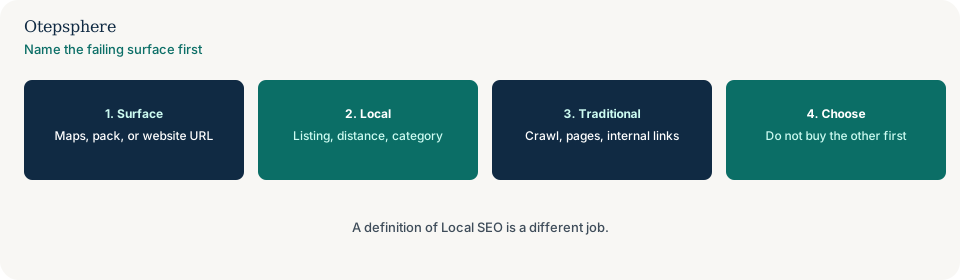
Is this the same as ranking in Search but not on Maps?
No. That is one symptom: a website URL is already preferred in organic results while the Business Profile is weak on Maps.
This page is the scope question before that symptom. You might have the opposite pattern — Maps looks healthy and the website is invisible — or both surfaces failing for different reasons. Diagnose the single symptom on why a website can rank in Search but not on Maps.
How do the two playbooks differ?
Local SEO is judged on local results; traditional SEO is judged on which web document Google prefers for a query.
Google documents three factors for local results: relevance, distance and prominence. Source: Tips to improve your local ranking on Google. Organic Search is a different system: discovery, crawl, indexing and ranking of pages. Source: How Google Search works. Distance to the searcher does not decide which blog post ranks. A perfect service page does not move a pin closer to the customer.
When is the problem Local SEO?
Treat it as Local SEO when the failing object is the listing, the Local Pack, or Maps visibility from where customers actually search.
Evidence looks like this: the query shows a pack and your business is missing or weak; the profile is unverified, restricted, or ineligible; the primary category does not describe the business; hours or the pin are wrong; reviews are missing or routed to the wrong location. Those are listing and geography jobs. A missing Maps listing starts at why a business is not showing on Google Maps.
When is the problem traditional SEO?
Treat it as traditional SEO when the failing object is a website URL: it is not discovered, not indexed, or not preferred for the service query.
Evidence looks like this: Search Console shows the intended page excluded or canonicalised away; two service URLs split the same query; the page is a thin city swap; internal links never reach the URL; the contact path is on a template Google cannot crawl. Those are document jobs. People-first guidance asks whether the page is useful for the person who would use it. Source: Creating helpful, reliable, people-first content. If a service URL is indexed but never preferred, use why a service page is indexed but not ranking.
When do you need both?
You need both when customers use Maps and still click through to a page that has to explain the service and take the enquiry.
Most local businesses sit here. The listing confirms who you are and how to contact you. The website holds depth the profile cannot: scope, process, proof, and a working form or click-to-call. Needing both is not a reason to run two unrelated retainers that undo each other. One source of truth for name, address or service area, phone and hours still applies — see entity SEO for local businesses.
Playbook decision table
| What you can show | What it usually means | Playbook | What not to buy first |
|---|---|---|---|
| The query shows a Local Pack; your listing is missing, unverified or in the wrong category | The local inventory object is the problem | Local SEO: eligibility, verification, category, accuracy | A blog series or a national backlink package |
| Search Console: intended service URL excluded, soft 404, or losing to a synonym page | The document is the problem | Traditional SEO: indexation, usefulness, one URL per job | More directory submissions |
| Website URL ranks for the service; Maps is weak from customer postcodes | Organic and Maps have diverged | Use the organic-versus-Maps diagnostic, then listing work | Rewriting the ranking URL as if Maps used the same ranking recipe |
| Maps looks healthy; the landing page is slow, broken, or does not match the service | Visibility is not becoming a contact | Website conversion and on-page usefulness — still a document job | A second Business Profile to “catch more calls” |
| Both surfaces are weak and facts disagree across site and listing | Entity and operations, not one tactic | Align facts, then pick the weaker surface | Two agencies writing the same fields without one owner |
What should I not do?
Action checklist
- Write down the query a customer would type and which surface they actually use.
- Capture evidence: pack or Maps screenshot from a customer area, plus Search Console for the intended URL.
- Assign the failure to listing, document, conversion, or mixed facts — not to “we need more SEO.”
- Pause work that belongs to the other playbook until the named surface has an owner and a next check.
- If both are needed, keep one source of truth for business facts and one person who can change each system.
- Re-measure the same surface. There is no published ranking timetable.
When professional help makes sense
Help is useful when a proposal mixes Maps promises with blog volume, when Search Console and the Business Profile are telling different stories, or when two vendors are each sure the other playbook is the fix. It cannot guarantee a Local Pack or a #1 organic URL.
Sources and further reading
- Google Business Profile Help: Tips to improve your local ranking on Google
- Google Search Central: How Google Search works
- Google Search Central: Creating helpful, reliable, people-first content
- Google Business Profile Help: Guidelines for representing your business on Google
Paying for SEO while the wrong surface stays broken?
Otepsphere can name whether the evidence points to the listing, the website, or both — a scope review, not a ranking promise.
Contact OtepspherePublished by Otepsphere
Published by Otepsphere, founded by Joseph Enmanuel. Learn about Otepsphere and its approach to local SEO.