What is a branded search?
A branded search is a query that already names the business, such as “ABC Dental Clinic,” so the searcher is trying to find that organisation rather than compare unnamed providers.
Typical branded queries include the trading name, a well-known abbreviation, or the name plus a city. The job is identification: match the query to the right website, profile and phone number. If branded search fails, you have an entity or access problem, not a service-page problem. That sits closer to entity SEO for local businesses and why a business is not showing on Google Maps.
Branded
ABC Dental Clinic The searcher already knows the name. Google mainly needs to identify the business entity.Non-branded
emergency dentist near me The searcher wants a service nearby. Relevance, distance and prominence are compared against other businesses.Implication
Name visibility is not service visibility Check service pages, categories, location and stronger competitors before publishing a page for every keyword.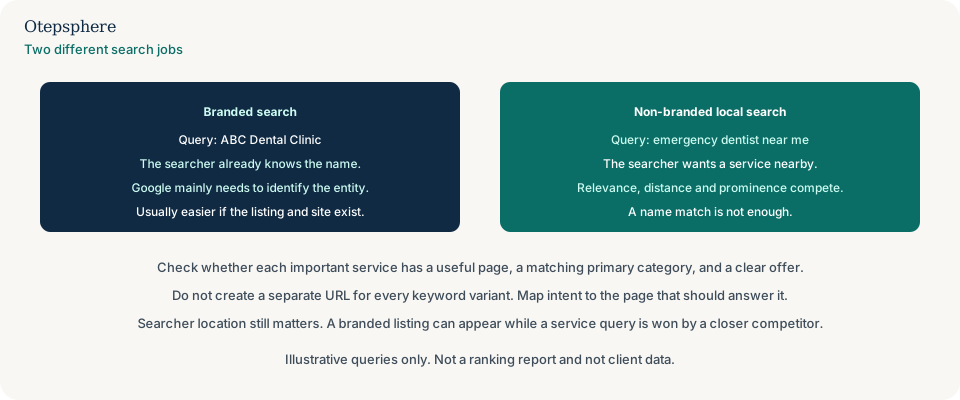
What is a non-branded local search?
A non-branded local search names a service, problem or category and usually implies a place, such as “emergency dentist near me,” without requiring the searcher to know your business name.
These queries are how new customers find you. Google’s local ranking help describes relevance, distance and prominence as the documented local result groups. A plumber who ranks for the company name but not for “blocked drain” plus the town is losing the queries that pay for the van. Source: Tips to improve your local ranking on Google.
Why is branded ranking usually easier?
Branded ranking is usually easier because the query already uniquely identifies the business, so Google mainly has to match that name to the correct entity rather than choose among many relevant local competitors.
That is not a claim that branded results ignore algorithms. Two businesses can share similar names. A duplicate listing can confuse which pin is yours. A website that never uses the trading name can slow identification. Still, “ABC Dental Clinic” is a narrower matching job than “emergency dentist near me,” where every nearby practice can be relevant. Do not oversimplify this into “Google always ranks you first for your name” or into a secret branded-rank boost you can buy.
What not to conclude: that strong branded rankings prove Local SEO is “done,” or that weak service rankings mean Google is punishing the profile. A rising branded traffic total can also hide a service-query fall: whether branded search growth is hiding a non-branded Local SEO decline.
Does my website clearly explain each important service?
If an important service is only a bullet on the homepage, the website may not give Google or a customer enough to understand that you actually offer it.
A dental clinic that ranks for its name but not for “Invisalign” often has no page that explains the treatment, who it is for, and how to book. A plumber whose homepage says “all plumbing” without a blocked-drain page is asking a general URL to win a specific job. You do not need a novel. You need a page a person can use. On-page structure is covered commercially on local on-page SEO. If that service URL is already indexed and still does not appear for the service query, diagnose it separately: why a service page is indexed but not ranking for the service. If every service is still sitting on the homepage, see whether a one-page website can rank for multiple local services.
Does the Business Profile category match what the business actually is?
The primary category should describe what the business is, because Google states that the categories you choose affect local ranking, and a mismatched category makes service queries harder to match.
A clinic whose primary category is a generic “Medical clinic” may lose “emergency dentist” to practices that selected a dentist category. Do not add extra categories as keywords. Choose the fewest specific categories that are true. Guide: how to choose Google Business Profile categories. Source: Tips to improve your local ranking on Google.
Do service pages satisfy commercial intent?
Service pages satisfy commercial intent when they help a ready customer decide and contact you, not when they only repeat the keyword in a blog introduction.
Someone searching “emergency dentist near me” wants hours, whether you take walk-ins, pain relief, and a phone number. An article titled “The history of enamel” does not complete that job. Include the facts that change a decision: what you do, who it is for, where you work, and the next step. Visibility without that next step is a conversion problem: Google visibility but no customers.
Does searcher location matter?
Yes. Searcher location can change which businesses appear for a service query even when branded search still finds you from anywhere.
A customer standing two suburbs away may see a closer dentist for “emergency dentist near me” while still finding you if they type your name. That is expected local behaviour, not proof that your service pages failed. Measure from the places customers actually search: why local rankings change by location.
Could stronger competitors explain the difference?
Yes. Other businesses can outrank you for a service query because they are more relevant, closer to the searcher, or more prominent, even when they cannot beat you for your own name.
Prominence includes things Google mentions such as reviews, while distance and relevance remain in the same documented group. Compare the listings that actually occupy the service query, not a national brand you admire. Do not copy keyword-stuffed names. Method: why a competitor ranks higher on Google Maps.
How should service keywords be mapped?
Map each important service intent to the one URL that should answer it, grouping close variants onto that page rather than splitting them across near-duplicate URLs.
“Emergency dentist,” “dentist open now,” and “toothache dentist” may belong together if they describe the same offer. “Invisalign” and “root canal” usually do not. The working method is how to map local keywords to services and locations. Keyword research as a service is local keyword research.
Should I create a page for every keyword?
No. Creating a separate page for every keyword variant produces thin, competing URLs and does not give customers a better answer.
Doorway-style location or “near me” pages are a common way this goes wrong. One useful service page that people can finish is worth more than twelve rewrites of the same paragraph. Google’s people-first guidance asks whether content is created for users; a keyword spreadsheet is not a user. Source: Creating helpful, reliable, people-first content.
Branded vs Non-Branded Visibility Checklist
- Confirm branded search finds the correct website and Business Profile.
- List the service queries that actually produce customers, not every synonym.
- Check each important service from a realistic customer location.
- Give each distinct service a useful page, not only a homepage mention.
- Match the primary category to what the business is.
- Make the service page answer a ready customer: offer, location, next step.
- Compare the businesses that occupy the service query, not a random national chain.
- Map variants to existing pages instead of publishing one URL per keyword.
- Do not add services or cities to the Google Business Profile name.
- Do not treat branded rankings as proof that service visibility is healthy.
When professional Local SEO assistance makes sense
Help is useful when branded search is healthy but service queries stay empty after the pages and category already describe the real offer, or when you cannot tell a location problem from a relevance problem. Otepsphere can review targeting and architecture. No one can honestly guarantee a Map Pack slot for a service keyword.
Official Google sources
- Tips to improve your local ranking on Google
- Guidelines for representing your business on Google
- Creating helpful, reliable, people-first content
Easy to find by name but invisible for your services?
Otepsphere can review your service targeting, website architecture and local visibility to identify where relevance may be weak.
Contact OtepspherePublished by Otepsphere
Published by Otepsphere, founded by Joseph Enmanuel. Learn about Otepsphere and its approach to local SEO.