What does this problem actually mean?
It means every service, every location fact and every enquiry path lives on a single URL, so Google and customers have to infer several offers from one document.
That can work for a narrow practice. It struggles when a plumber offers blocked drains, hot water, gas fitting and bathroom renovations, or when a dentist offers examinations, Invisalign and implants, and each job needs different proof. The homepage may still rank for the business name; service queries are a different test. See why a business ranks for its name but not its services.
Can a one-page site rank for local services?
Yes, for some queries — especially brand searches and a single, clearly explained service — but ranking is not guaranteed, and one URL is a weak home for several unrelated jobs.
Google crawls, indexes and ranks documents. A single strong page can be relevant. It cannot give each service its own title, heading, proof and enquiry path. Extra URLs are not an automatic ranking upgrade; they are extra documents that still have to be useful. Sources: How Search works and Creating helpful, reliable, people-first content.
Fit
Is one URL enough? A single-service tradesperson with a clear offer may not need more pages yet.Jobs
How many distinct services? Invisalign, emergency dentistry and hygiene are different customer decisions.Crawl
Can Google and people find each job? In-page anchors are weaker than crawlable service URLs with their own links.Yes
Split only for real jobs Write a useful service page, not a keyword shell.Next
Do not mass-publish city clones Location-page strategy is a separate decision.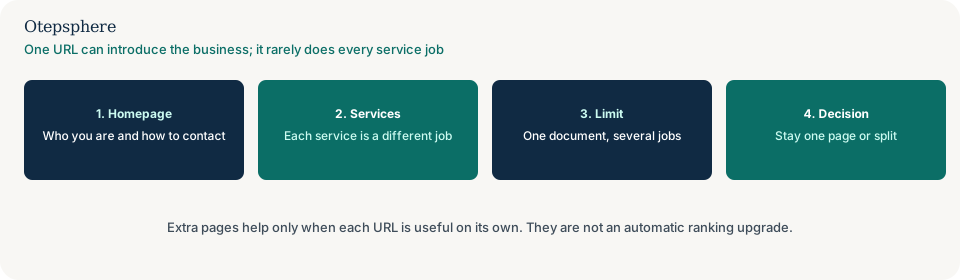
Is this the same as needing location pages?
No. Location pages exist because a real place deserves its own document. Service pages exist because a distinct job deserves its own document.
A one-page site with one premises is not the same problem as deciding whether each branch gets a URL. That decision is when a location deserves its own page. Do not turn a one-page site into a city-name template factory. Map jobs first: how to map local keywords to services and locations.
When is one URL enough?
One URL is often enough when the business does one primary job, from one place, and the page already answers how to enquire.
A locksmith who only does emergency lockouts, or a café with one dining room, can explain the offer, hours, address and booking path on a single page. Customers do not have to hunt among sections. Google does not need a second URL for every synonym of that one job.
When do dedicated service pages help customers?
Dedicated pages help when a customer would search a specific service, need different facts to decide, and would struggle to find that offer inside a long homepage.
If “Invisalign” and “emergency extraction” share one scroll, the wrong section may be what Google snippets, and the mobile visitor may never reach the form. Separate URLs let each job have a clear title, proof and call to action. That is a customer and crawl-clarity decision, not a promise that more pages will rank.
One-page vs service-page decision table
| Question | One URL is usually enough when | A dedicated service page usually helps when | What not to assume |
|---|---|---|---|
| Customer job | People book one primary service and the page already explains it | People book distinct jobs that need different eligibility, process or proof | That every synonym needs its own URL |
| Crawl and indexing | Google can fetch the homepage and the Business Profile points at it | Service sections are buried, duplicated in tabs, or never linked as real URLs | That publishing pages guarantees they will be crawled or ranked |
| Conversion | The enquiry path is visible without hunting, including on a phone | Visitors land needing one service and cannot find the matching facts or form | That extra URLs will create enquiries by themselves |
| Search Console pattern | Queries that matter already attach to this URL, mostly brand or one service | Service queries attach to the homepage weakly, or not at all, while brand is fine | That the homepage is “failing Local SEO” because it is one page |
What should I not do?
Action checklist
- Write the distinct jobs a customer would book. Mark which ones the homepage already explains fully.
- Check Search Console: which queries hit the single URL, and which never appear.
- Read the page on a phone. Note where a visitor would get lost or fail to enquire.
- If several jobs need their own proof, plan a small set of service URLs — one primary URL per job.
- Keep the homepage as the brand and overview document. Link it clearly to each service URL.
- Re-measure after recrawl. Extra pages are not a published ranking timetable.
When professional help makes sense
Help is useful when one URL is carrying every service, the Business Profile and the site disagree, or it is unclear whether dedicated service pages would help customers or merely duplicate the homepage. It cannot guarantee rankings or enquiries.
Sources and further reading
- Google Search Central: How Search works
- Google Search Central: Creating helpful, reliable, people-first content
- Google Search Central: Google Search Essentials
One URL carrying every service?
Otepsphere can review whether dedicated service pages would help customers find the right offer — a document and conversion review, not a ranking guarantee.
Contact OtepspherePublished by Otepsphere
Published by Otepsphere, founded by Joseph Enmanuel. Learn about Otepsphere and its approach to local SEO.