What does this problem actually mean?
It means the location or service page is written to repeat search phrases rather than to help someone choose the business, so the copy is harder to use and can match Google’s keyword-stuffing examples.
Naming the service and the area once, clearly, is ordinary on-page work. Repeating “emergency plumber [suburb]” through titles, headings, body and a closing list of every nearby place is a different pattern. The harm to worry about first is a page people will not read or trust — not a folklore percentage of keywords.
Is this the same as recovering from bad Local SEO or AI location pages?
No. This article is about copy on pages you already have. An inherited agency mess, and scaled AI city templates, are wider problems.
If you took over a site full of risky tactics, start with how to recover from bad Local SEO without making things worse before you rewrite one paragraph in isolation. If the issue is hundreds of unoriginal city URLs, see whether AI-generated location pages can hurt Local SEO and whether you should delete thin or duplicate city pages. Stay here when one page (or a template) is stuffed rather than useful.
Use
Can someone decide or book? If the H1 is a town list, the page is not written for the visitor.Pattern
Unnatural keyword groups? Google’s stuffing examples include lists of keywords out of context.Not
This is not a ranking factor hack E-E-A-T is not documented as one ranking factor to stuff into copy.Yes
Rewrite for the customer Keep the URL unless the page should not exist.Next
Do not add more location URLs Stuffing plus doorway templates stacks two problems.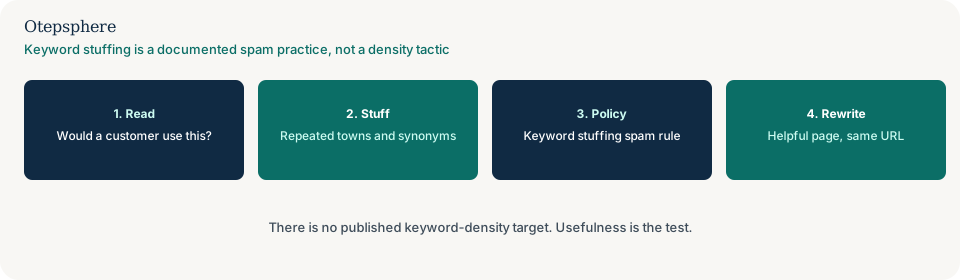
What does Google call keyword stuffing?
Keyword stuffing is filling a page with keywords or numbers in an attempt to manipulate rankings. Google lists it as a spam practice.
Documented examples include repeating the same words or phrases so often that the text sounds unnatural, lists of phone numbers without substantial added value, and blocks of text that list cities and regions the page is trying to rank for. Source: Google Search spam policies (keyword stuffing). Google does not publish a permitted keyword density. Do not invent one.
Are suburb lists a local form of stuffing?
They can be. A block of place names with no operational meaning is the local version of Google’s “cities and regions” stuffing example.
A short, true statement of where you travel from, or which sites you occupy, can help a customer. A paragraph that only concatenates neighbouring suburbs after every heading does not. If the list is there so the page “contains” more town names, treat it as stuffing and replace it with catchment, travel time or booking rules that are actually true.
What does people-first content ask instead?
It asks whether the content is helpful and reliable for the person who would use it — not whether every synonym appears.
Google’s people-first guidance is about creating helpful, reliable content for people. A service page should make the offer, process, area and enquiry path clear. That is the same job as local on-page SEO done honestly. Source: Creating helpful, reliable, people-first content. Do not treat “E-E-A-T” as a documented ranking factor on this page; Google’s public ranking-systems material does not list E-E-A-T as a ranking factor, and stuffing is not fixed by adding credential language as a ritual.
How should the page be rewritten?
Rewrite so a customer can decide, book or visit. Keep one clear primary service and location story; cut repeated phrases and decorative suburb lists.
Put the real offer in the title and opening answer. Explain who the page is for, what happens next, and any limits (call-out fees, areas you do not cover, same-day cut-off). Then check Search Console for that URL: impressions and clicks can show whether the snippet still matches the query, but they do not prove stuffing “worked” or that a rewrite will restore a previous position.
Stuffed versus usable local copy
| Pattern | What it usually does | What to write instead | What not to assume |
|---|---|---|---|
| Same phrase repeated in title, H1, first line and every subheading | Sounds unnatural; hard to scan | One clear offer; headings that answer real questions | That more repetition raises rankings |
| Block of neighbouring suburbs with no travel or booking facts | Matches Google’s city-list stuffing example | True catchment, travel policy or which sites you operate | That a density target exists |
| Phone numbers or postcodes listed without a reason to use them | Noise unless each number is a real contact path | The number to call for that location or service | That more numbers are a local ranking tactic |
| Page explains the service, area and how to enquire | Someone can act | Keep that; tighten wording | That useful copy is “under-optimised” |
What should I not do?
Action checklist
- Print or paste the page. Highlight repeated phrases and any city block that adds no operational fact.
- Rewrite the title, H1 and opening answer so a customer can tell what you do and where.
- Replace suburb stuffing with true coverage, hours, process and enquiry steps.
- Check internal links still describe the page in plain language, not a keyword string.
- Inspect the URL and review Performance after recrawl. There is no published timetable.
- If the same stuffed template sits on many city URLs, audit the set rather than polishing one page only.
When professional help makes sense
Help is useful when stuffed templates sit across a location set, when stuffing is mixed with thin city pages or leftover agency work, or when Search Console shows the page earning impressions but not helping the people who click. Rewriting copy does not guarantee better rankings.
Sources and further reading
- Google Search Central: Spam policies (keyword stuffing)
- Google Search Central: Creating helpful, reliable, people-first content
- Google Search Central: Google Search Essentials
Location and service pages that repeat keywords instead of helping someone book?
Otepsphere can review titles, headings and body for stuffing versus usable local copy — without a density formula or a ranking guarantee.
Contact OtepspherePublished by Otepsphere
Published by Otepsphere, founded by Joseph Enmanuel. Learn about Otepsphere and its approach to local SEO.