Are temporary ranking changes normal after a migration?
Yes. Google currently says you may see ranking fluctuations while it recrawls and reindexes a site after a significant change, and that a medium-sized site can take a few weeks or more for new URLs to replace old ones, with larger sites taking longer.
That guidance is about processing time, not a promise that rankings will return to the previous graph. If the drop is not recovering, Google points you to common site-move mistakes such as broken redirects. Hosting-only moves without URL changes have a separate guide. Sources: Site moves with URL changes and Debug Google Search traffic drops.
This page is the post-launch technical path. A drop that is not tied to a redesign belongs on why local rankings and leads dropped.
Old site to mapping
List every important local URL before launch Service pages, location pages, contact, and the URLs used on Google Business Profile belong on that list.Redirects and new site
Permanent redirects to equivalent new URLs Missing service or location pages, leftover noindex, and robots.txt blocks are common launch defects.Crawl, local pages, GBP
Confirm Google can index the new pages and that profiles still point to the right landing pages A redesigned homepage that replaced a location URL will drop that branch’s website support.Measurement
Search Console, sitemaps and analytics must still record the important URLs Ranking fluctuation after a URL change can be normal while Google recrawls. Broken tracking is not.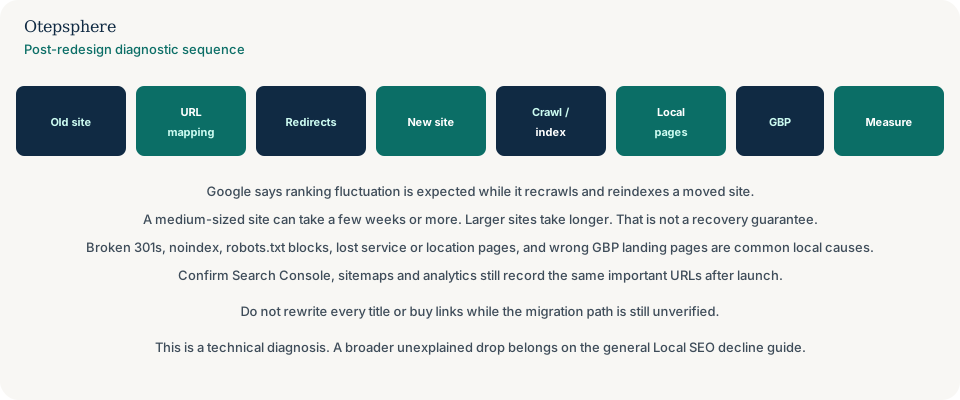
Did the URLs change?
URLs changed if the address bar for important local pages is different after launch, including trailing slashes, new folders, new domains, or a move from a location path to a query-string template.
Make a spreadsheet of old URL and new URL for homepage, contact, each service, each location, and every URL saved on a Google Business Profile. If you cannot complete that sheet, the migration was not mapped. Google’s site-move documentation starts with URL mapping for a reason.
Were permanent redirects implemented?
Permanent redirects were implemented if each important old URL returns a 301 or equivalent permanent redirect to the matching new URL, not to the homepage, and not as a chain of hops.
A homepage redirect for every retired dentist service page tells Google and customers that those services vanished. Temporary 302s are the wrong signal for a finished move. Test on a phone as well as a desktop. Keep redirects in place; Google notes that old URLs can be remembered for a long time. If leftover hops remain after the mapping is correct, collapse them using whether redirect chains are hurting location and service pages. Old URLs that 404 but still attract links are a separate decision: what to do with old local URLs that still have backlinks.
Were service pages removed?
Service pages were removed if URLs that used to explain a real offer now 404, redirect to a generic homepage, or were never rebuilt on the new site.
Local customers often land on those pages from Maps and from old links. Replacing “emergency plumber” with a single “What we do” slider removes the URL that had search history. Rebuild equivalent content on a stable URL, then redirect.
Were location pages removed?
Location pages were removed if branch URLs disappeared, merged into one “find us” map, or were replaced with city-swapped shells that no longer name a real premises.
Multi-location businesses feel this immediately: the Richmond profile still points at /richmond/ while that path now loads a template with no address. Restore unique location pages for real premises. Decision rules: when to create location pages.
Did important content disappear?
Important content disappeared if the new templates dropped NAP facts, service detail, opening hours, parking, or other unique local information that used to sit on the page.
Design systems often ship with short hero copy and no room for the facts customers need. Compare a rendered old page (from archives or staging) with the live page. People-first content still has to exist after a visual redesign. Source: Creating helpful, reliable, people-first content.
Did title tags and H1s change?
Title tags and H1s changed if the new CMS overwrote unique local titles with a brand pattern such as “Home” or “Services | Brand” on every URL. A missing homepage favicon link after a theme swap is a separate Search appearance issue: why Google may show the wrong favicon.
A change is not automatically a drop. A sitewide identical title is a problem. Restore titles that name the location and the offer. Do not bulk-rewrite them again the following week while you are still fixing redirects.
Are canonicals correct?
Canonicals are correct when each important local URL suggests itself, unless a URL is a true duplicate of another page you intend to consolidate.
A default canonical to the homepage, HTTP/HTTPS mismatches, or parameter URLs winning over clean location paths can hide the pages you just launched. Inspect the live HTML and the URL Inspection tool. Protocol pairs are HTTP and HTTPS duplicate local pages. If Search Console reports that Google chose a different canonical than you declared, use why Google chose a different canonical for a location page. Source: How to specify a canonical URL.
Is noindex accidentally present?
Noindex is accidentally present if staging rules, a “discourage search engines” checkbox, or a leftover meta tag or HTTP header is still blocking the production pages Google should index.
Google has to recrawl a page to see a new noindex. If a site launched with noindex and you removed it, request a recrawl and wait. If a separate staging host is what appeared in Search, that leak is diagnosed in why a staging or development website is showing in Google. Source: Block Search indexing with noindex.
Is robots.txt blocking important content?
Robots.txt is blocking important content if Disallow rules left over from staging prevent Googlebot from crawling service, location or assets you need indexed.
Google’s hosting-move guide specifically says to remove temporary crawl blocks when the new copy is ready. A Disallow: / that was useful on the staging host is a local-search outage on production. Source: Site moves without URL changes.
Are internal links still correct?
Internal links are still correct if menus, locators, breadcrumbs and in-content links point at the new URLs rather than at 404s or at a single homepage for every location.
A visual redesign often rebuilds navigation from scratch and drops the location index. Repair those links; crawlers follow them. Guide: internal linking for Local SEO.
Did structured data disappear or become inaccurate?
Structured data disappeared or became inaccurate if LocalBusiness, address, hours or URL markup was not rebuilt, or now describes the wrong location.
Markup must match visible content. Review-star markup that does not match visible reviews, or a leftover suburb in JSON-LD, will not rescue a 404, and they can create trust problems. Google’s structured data introduction is the place to check current required properties rather than copying an old plugin dump. Source: Introduction to structured data.
Does GBP still link to the correct landing page?
Each Google Business Profile should still open the website URL that represents that location or that business, and a redesign is a common moment those URLs break.
Click every location’s website button. If it 404s, Google and customers lose the page that supported the listing. Update the profile after the redirect map is in place so you are not saving a URL that will change again tomorrow. Representation: Guidelines for representing your business on Google.
Was analytics or tracking broken?
Tracking is broken if GA4, conversion events, call tracking or form tags did not survive the new templates, which can look identical to a lead collapse.
Test a form, a tel: link, and a booking tool. Compare GA4 page paths with the new URL structure. A missing tag is not a Map Pack penalty. Confirm measurement before you commission more SEO.
Was Search Console configured correctly?
Search Console is configured correctly when the property covers the live host you migrated to, including the correct domain or URL-prefix property, and you can inspect the new URLs.
A move to a new domain needs the new property verified. Google’s site-move guide also describes the Change of Address tool for domain moves. If you only watch the old property, you will think the site vanished. Source: Site moves with URL changes.
Was the sitemap updated?
The sitemap is updated when it lists the new canonical URLs, is submitted in Search Console, and no longer presents the retired URLs as the current site.
Sitemaps help discovery. They do not guarantee indexing. Google’s site-move documentation recommends watching old and new sitemap index counts move in opposite directions during a URL change. If live location URLs never made it into the file Google fetches, see why location pages are missing from the XML sitemap. Source: Build and submit a sitemap.
How should post-migration performance be monitored?
Monitor post-migration performance in Search Console, analytics, Business Profile landing-page clicks and a consistent local rank method, expecting fluctuation while Google recrawls rather than judging the move on one overnight screenshot.
Watch crawl errors, indexed URL counts, and the Performance report for the URLs you mapped. Keep geo-grid settings stable. Reporting: Local SEO reporting. How long processing can take: how long Local SEO takes.
Migration diagnostic table
| Check | Why it matters | Status | Action |
|---|---|---|---|
| URL mapping | Old local URLs need a documented destination | Complete / gaps | List every service, location and GBP URL |
| Redirects | Equity and customers follow permanent redirects | 301 / 302 / 404 | Fix chains and homepage dumps |
| Service and location pages | These URLs often carry local demand | Present / removed | Rebuild equivalents, then redirect |
| noindex / robots.txt | Google cannot use blocked pages | Open / blocked | Remove staging rules on production |
| Canonicals | Wrong canonicals hide the intended URL | Self / homepage | Self-reference real local pages |
| GBP website URLs | Profiles must represent that location | Correct / 404 | Update after redirects work |
| Tracking | Broken tags mimic a lead crash | Firing / silent | Test forms, calls, GA4 events |
| Search Console and sitemap | You need the live host and new URLs | Verified / missing | Add property; submit new sitemap |
When professional Local SEO assistance makes sense
Help is useful when a launch already happened, the URL map is missing, and you cannot tell recrawl noise from a lost location architecture. Otepsphere can review the migration, redirects, local landing pages, Search Console and Business Profile connections. Recovery is not guaranteed, and rewriting everything at once will hide the cause. If the same site is still live and a plugin update reverted titles or canonicals, that is why CMS or plugin updates overwrite SEO changes, not a full redesign.
Official Google sources
- Site moves with URL changes
- Site moves without URL changes
- Debug Google Search traffic drops
- Block Search indexing with noindex
- How to specify a canonical URL
Local rankings or enquiries dropped after a website launch?
Otepsphere can review the migration, redirects, local landing pages, Search Console data and Google Business Profile connections to identify what changed.
Contact OtepspherePublished by Otepsphere
Published by Otepsphere, founded by Joseph Enmanuel. Learn about Otepsphere and its approach to local SEO.