Can an online-only business have Google Business Profile?
An online-only business generally cannot have a Google Business Profile, because Google’s eligibility rules require in-person contact with customers during the business’s stated hours.
Google’s eligibility help lists “brands, organizations, artists, and other online-only businesses” among examples that are not eligible. The same page states the core test: to qualify, a business must make in-person contact with customers during its stated hours. Source: Business eligibility and ownership guidelines.
That is why an ecommerce brand, a purely remote SaaS product, or a consultant who never meets clients in person often cannot complete verification. The rejection is usually eligibility, not a broken postcard or video.
What does Google consider an online-only business?
Google treats a business as online-only when it does not make in-person contact with customers at a location it operates or by travelling to customers.
The representation guidelines open with the same split: if the business has a physical location customers can visit, or travels to customers where they are, it can create a Business Profile. A website, app, warehouse that customers never visit, or a brand that only ships goods does not meet that test on its own. Source: Guidelines for representing your business on Google.
“Online-only” is about the customer interaction, not the legal form. A registered company with a website can still be a storefront or a service-area business if people actually meet staff in person.
Does having a registered office make the business eligible?
No. A registered office, company-secretary address or mailing address does not make an online business eligible unless customers actually visit that place for in-person contact during stated hours.
Google requires a precise, real-world operating location. P.O. boxes and remote mailboxes are not acceptable. If you rent a physical mailing address but do not operate there — Google’s wording for a virtual office — that location is not eligible. Source: Guidelines for representing your business on Google. The mailing-address diagnosis is whether a PO box or mailbox can be used for a Business Profile. A holiday home with a physical address is a different ineligible example: whether an Airbnb or vacation rental can have a Business Profile.
Does using a home address make an online business eligible?
No. Using a home address does not make an online-only business eligible if customers are not received there, or if you do not travel to them.
A home can be a legitimate base for a service-area business. Google’s plumber example is to hide a residential address when customers are not received at the house, and to set a service area instead. That model still requires in-person work at the customer’s location. It is not a loophole for a shop that only exists on a website. See Google Business Profile for service-area businesses.
What if customers visit my home or office?
If customers genuinely visit a staffed location during stated hours, the business may be eligible as a storefront rather than as an online-only brand.
Google says businesses showing an address should maintain permanent fixed signage of the business name at that address. Co-working space is allowed only when the office has clear signage, receives customers during business hours, and is staffed during those hours by your business’s staff — not a receptionist who works for the building. Source: Guidelines for representing your business on Google.
Occasional parcel collection, a one-off meeting, or “customers can visit if they really want to” is not the same as a customer-facing location. If you would not want a stranger arriving during published hours, do not publish the address as a storefront.
What if I travel to customers?
If you travel to customers at their physical locations, the business may be eligible as a service-area business rather than as an online-only brand.
Google allows one service-area profile for the central office or location, with a designated service area, when the business serves customers at their locations. Hide the address when customers are not received there. Do not invent extra pins for cities you would like to rank in. Setup detail is in GBP for service-area businesses and Local SEO for service-area businesses. If clients come to an office only by booking, that is a different eligibility question: whether an appointment-only business can have a Google Business Profile.
Online-only business vs service-area business
The useful distinction is how customers meet you, not whether you also have a website.
Online only
No face-to-face activity Generally ineligible for a Business Profile.Service area
Travels to customers May be eligible with one service-area profile.Storefront
Customers visit May be eligible when the location is staffed and signed.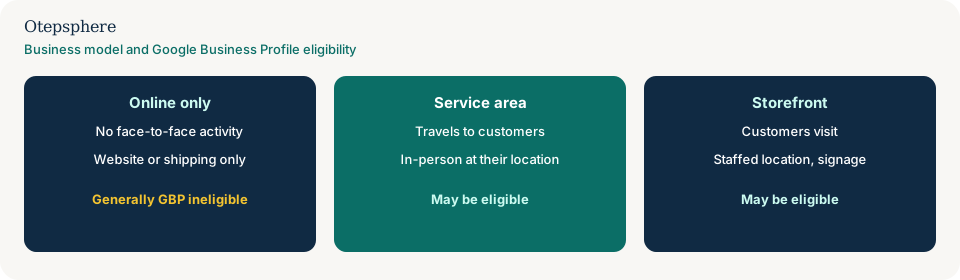
| Business model | Customer interaction | Physical customer contact? | Potential GBP eligibility | Typical setup |
|---|---|---|---|---|
| Online only | Website, app, shipping or remote delivery with no in-person meeting | No | Generally not eligible | Do not create a Business Profile for the brand as if it were a shop |
| Service-area | Staff travel to the customer | Yes, at the customer’s location | May be eligible | One profile, service area, address usually hidden |
| Storefront | Customers visit your location | Yes, at your premises | May be eligible | Public address, permanent signage, staffed hours |
| Hybrid | Customers visit and you also travel or deliver | Yes | May be eligible | Show the address and set a service area when both are true |
Eligibility is Google’s decision. The table is a planning aid, not a promise that a given profile will be verified.
Can an ecommerce store create a GBP?
An ecommerce store that only sells online, with no in-person customer contact, generally cannot create an eligible Google Business Profile.
A retailer that also operates a staffed shop customers visit may be eligible for that shop. A warehouse or fulfilment centre that the public cannot visit is not a storefront. Pickup that is genuinely available to customers at a staffed location is a different operating model from “we ship from a warehouse.”
Product visibility on Google is a separate product family from Business Profile. Merchant Center and Shopping listings are for products, not a substitute eligibility path for a Maps pin.
Can a SaaS business create a GBP?
A SaaS business that only delivers software online, with no in-person customer contact, generally cannot create an eligible Google Business Profile.
A software company that also runs a staffed office customers visit for onboarding, training or support may be eligible for that office if the location meets storefront rules. A salesperson who sometimes flies to a client site may support a service-area model only if that travel is a real, ongoing way customers receive the service — not a justification for a pin in every city on the roadmap.
Can an online consultant create a GBP?
An online consultant who never meets clients in person generally cannot create an eligible Google Business Profile.
A consultant who travels to client offices, homes or sites may be eligible as a service-area business. A consultant who receives clients at a staffed, signed office during stated hours may be eligible as a storefront. Video calls alone do not meet Google’s in-person contact test as currently written.
What if Google already created a listing?
A listing that already appears does not prove the business is eligible, and it does not mean you should claim it as a storefront if the operation is online-only.
Google can show business information from websites, licensed data and user contributions. An unclaimed or user-created pin can still be inaccurate. Claiming an ineligible listing, or turning it into a fake shop, can create a later restriction. If the public record is wrong, correct facts through Google’s current suggestion and support paths rather than inventing a walk-in offer. Background on how facts assemble is in inconsistent business information online.
Should I create a fake service area?
No. You should not create a fake service area to obtain a Google Business Profile.
Service area is for businesses that actually visit or deliver to customers. An oversized or invented area is a representation problem and a common path to suspension. Do not use it to simulate local presence for an online-only brand.
Should I rent a virtual office?
No. Renting a virtual office as a mailing address does not make an online-only business eligible for a Google Business Profile.
Google states that if the business rents a physical mailing address but does not operate out of that location, that location is not eligible. Service-area businesses cannot list a virtual office unless that office is staffed during business hours. Source: Guidelines for representing your business on Google.
Paying for a prestigious address to obtain a Maps pin is the opposite of Google’s current address rules. If verification or a later review fails, start with Google Business Profile suspended only after you confirm the issue is a restriction rather than simple ineligibility.
What Google products can an online-only business use instead?
An online-only business should invest in an indexable website and Search visibility rather than forcing a Business Profile it is not eligible for.
Useful, legitimate channels include:
- A clear website that Google can crawl and index, following Google Search Essentials and people-first content.
- Google Search Console, to inspect indexing and search performance for that site.
- Google Analytics, to measure website sessions and key events after people arrive.
- Google Merchant Center and Shopping, where the business sells products and meets those product-feed rules.
- YouTube, if video is a genuine way customers learn about the offer.
Paid Search is a separate advertising product. It is not a substitute eligibility path for Maps, and this page is not a recommendation to buy ads. Brand knowledge panels, where they appear, are also not something a business creates by opening a Business Profile.
What not to assume
Do not assume that a company registration, VAT number, warehouse, “we ship nationwide,” or a previous agency’s listing proves eligibility. Do not assume that hiding an address automatically converts an online brand into a service-area business. Do not assume that a competitor’s ineligible pin means Google will allow yours.
What not to do
Practical action plan
- Write down how customers actually receive the product or service this month — not the model you wish you had.
- If there is no in-person contact, stop the Business Profile application and focus on the website and Search Console.
- If staff travel to customers, configure one honest service-area profile and hide a residential address when customers are not received there.
- If customers visit a staffed, signed location, represent that location as a storefront and keep hours true.
- Align the website with the same operating model so the landing page does not contradict the profile.
- Re-read Google’s current eligibility and representation pages before the next verification attempt.
Online-only vs eligible local business checklist
- Customers meet staff in person at a location you operate, or you travel to them.
- The address is a real operating location, not a P.O. box, mailbox or unstaffed virtual office.
- If the address is public, permanent signage and staffed hours match the profile.
- If the model is service-area, the area matches jobs you actually take.
- The website describes the same model as the profile.
- You are not creating extra listings for cities, brands or product lines that are not separate eligible businesses.
When professional help makes sense
Help is useful when the operation sits on the boundary: pickup plus shipping, occasional site visits, a studio that sometimes receives clients, or a leftover listing created by someone else. It is not useful if the only brief is “get us a Maps pin” for a business that never meets anyone in person.
No consultant can legitimately guarantee verification or eligibility. Google decides.
Sources and further reading
- Google Business Profile Help: Business eligibility and ownership guidelines
- Google Business Profile Help: Guidelines for representing your business on Google
- Google Business Profile Help: Overview of Google Business Profile policies
- Google Search Central: Google Search Essentials
- Google Search Central: Creating helpful, reliable, people-first content
Unsure whether your business qualifies for Google Business Profile?
Otepsphere can review how your business actually operates and help distinguish between an eligible storefront, service-area model and online-only business before unnecessary profiles are created.
Contact OtepspherePublished by Otepsphere
Published by Otepsphere, founded by Joseph Enmanuel. Learn about Otepsphere and its approach to local SEO.