What does Google require for Business Profile eligibility?
Google currently requires a business to make in-person contact with customers during its stated hours, with a short list of documented exceptions such as certain ATMs, seasonal businesses with year-round signage, and delivery-only food services under separate virtual food brand conditions.
That in-person test is the core of Google’s eligibility and ownership guidelines. Online-only brands, organisations and artists are listed as ineligible examples. A website, booking calendar or video-call practice does not replace face-to-face contact.
Representation is a second test. The guidelines for representing your business on Google say a profile should match how the business is recognised in the real world, that a public address should have permanent fixed signage, and that a virtual office used only as a mailing address is not eligible.
Does a business need walk-in customers?
No. Google’s eligibility rule is in-person contact during stated hours, not an open-door walk-in policy.
A therapist, attorney, consultant, private clinic, studio or specialist professional can meet that test when clients actually attend the location, or when the professional travels to the client. None of those examples is automatically eligible. The same job titles can also be fully remote. Title is not proof of a customer-facing location.
Can an appointment-only office qualify?
Yes, when the office is a genuine customer-facing location: clients come there, staff can receive them during the hours you would state, and the address is not a mailbox or unused registered office.
That is different from an online-only business, which generally cannot have a Business Profile because there is no in-person contact. It is also different from a service-area business that travels to customers and should hide a residential or non-customer-facing address.
If clients come to a signed, staffed office by booking only, treat it as a storefront with restricted access — not as a shop that pretends to take walk-ins. If nobody can visit and you never travel, treat it as online-only.
Should an appointment-only business publish normal business hours?
No, not as ordinary walk-in hours. Google currently says businesses that operate only by appointment, and some businesses with highly varied schedules, should not provide simple hours.
The representation guidelines list appointment-only operators alongside examples such as hotels, schools, movie theatres, transportation services and event venues as types that should not publish ordinary hours. If a customer cannot arrive without a booking, do not advertise 9-to-5 walk-in hours you will not honour. The hours editor also includes options such as “Open with no main hours” when you do not want hours to display. Source: Guidelines for representing your business on Google.
If you keep a real desk window when booked clients can arrive, publish that window. Match the website and booking tool to the same fact. Conflicting hours are an accuracy problem, not a ranking tactic.
Can customers visit a home office by appointment?
Only when that home is a genuine customer-facing location that can satisfy Google’s current location rules, including in-person contact and, if the address is shown, permanent signage.
Distinguish three models:
- Customer-facing location. Clients attend the address. The profile may show the address when signage, staffing and eligibility match.
- Service-area business. You travel to customers. Google says you should hide a residential address. See Local SEO for service-area businesses.
- Online-only operation. Appointments are remote. A home address used only for mail or company registration does not make the business eligible.
Privacy and safety matter for home-based professionals. Hiding an address because clients never visit is a service-area decision. Hiding an address while still claiming a storefront is a representation problem.
What if the address cannot receive customers?
Then it is not a customer-facing storefront, even if appointments are booked in a calendar.
A locked co-working mailbox, a registered office with no client access, or a home that never admits visitors should not be published as a shop customers can find on Maps. If you still meet people in person at their locations, use a service-area profile. If you do not, do not create a Business Profile for local discovery.
What if appointments happen only online?
Then the business is generally ineligible, because Google’s current eligibility test is in-person contact.
Video therapy, remote legal advice, and online consulting can be real businesses. They are not, on that basis alone, Google Business Profile businesses. Creating a pin for a Zoom practice is the same mistake as creating a pin for a SaaS company. Use the website, Search, and other Google products that do not require a local listing.
What if the business sometimes visits customers?
Then the correct model depends on where the in-person contact actually happens, not on which option feels more visible.
If clients sometimes come to the office and you also travel, Google describes a hybrid service-area business: the location should be staffed and able to receive customers during stated hours, and a service area can be added. If clients never come to the address and you only travel, hide the address. Occasional site visits do not turn an otherwise online business into a storefront.
Could verification still be required?
Yes. Eligibility and verification are separate. An eligible appointment-only office can still be asked to verify, and verification can fail when the location, signage or access does not match the profile.
Postcard, video and other methods depend on business type, region and the options Google offers. A location that cannot receive mail, cannot show signage, or cannot demonstrate the business operating there is harder to verify. If verification has already failed, start with why Google Business Profile verification fails rather than creating a second profile.
Appointment-only GBP eligibility checklist
No
Online appointments only Generally ineligible. Do not force a listing.Customers visit
Office, clinic or studio Review a storefront model when the location is staffed and signed.Business travels
Customer sites or homes Review a service-area model for genuine fieldwork.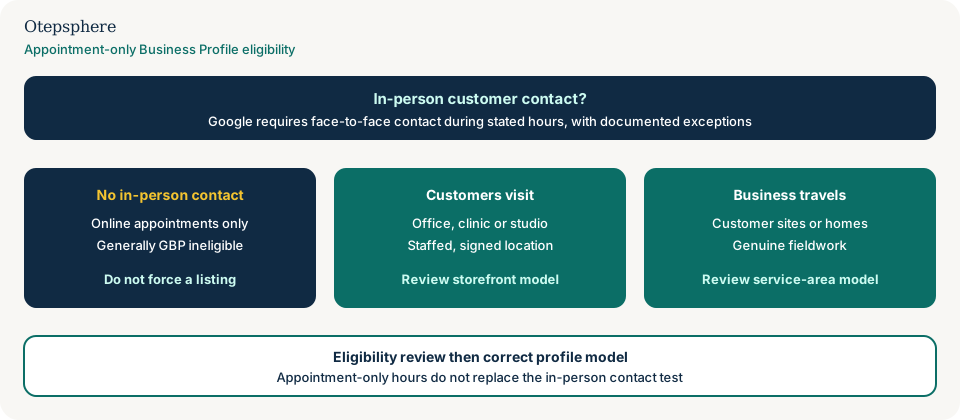
- Customers meet you in person, or they do not. Remote-only work stops here.
- If they visit, the address is a real operating location with access during stated hours.
- If they do not visit and you travel, the profile is a service-area listing with a hidden address where required.
- Hours are not advertised as walk-in when arrival requires a booking.
- The website, booking tool and profile describe the same access model.
- No extra listing exists for a mailbox, unused home office or city you do not occupy.
What not to assume
- That “appointment only” automatically qualifies a business.
- That “appointment only” automatically disqualifies a business.
- That a professional title — therapist, lawyer, consultant — is proof of a customer-facing location.
- That a home address on Companies House, the SEC filing or a domain WHOIS record is a storefront.
- That publishing 9-to-5 hours will make Google treat the office as more complete.
What not to do
- Do not create a Maps pin for a fully remote practice.
- Do not show a home or mailbox address as if clients can walk in.
- Do not invent a service area to bypass the online-only rule.
- Do not copy a competitor’s walk-in hours when your diary is booking-only.
- Do not create a second profile after a verification failure without diagnosing the first one.
Practical action plan
- Write down where in-person contact happens, if it happens at all.
- Choose storefront, service-area or ineligible before you touch the profile.
- Align hours, address visibility, website copy and booking instructions on the same day.
- Verify only the profile that matches the real model.
- Search Maps afterwards for a leftover listing that still shows walk-in hours or the wrong address.
When professional help makes sense
Help is useful when the operation sits on the boundary: a studio that sees clients two days a week, a consultant who sometimes visits sites, or a clinic that is appointment-only at a shared building. It is not useful if the brief is to place a pin on Maps for a business that never meets anyone in person.
No consultant can legitimately guarantee eligibility or verification. Google decides against its current guidelines.
Sources and further reading
- Google Business Profile Help: Business eligibility and ownership guidelines
- Google Business Profile Help: Guidelines for representing your business on Google
- Google Business Profile Help: Overview of Google Business Profile policies
- Google Business Profile Help: Verify your business on Google
Unsure whether an appointment-only business qualifies?
Otepsphere can review how the business actually interacts with customers and help identify whether the setup more closely matches a storefront, service-area business or online-only operation.
Contact OtepspherePublished by Otepsphere
Published by Otepsphere, founded by Joseph Enmanuel. Learn about Otepsphere and its approach to local SEO.