Can a ghost kitchen have a Google Business Profile?
It depends which entity you mean. The terms are not interchangeable.
- Virtual kitchen / ghost kitchen: a production space that prepares food, often without a public dining room.
- Delivery-only food brand: a customer-facing food brand that sells through delivery and does not offer pickup.
- Shared kitchen facility: the building or operator that houses one or more brands.
Google’s representation guidelines have a dedicated “Virtual food brands” section. Delivery-only brands operating out of virtual kitchens are permitted if they have distinct branded packaging and a distinct website. Multiple virtual brands at one location are permitted with additional verification. The facility that houses those brands may have its own separate profile. Source: Guidelines for representing your business on Google.
Eligibility help also lists delivery-only food services as a documented exception to the usual in-person contact rule, and points to those virtual-food-brand conditions. Source: Business eligibility and ownership guidelines.
A generic restaurant listing guide does not answer this. The question is which brand, which fulfilment model, and which address visibility rule applies.
What does Google require for a delivery-only food brand?
Google currently requires distinct branded packaging and a distinct website. Delivery-only brands must add their service areas and hide the address on the Business Profile so customers are not sent to a kitchen they cannot visit.
Multiple virtual brands operating from one location are permitted, but they are subject to additional verification steps. If a food brand authorises the virtual kitchen as a verified provider, the kitchen may manage that brand’s profile once authorisation is confirmed.
Google does not publish a longer official packaging or website checklist. Do not invent extra requirements such as a minimum order volume or a particular aggregator. Use the documented conditions, then keep the menu information accurate for what that brand actually sells.
Should a delivery-only brand show the kitchen address?
No. Delivery-only brands must hide the address and add service areas.
Google’s wording is that this avoids confusing customers. A pin on a closed production kitchen sends people to a door they cannot use. Set the service area for that specific brand, not a fabricated city-wide coverage map.
What if customers can collect food?
Then the brand is not delivery-only, and the co-located pickup rules apply.
Food brands that are co-located each must have permanent separate signage. They should display their address only if they offer pickup to all customers. A brand that offers pickup to some people and hides the address from others is mixing two models.
If pickup exists, customers need to find the correct door. Separate signage is how Google currently expects those brands to remain distinct at the same kitchen.
Can several virtual brands operate from one kitchen?
Yes, under the current virtual-food-brand rules, with additional verification.
Each brand still needs to be a genuine distinct food business, not a duplicate name for the same menu. Shared staff and a shared cook line do not automatically make the brands the same listing, and they do not automatically make every menu name eligible.
Can the kitchen facility itself have a profile?
Yes. Google currently says the facility that houses delivery-only brands is permitted to have its own separate Business Profile. Only someone affiliated with the facility can claim and verify that profile.
The facility profile represents the kitchen operator, not each food brand. Do not put a brand’s menu on the facility listing, and do not put the facility’s name on a brand listing.
Can all virtual brands use the same website?
Not if they are delivery-only brands seeking their own profiles. Google currently requires a distinct website for those brands.
A single landing page that lists every kitchen brand as tabs is not the same as a distinct website for each brand. If several brands share one domain, each brand still needs a URL that represents that brand rather than a generic kitchen homepage. Google does not define “distinct website” beyond that phrase. Do not assume a subdirectory is automatically enough or automatically forbidden.
What if Google marks the profiles duplicate?
Treat it as a duplicate diagnosis, not as permission to create a third brand profile.
Same-address food brands are a common reason Google groups listings. Follow how to diagnose a duplicate Google Business Profile and gather evidence that each brand is a distinct customer-facing food business, including packaging, website and, where pickup exists, signage.
What if several brands share one address?
Sharing a kitchen address is expected for this model. Each listing still has to be independently eligible.
For the broader same-address problem outside food brands, see whether two businesses at the same address can have separate profiles. Virtual food brands have extra, food-specific rules on top of that.
Virtual food brand decision tree
Pickup available
Co-located pickup rules Permanent separate signage. Show the address only if pickup is offered to all customers.Delivery only
Hide address, set service area Distinct branded packaging and a distinct website are currently required.Several brands, one kitchen
Additional verification Multiple virtual brands at one location are permitted with extra steps.Kitchen facility
Separate facility profile Only someone affiliated with the facility can claim that profile.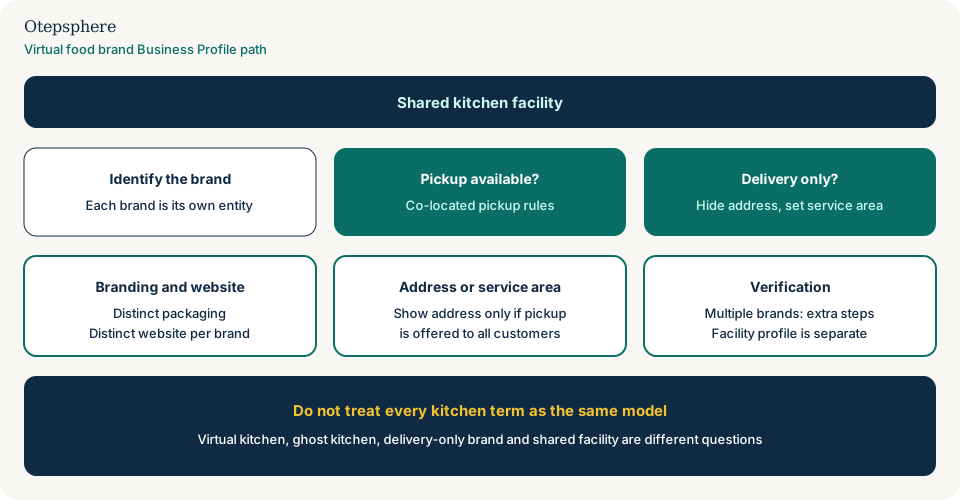
- Each brand is a real food business, not only an aggregator nickname.
- Delivery-only brands have distinct packaging, a distinct website, a service area and a hidden address.
- Pickup brands have permanent separate signage and show the address only if pickup is offered to all customers.
- The kitchen facility listing, if it exists, is claimed by someone affiliated with the facility.
- No extra profile was created after a duplicate or verification problem.
If verification fails, diagnose the brand’s eligibility facts before retrying. See why verification fails.
What not to assume
- That any menu name on a delivery app is an eligible Business Profile.
- That a shared kitchen automatically allows unlimited brand listings.
- That showing the kitchen address helps delivery-only customers.
- That one website can represent every delivery-only brand.
- That the facility operator can claim a brand it is not authorised to represent.
What not to do
- Do not list a delivery-only brand as a dine-in restaurant.
- Do not create a second profile after Google marks the first as duplicate.
- Do not reuse one set of photos and one website for brands you are presenting as distinct.
- Do not invent a service area the brand does not actually deliver to.
- Do not treat this page as advice for a conventional restaurant with a dining room.
Practical action plan
- List each brand, its fulfilment model (delivery-only, pickup, or both), and its website.
- Compare each brand with Google’s current virtual-food-brand wording.
- Set address visibility and service areas to match that model.
- Prepare packaging, signage and verification evidence only for brands that meet the conditions.
- Search Maps for existing kitchen and brand listings before creating more.
When professional help makes sense
Help is useful when several brands already share a kitchen, websites overlap, or Google has marked listings as duplicates. It is not useful if the brief is to manufacture extra Maps pins for the same menu.
No consultant can guarantee that Google will accept every virtual brand. Additional verification still applies.
Sources and further reading
- Google Business Profile Help: Guidelines for representing your business on Google
- Google Business Profile Help: Business eligibility and ownership guidelines
- Google Business Profile Help: Get started with a Business Profile for your restaurant
- Google Business Profile Help: Resolve duplicate profiles and ownership issues
Running multiple food brands from one kitchen?
Otepsphere can review the business structure, websites and Business Profiles to help identify how each real food brand should be represented.
Contact OtepspherePublished by Otepsphere
Published by Otepsphere, founded by Joseph Enmanuel. Learn about Otepsphere and its approach to local SEO.