Can two companies use the same address on Google?
Yes. Two or more eligible businesses at the same address can each have their own Business Profile when they are distinct businesses with different names and clearly visible differences in signage.
Google’s duplicate-help page states that condition explicitly. It includes locations with multiple brands, and it is about two peer businesses, not a shop inside a host venue. Tenant-inside-mall setup is how to list a business inside a shopping centre. departments within other businesses, or individual practitioners at a shared location. Source: Resolve duplicate profiles and ownership issues.
The same page also says you can have only one Business Profile for each business. Sharing an address is allowed. Creating a second listing for the same operation is not.
What makes businesses genuinely separate?
Google currently describes genuine separation at one address as distinct businesses with different names and clearly visible differences in signage, each independently eligible for a Business Profile.
In practice that means:
- A separate real-world business identity, not two labels for the same shop.
- A distinct business name that matches how the operation is known to customers.
- Separate operations: different work, not a second profile for another service of the same company.
- Signage that clearly shows both businesses when both serve customers at the location.
- Independent eligibility: each one still needs in-person customer contact under current rules.
- A customer-facing presence for each listing, not a name on a mailbox.
Do not invent extra tests Google does not publish. The representation guidelines also say that if two brands operate independently at one location, you may use a separate profile for each brand, and you should not combine brand names into a single profile. Source: Guidelines for representing your business on Google. Several delivery-only food brands in one kitchen have extra conditions: virtual kitchen and delivery-only restaurant eligibility.
Start
Two listings, one address Decide whether this is one business or two genuine operations.Same operation
Keep one profile Different services at the same business are not a reason for a second listing.Distinct businesses
Different names and operations Each must still be independently eligible for a Business Profile.Evidence
Visible differences in signage Google may ask for permanent signage that clearly shows both businesses.If marked duplicate
Appeal only when both are eligible and distinct Do not add fabricated suite numbers to force a split.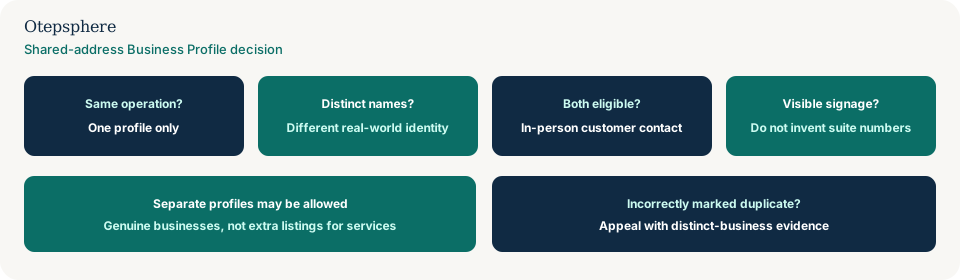
What if both businesses have the same owner?
Ownership alone does not decide whether two listings are allowed. Google’s test is whether they are distinct, eligible businesses, not whether one person owns both.
A holding company can own a cafe and a bookshop in the same building. Those can be separate profiles if they operate as distinct businesses. The same owner running “Smith Plumbing” and “Smith Emergency Plumbing” as two names for one van and one phone is still one business. Departments and practitioners have their own rules — see whether a department should have its own profile and multiple practitioners at the same address.
What if the businesses share a reception area?
A shared reception does not automatically make two listings duplicates, and it does not automatically make them eligible as two profiles.
Google asks for clearly visible differences in signage when both businesses serve customers at the same location. A shared lobby can still contain two signed, staffed operations. A shared desk with one name on the door and a second name only on invoices is weaker evidence of a distinct public-facing business.
What if they share a phone number?
A shared phone number does not by itself prove the listings are duplicates, but it weakens the public evidence that they are separate businesses.
Google’s representation guidelines say to provide a phone number that connects to the individual business location, under the direct control of the business. Two genuine companies can share a switchboard. One company using two profiles and one number to rank twice is a different situation. If Google asks you to show they are distinct, a dedicated number for each operation is often easier for customers and for evidence — that is an operational choice, not a published ranking factor.
What if they share a website?
A shared website does not automatically forbid two profiles, but the site should still make each business easy to identify.
Google asks for a website that represents the individual business location, and says not to use URLs that redirect people to a different business. If both companies live on one domain, each profile should point to a page that is clearly about that business: its name, offer, hours and how to visit. A single homepage that only names one company makes the second listing look like a duplicate. Entity clarity on the site is covered in entity SEO for local businesses.
Why might Google mark one as duplicate?
Google may mark a profile as a duplicate when it believes another profile already represents the same business, including when multiple profiles share the same address.
Documented reasons include an existing verified profile for the same business, the same address on multiple profiles, and multiple profiles for the same business that offer different services. If a profile is considered a duplicate, Google says it will not show on Search or Maps. Source: Resolve duplicate profiles and ownership issues.
Same address is therefore a trigger Google names, not proof that your second company is fake. It is a reason to gather evidence before creating another listing.
What evidence might Google request?
If two distinct eligible businesses were incorrectly merged, Google says to contact support to appeal the duplicate status, and that if both serve customers at the same location you will be asked to provide evidence of permanent signage that clearly shows both businesses.
That is the evidence Google currently documents for this appeal. Do not submit altered documents. Do not assume a utility bill or company registration alone replaces the signage request when both businesses serve customers on site. Source: Resolve duplicate profiles and ownership issues.
What if one profile is incorrectly marked duplicate?
If two distinct, eligible businesses were incorrectly treated as one, appeal the duplicate status through Google’s current support path rather than creating a third profile. The dedicated incorrect-merge workflow is in what to do if Google merged your Business Profile with another business.
First identify which listing still appears publicly. The full duplicate workflow — ownership requests, merges, and when not to delete — is in why a Google Business Profile is marked as a duplicate.
Should I add suite numbers just to separate listings?
No. Do not add fabricated suite numbers, unit labels or “suite B” text to force two listings apart.
Google allows suite, floor and building numbers when they describe the real physical location. Address lines must not include information that does not pertain to the physical location, such as URLs or keywords. A suite number that exists on the lease and on the door is a fact. A suite number invented for Maps is a representation problem.
What not to assume
Do not assume that two legal entities automatically get two Maps pins. Do not assume that one owner forbids two listings. Do not assume that sharing a receptionist, accountant or website is itself a policy violation. Do not assume Google will split listings because you added extra categories.
What not to do
Practical action plan
- Search Maps by name and by address. Record every listing that could be either business.
- Write one sentence for each operation: what it is, who visits, and how it is signed.
- If they are the same business, keep one profile and list services there.
- If they are distinct and eligible, align names, hours, websites and signage with the real world.
- If Google marked one as duplicate incorrectly, appeal with the signage evidence Google currently asks for.
- Wait for Google’s decision before opening another profile for the same place.
Shared Address GBP Checklist
- Each listing is a distinct business, not a second service of the same operation.
- Each name matches real-world branding, without extra keywords.
- Each business independently meets current eligibility rules.
- Permanent signage clearly shows both businesses when both serve customers on site.
- Suite or unit numbers, if used, exist in the real building — they were not invented for Google.
- Website pages identify each business rather than collapsing them into one unnamed brand.
- You know which profile still appears publicly before you remove, merge or appeal.
When professional help makes sense
Help is useful when a shared building contains several similar names, when a merge could combine the wrong two companies, or when the website still describes only one of the businesses. Nobody can guarantee that Google will restore a listing it marked as a duplicate.
Sources and further reading
- Google Business Profile Help: Resolve duplicate profiles and ownership issues
- Google Business Profile Help: Guidelines for representing your business on Google
- Google Business Profile Help: Business eligibility and ownership guidelines
Managing two genuine businesses from one address?
Otepsphere can review the business structure, profiles, website information and duplicate risk before profile changes are made.
Contact OtepspherePublished by Otepsphere
Published by Otepsphere, founded by Joseph Enmanuel. Learn about Otepsphere and its approach to local SEO.