What is an individual practitioner?
An individual practitioner is a public-facing professional, typically with their own customer base. Google names doctors, dentists, lawyers, financial planners, and insurance or real estate agents as examples.
Practitioner profiles may include a title or degree, such as Dr., MD, JD, Esq. or CFA. Sales associates or lead-generation agents for corporations are not individual practitioners and are not eligible for a Business Profile. Source: Guidelines for representing your business on Google.
Accountants and similar public-facing professionals sit in the same pattern even when Google’s example list uses other titles: the test is a public-facing role and a customer base, not a job title you wish to rank.
Who qualifies for their own Business Profile?
A practitioner should create a dedicated Business Profile if they operate in a public-facing role and can be contacted directly at the verified location during stated hours.
Those two conditions are Google’s current wording. A dentist who takes their own bookings qualifies. A hygienist who is not offered as a separately bookable professional usually does not. A lawyer who can be reached at the office during the hours on the profile qualifies. A file clerk does not. Source: Guidelines for representing your business on Google.
Several practitioners
Create a location profile plus a name-only practitioner profile The practitioner title should not include the organisation name.Solo branded practitioner
Use one profile named Brand: Practitioner That is Google’s format when one public-facing professional represents a branded organisation.Specialities
Do not create a second profile for each speciality One practitioner still has one profile.Risk
Too many ineligible profiles confuse customers and split reviews This is a structure decision, not a ranking tactic.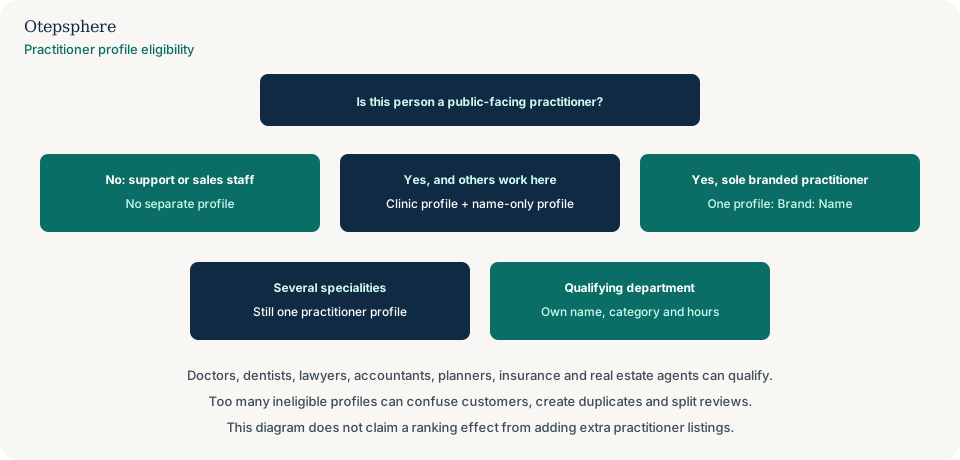
Should support staff have profiles?
No. Support staff should not create their own Business Profiles.
Google states that directly. Receptionists, practice managers, nursing support, paralegals who are not public-facing practitioners, and corporate sales associates are not a reason for extra pins. Putting their names on Maps does not make the clinic easier to understand. It creates listings customers cannot book.
What if several doctors work in one clinic?
If several public-facing practitioners work at one location, each qualifying practitioner may have a profile in their own name, and the organisation should also have a profile for the location.
Google’s multiple-practitioner rule is: the organisation should create a Business Profile for the location, separate from that of the practitioner, and the practitioner title should include only the practitioner’s name, not the organisation name. Source: Guidelines for representing your business on Google.
That structure lets a patient search for the clinic or for a named doctor. It is not a licence to publish a profile for every employee on the payroll.
Should the clinic also have a profile?
Yes, when more than one public-facing practitioner works at the location. The organisation profile represents the place; practitioner profiles represent the people who can be contacted there.
Departments are a related but different rule. A publicly facing department that operates as a distinct entity may have its own page, with a different name and a different representative category from the main business. Typical examples in Google’s help include a hospital dermatology department or a store vision centre, not the hot-food bar inside a supermarket. Do not treat every room in the building as a department. Source: Guidelines for representing your business on Google.
How should practitioner profiles be named?
When several practitioners share a location, the practitioner profile title should include only the practitioner’s name and should not include the organisation name. Titles or degrees are allowed.
Acceptable examples follow Google’s pattern: “Dr. Ana Reyes, MD” rather than “City Dental — Dr. Ana Reyes Invisalign.” Category choice still describes what the person is, not every treatment they offer. Category method is in how to choose Google Business Profile categories.
Can one practitioner create separate profiles for each speciality?
No. A practitioner should not have multiple Business Profiles to cover all of their specialisations.
Google states that rule in the same practitioner section. One doctor who also offers cosmetic treatments still has one practitioner profile. List additional services on that profile or on the clinic profile. Creating “Jane Chen Dermatology” and “Jane Chen Aesthetics” at the same desk is the service-split pattern Google already treats as a duplicate risk for ordinary businesses.
What if one practitioner is the only public-facing professional?
If a practitioner is the only public-facing practitioner at a location and represents a branded organisation, Google says it is best to share one Business Profile named in the format Brand: Practitioner.
The documented example is “Allstate: Joe Miller” when Joe is the sole public-facing practitioner at that Allstate-branded location. Do not create both an organisation listing and a person listing for the same sole practitioner if that is the situation Google describes. Source: Guidelines for representing your business on Google.
What problems can too many profiles create?
Too many profiles can confuse customers about whom to call, create duplicate or eligibility issues, and split reviews across listings that all describe the same waiting room.
A patient may review the unfindable hygienist listing instead of the clinic. Two thin doctor listings can be marked as duplicates of the practice. Hours and phone numbers drift. Those are customer and compliance problems. This guide does not claim that extra practitioner profiles improve or harm Map Pack rankings. Google has not published a ranking bonus for creating more pins at one address.
Website architecture should match the same rule: a clinic page, plus practitioner pages only for people who are actually bookable. Local on-page structure is covered in local on-page SEO. If a qualifying practitioner later leaves, that is a departure job, not a “how many profiles” job: what happens to a practitioner profile when they leave a clinic. Real estate agents are among Google’s practitioner examples; the office-versus-property split is whether a sales or leasing office can have a Business Profile.
Practitioner GBP Decision Tree
- Is the person a public-facing professional with a customer base? If not, stop.
- Can the public contact them at this location during the hours you would publish? If not, stop.
- Is the person support staff or a corporate sales associate? If yes, do not create a profile.
- Are there several such practitioners? Create a location profile plus name-only practitioner profiles.
- Is there only one public-facing practitioner for a branded organisation? Use one Brand: Name profile.
- Do not create a second profile for each speciality. Working from more than one office is a different question: whether one practitioner can have Google Business Profiles at multiple locations.
- Do not put the clinic name in the practitioner title when several practitioners share the site.
- Use a department profile only when the department is a distinct, publicly facing entity with its own category — see whether a department should have its own Google Business Profile.
- Search Maps for existing duplicates before you add listings.
- Keep website practitioner pages aligned with the people who actually qualify.
When professional Local SEO assistance makes sense
Help is useful when a clinic already has a mix of staff listings, department listings and a location listing, or when the website and Maps tell different stories about who can be booked. It cannot make support staff eligible, and it cannot promise a ranking gain from extra profiles.
Official Google sources
- Guidelines for representing your business on Google
- Resolve duplicate profiles and ownership issues
- Edit your Business Profile
Managing several professionals at the same location?
Otepsphere can review the Business Profile structure, practitioner eligibility and website architecture to help avoid unnecessary duplicates and customer confusion. Eligibility is set by Google’s current guidelines, not by how many listings a clinic would like to have.
Contact OtepspherePublished by Otepsphere
Published by Otepsphere, founded by Joseph Enmanuel. Learn about Otepsphere and its approach to local SEO.