Can an estate agency or leasing office have GBP?
Yes, a genuine customer-facing sales or leasing office may qualify if it independently meets current eligibility and representation rules.
Google’s eligibility help lists rental or for-sale properties such as vacation homes, model homes or vacant apartments as ineligible, then states that sales or leasing offices are eligible for verification. Source: Business eligibility and ownership guidelines.
An estate agency that receives clients at a staffed office during stated hours is that office entity. It is not a pin for each house on the books. For the holiday-home version of the property question, see whether a vacation rental can have a Business Profile.
Why are individual properties treated differently?
A property is inventory. An office is an operating business location.
Customers interact with an agency or leasing team. They inspect a house. Those are different entities. Google’s ineligible examples are the places themselves — vacant apartments, model homes, vacation homes — not the staffed office that sells or lets them.
Can a model home have a Business Profile?
Generally no. Google currently names model homes among ineligible rental or for-sale properties.
A furnished display unit is still a property. If buyers meet staff at a separate sales office on the same development, review the office, not the show home. Do not rename the model home as an office to pass verification.
Can the sales office for a development qualify?
It may, when it is a real customer-facing office and not only a weekend gazebo or a vacant show unit.
Apply the same location tests as any other office: precise address, in-person contact during stated hours, and permanent signage if the address is shown. Source: Guidelines for representing your business on Google.
A sales office that moves every few weeks with the build programme may instead be a temporary presence. If verification fails, diagnose eligibility before creating another development pin. See why verification fails.
What if the office is temporary?
A short-term sales cabin can overlap with temporary-event rules.
Maps place policy lists temporary, one-time events as ineligible. An office that exists only for a launch weekend is closer to that problem than to a permanent agency. An office that will remain for the life of the development, with staff and signage, is closer to an ordinary location. See pop-up and temporary Business Profile eligibility.
Can every housing development have its own profile?
Do not generalise. Eligibility follows the office, not the marketing name of the estate.
A developer with one staffed sales suite can have that office. Creating a profile for every named precinct, stage or unbuilt masterplan produces property-style pins. If two offices are genuinely separate — different staff, different addresses, different customer contact — review each one. If they are two brands on the same desk, start from the same-address rules instead of multiplying listings.
What if the agent is an individual practitioner?
Real estate agents are among Google’s individual-practitioner examples. Practitioner rules then apply.
A public-facing agent who can be contacted at a verified location during stated hours may have their own profile. Support staff and lead-generation agents for a corporation are not individual practitioners. See multiple practitioners at one location.
What if agents work from the same office?
Shared occupancy does not automatically create one profile per desk, and it does not forbid eligible practitioner listings.
The organisation can have a location profile. Each additional practitioner listing still needs a public-facing role and contactability at that location. Do not create a profile for every licensed person who sometimes uses a hot desk. Do not put the agency name into the practitioner’s profile title when they are one of several public-facing agents at the site.
Should property listing pages be location pages?
No. Property inventory pages and business-location pages serve different intents.
A listing page answers “what is this house, and is it available?” A location page answers “how do I contact this office or agency?” Turning every sold or let property into a Local SEO location URL creates thin, time-limited pages that compete with the real office. Use when to build location pages for genuine premises, not for stock.
Real estate eligibility matrix
Property or model home
Generally ineligible Inventory and display units are not the business.Sales or leasing office
Review office eligibility Staffed, customer-facing, independently meeting current rules.Agency or individual agent
Organisation or practitioner rules Agents who share one office still need contactability at that location.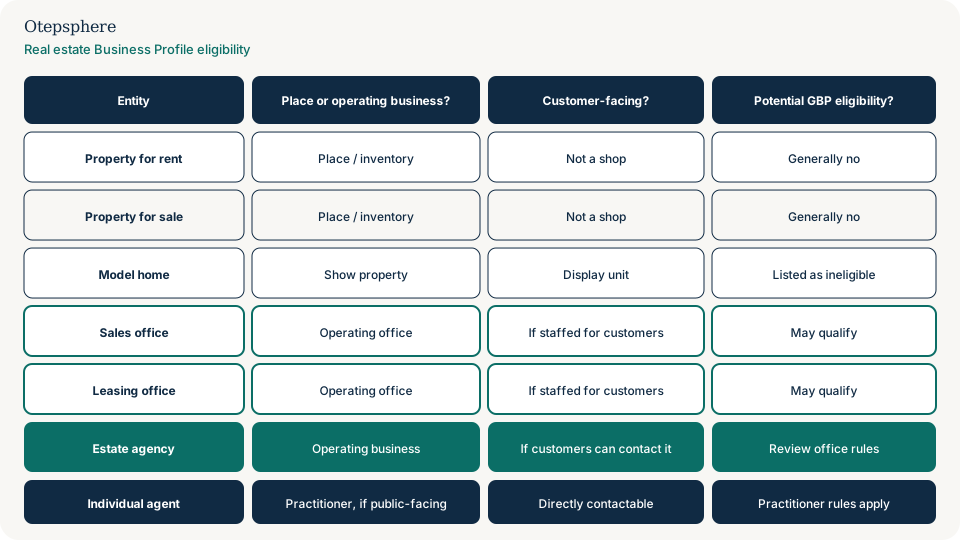
| Entity | Place or operating business? | Customer-facing? | Potential GBP eligibility? |
|---|---|---|---|
| Property for rent | Place / inventory | Not a shop | Generally no |
| Property for sale | Place / inventory | Not a shop | Generally no |
| Model home | Show property | Display unit | Listed as ineligible |
| Sales office | Operating office | If staffed for customers | May qualify |
| Leasing office | Operating office | If staffed for customers | May qualify |
| Estate agency | Operating business | If customers can contact it | Review office rules |
| Individual agent | Practitioner, if public-facing | Directly contactable | Practitioner rules apply |
What not to assume
- That every listing on the agency website needs a Maps pin.
- That a model home is a sales office because staff sometimes sit in the kitchen.
- That a development name is a business location.
- That every licensed agent at a desk needs a practitioner profile.
- That this page answers holiday-rental property eligibility. That is a separate guide.
What not to do
- Do not create a Business Profile for each property for sale or rent.
- Do not list a model home as the company office.
- Do not turn sold-stock URLs into location pages.
- Do not create a second office listing after a verification failure without a diagnosis.
- Do not move a permanent agency pin to a weekend launch tent.
Practical action plan
- Write down the entities: properties, model homes, offices, agency brand, individual agents.
- Compare each with Google’s current property versus sales-or-leasing-office wording.
- Create or update listings only for offices or practitioners that independently qualify.
- Keep property URLs as inventory. Keep office URLs as location pages.
- Search Maps for leftover house pins before adding anything.
When professional help makes sense
Help is useful when a developer, agency and several agents already have overlapping listings, or when inventory URLs have been built as if they were branches. It is not useful if the brief is to pin every house on the market.
No consultant can guarantee that Google will accept an office or practitioner profile.
Sources and further reading
- Google Business Profile Help: Business eligibility and ownership guidelines
- Google Business Profile Help: Guidelines for representing your business on Google
- Google Business Profile Help: Overview of Google Business Profile policies
Unsure whether a property, sales office or agent is the correct Google entity?
Otepsphere can review the real-world business structure before additional Business Profiles are created.
Contact OtepspherePublished by Otepsphere
Published by Otepsphere, founded by Joseph Enmanuel. Learn about Otepsphere and its approach to local SEO.