Can a temporary event have its own Business Profile?
Generally no. A one-time temporary event is not an eligible permanent Maps place.
Google’s Maps place eligibility policy lists “temporary, one-time events” among ineligible businesses and places. The same page lists seasonal businesses that reopen in the same location as eligible examples. Source: Business and place eligibility.
Business Profile eligibility still requires in-person contact during stated hours, with documented exceptions such as seasonal businesses that display permanent signage year-round. A weekend market stall does not become that exception because it is popular. Source: Business eligibility and ownership guidelines.
What about a two-week pop-up shop?
A short pop-up is still a temporary presence. It is not automatically a permanent business location.
Google does not publish a minimum number of days that turns a pop-up into an eligible storefront. Do not invent one. Judge permanence, whether customers can keep using the place after the dates end, and whether the business already has an eligible location elsewhere.
If the pop-up is the first public appearance of a business that will continue at that address, review it as a new business launch against ordinary location rules — not as an event pin. If the lease ends in a fortnight and the brand returns to its usual shop or to storage, it is a temporary event.
Is a seasonal business the same as a pop-up?
No. A seasonal business may return to a permanent real-world location. A pop-up is usually a short occupation of someone else’s place.
Google currently says seasonal businesses, such as an ice-skating rink open only in winter, are eligible and must display permanent signage at their location year-round. Maps policy also lists seasonal or recurring businesses without a permanent location as ineligible. The dividing line is the permanent place, not the calendar.
For hours, temporarily closed status and off-season website copy, use seasonal business Local SEO. Do not use that page to justify a one-off stall.
What if the pop-up occurs every year?
Recurrence is not enough if there is no permanent eligible location.
A Christmas stall that appears in a different mall each December is still a temporary event. A Christmas tree lot that returns to the same fenced yard, with signage that remains, is closer to the seasonal-business example. Evaluate permanence and current eligibility. Do not assume “we do this every year” creates a Maps place.
Can I use the venue's address?
Not as your permanent business location unless you are eligible to represent that place.
Google lists “an ongoing service, class, or meeting at a location that you don't own or have the authority to represent” among ineligible examples. Claiming a gallery, hotel ballroom or market hall as your storefront misrepresents both businesses. The venue already has, or can have, its own listing.
What if we rent a booth at an exhibition?
A booth is a temporary presence inside another organisation’s facility. It is not your permanent address.
Promote the stand on the existing website and, where you already have an eligible profile, with a Business Profile event post. Do not create a Maps place for stand B14. Do not point the company’s existing pin at the exhibition centre for three days.
What if customers meet us there temporarily?
Temporary customer contact at a venue does not automatically create an eligible location.
People can find you from an event page, a QR code, the venue’s own map, or directions on your site. If the underlying business is relocating for weeks or months, that is a different job: temporary business relocation. A genuine relocation still has to satisfy current address and eligibility rules.
Should I change my existing business address to the event venue?
Generally no, unless the business genuinely relocates and current policy supports that address.
Moving a verified pin to a venue you will leave next week sends regular customers to the wrong door after the event. It can also look like a fake location. Keep the existing eligible address, and tell people about the pop-up somewhere else.
If an address change is later rejected or verification fails, see why verification fails rather than creating an event listing as a workaround.
What should the website do instead?
Carry the information customers need without inventing a Maps place.
- An event page with dates, hours, directions and what to bring or book.
- Event structured data on that page where the event is a public, physical event and current Search documentation applies. Source: Event structured data.
- A Business Profile event post on an existing eligible listing, if you have one. Source: Create and manage posts.
Markup and posts do not guarantee a rich result or a Maps place. They are better tools than creating a Business Profile solely to promote the event.
Temporary versus seasonal decision tree
One-time event
Generally not a Maps place Use the existing website, Event markup where appropriate, and profile posts instead.Recurring seasonal business
Permanent place, seasonal hours Same real-world location that reopens. Year-round signage rules may still apply.Permanent storefront
Ordinary location rules Do not change the existing address to a booth or exhibition venue.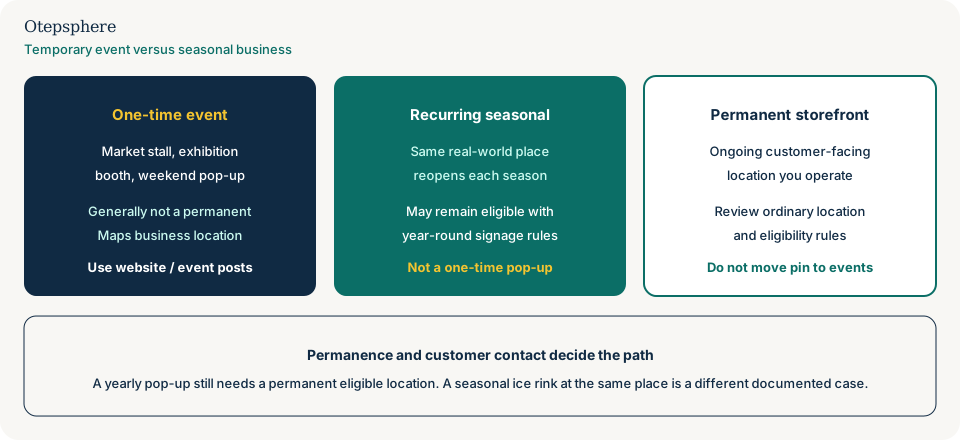
- The activity is classified as one-time event, seasonal return, relocation, or permanent storefront.
- No new Maps place was created only to advertise dates.
- The existing business address was not pointed at a booth or venue.
- The website states when and where customers can actually attend.
- A yearly pop-up was not labelled “seasonal business” without a permanent location.
What not to assume
- That a successful pop-up deserves a permanent pin.
- That repeating an event annually creates eligibility on its own.
- That the venue will not mind being listed as your storefront.
- That Event structured data creates a Business Profile.
- That a two-week lease is automatically a storefront or automatically an event.
What not to do
- Do not create a Business Profile solely to promote an event.
- Do not move an existing pin to an exhibition or market for the duration.
- Do not claim another organisation’s facility as your permanent location.
- Do not mark a one-off stall as a seasonal business to keep it on Maps all year.
- Do not add a second listing if the first address edit is rejected.
Practical action plan
- Write the start date, end date and whether any permanent location remains afterwards.
- Compare that plan with Maps place eligibility and Business Profile seasonal wording.
- If it is a one-time event, build an event page and use an existing profile’s posts if you have one.
- If it is a genuine seasonal return to the same place, follow the seasonal-business guide.
- Search Maps for a leftover event pin after the dates end.
When professional help makes sense
Help is useful when a retailer already has a verified shop and is adding a long concession, or when an event pin already exists and is confusing customers. It is not useful if the brief is to manufacture a Maps place for a weekend stall.
No consultant can guarantee that Google will accept a short-term location.
Sources and further reading
- Maps User Generated Content Policy: Business and place eligibility
- Google Business Profile Help: Business eligibility and ownership guidelines
- Google Business Profile Help: Guidelines for representing your business on Google
- Google Search Central: Event structured data
Running a pop-up or temporary customer location?
Otepsphere can review whether the activity represents an eligible business location or should be promoted through the existing business website and profile instead.
Contact OtepspherePublished by Otepsphere
Published by Otepsphere, founded by Joseph Enmanuel. Learn about Otepsphere and its approach to local SEO.