What does Google consider a department?
Google considers a department a publicly facing part of a business, university, hospital or government institution that operates as a distinct entity, not merely a product section inside the same shop.
Documented acceptable examples include a Walmart Vision Center, a Sears Auto Center, and Massachusetts General Hospital Department of Dermatology. Documented unacceptable examples include the Apple products section of Best Buy and the hot food bar inside Whole Foods Market. Auto dealers have additional, separate guidelines. Source: Guidelines for representing your business on Google.
Other common real-world cases — a pharmacy inside another facility, an independently operated cafe, a university office, a store department — only qualify if they match those distinct-entity rules, not because the word “department” appears on an org chart.
When can a department have a separate Business Profile?
A department can have a separate Business Profile when it is publicly facing, operates as a distinct entity, uses a different exact name, and uses a different most-representative category from the main business and from other departments.
Google says these departments typically have a separate customer entrance, and their hours may sometimes differ from the main business. Each department still has to be eligible for a Business Profile in its own right: in-person contact during stated hours. Source: Guidelines for representing your business on Google.
Does it need a different business name?
Yes. The exact name of each department must be different from that of the main business and that of other departments.
Google also says not to include containment information such as “inside Best Buy” in the name. Use the department’s real-world name, as on signage. “Geek Squad” is the documented acceptable form, not “Geek Squad (inside Best Buy).”
Does it need independent customer access?
Google currently says qualifying departments typically have a separate customer entrance. That is the documented typical pattern, not a sentence that every department without a second door is forbidden.
If customers cannot find or use the department as its own public-facing place — a counter with no identity, an aisle, a back-office function — it is unlikely to fit the distinct-entity test. Do not invent a second doorway on Maps that does not exist in the building.
Does it need separate hours?
Google does not say a department must have different hours. It says hours may sometimes differ, and that each department profile should show that department’s hours while the main profile shows the main business hours.
If the vision centre closes earlier than the store, put those hours on the vision-centre profile. If hours are identical, still keep them accurate on both listings. Do not copy parent hours onto a department that customers cannot use at those times.
Does it need a separate phone?
Google’s department section does not require a unique phone number as a published eligibility test. A number that connects customers to that department is still the useful setup.
Representation guidelines ask for a phone number that connects to the individual business location, under the direct control of the business. A hospital switchboard that cannot reach dermatology is a customer problem. A second profile that exists only to rank a second keyword is a duplicate problem. Source: Guidelines for representing your business on Google.
Should every product or service get its own profile?
No. Different services at the same business should be listed on one Business Profile, not split into extra listings.
Google names “different services” as a reason profiles are marked duplicate, and says not to create separate profiles for each service. Source: Resolve duplicate profiles and ownership issues. The duplicate workflow is in why a Google Business Profile is marked as a duplicate.
Department vs additional category
An additional category describes more about one business. A department profile is a second listing for a distinct public-facing entity with a different name and a different most-representative category.
Google’s category help says not to use categories that pertain to another business contained in yours. A supermarket should not add Pharmacy as a category if the pharmacy is a separate operated business with its own profile. Conversely, adding “Auto Repair Shop” to a dealership is not the same as creating a service-department listing that meets department rules. Category choice is in how to choose Google Business Profile categories.
Google also lists co-located businesses that should each have their own profile rather than combining categories, including a restaurant inside a hotel, a pharmacy inside a supermarket, and a gas station next to a supermarket. Those are often independently branded operations, not aisles.
Department vs practitioner
A department is an organisational unit. A practitioner is a public-facing professional, such as a doctor or lawyer, who can be contacted at the location.
Support staff should not create practitioner profiles. A practitioner should not create multiple profiles for specialisations. Several practitioners at one site is a different Google section from departments. Use whether multiple professionals at the same address should have separate profiles. One professional working at more than one office is a third case: whether one practitioner can have Google Business Profiles at multiple locations.
What if the department is independently operated by another company?
If another company owns and operates the unit — a branded cafe inside a store, a pharmacy chain inside a supermarket — treat it as a separate eligible business at the same address, not as a category on the host’s listing.
The host should not claim the tenant’s category. The tenant needs its own name, eligibility and, where Google asks, signage. Shared-address rules are in two businesses at the same address. A tenant inside a mall or host venue, rather than a department of the same brand, is covered in Business Profile setup inside a shopping centre.
Department GBP Decision Tree
Start
Is this a department or a service? Extra services at the same business belong on one profile.Public-facing
Can customers use it as its own entity? Support desks and product aisles generally do not qualify.Identity
Different name and representative category The department name must differ from the parent and from other departments.Operations
Typically separate customer access Hours may differ. Independently operated businesses inside a site are a related case.Decision
Create a department profile only when Google’s current rules fit Otherwise keep one listing and use additional categories or services.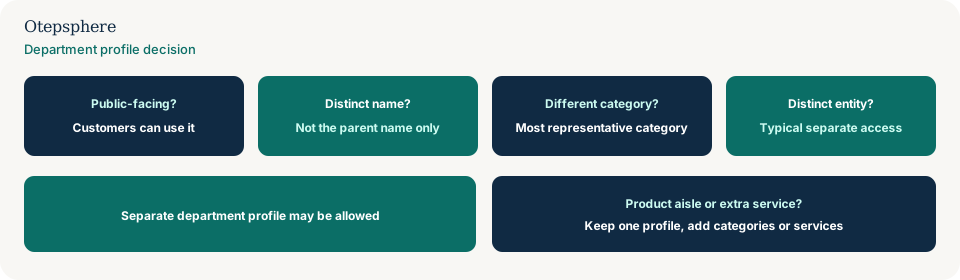
What not to assume
Do not assume every hospital ward, university team or store section qualifies. Do not assume a second category is a second profile. Do not assume a separate phone is a published Google requirement. Do not assume “typically a separate entrance” means you should draw a second door on the map.
What not to do
Practical action plan
- List each candidate against Google’s acceptable and not-acceptable examples.
- Confirm distinct name, distinct representative category, and public-facing operations.
- Put department hours on the department profile and parent hours on the parent profile.
- Point each listing at a website page that is actually about that entity.
- If it is only a service of the same business, keep one profile and list services there.
- If Google marks a genuine department as a duplicate, appeal with current evidence rather than creating a third listing.
When professional help makes sense
Help is useful for hospitals, campuses, dealers and mixed-use sites with several similar names. It cannot guarantee Google will accept a department profile.
Sources and further reading
- Google Business Profile Help: Guidelines for representing your business on Google
- Google Business Profile Help: Resolve duplicate profiles and ownership issues
- Google Business Profile Help: Business eligibility and ownership guidelines
Unsure whether departments at your location need separate profiles?
Otepsphere can review the real business structure, Business Profiles and website architecture before duplicate listings are created.
Contact OtepspherePublished by Otepsphere
Published by Otepsphere, founded by Joseph Enmanuel. Learn about Otepsphere and its approach to local SEO.