What does concurrent access mean?
It means two agencies (or an agency and an in-house team) can edit the same profile, titles or citations at the same time, so one “fix” undoes the other.
Typical pattern: the listing hours flip twice in a week; titles bounce between two templates; each vendor reports the other as the problem. The job is one writer per asset, not a second strategy deck.
Is this an agency handover?
Only when one vendor is leaving and the job is transferring ownership and a baseline.
Use what to do when you change Local SEO agency for a planned exit. Stay here when both vendors still have write access and are changing the same fields.
Is this recovering from bad work?
Use recovery when harmful work already shipped and you need an evidence-based cleanup.
Diagnose that on how to recover from bad Local SEO work. Stay here when the immediate problem is two live writers, not leftover doorway pages or fake listings.
Who
Who has write access today? CMS, Search Console, Business Profile, citations.What
Which fields did each vendor change? Hours, titles, categories or links.Conflict
Did one change undo the other? Two “fixes” on the same listing often cancel.Sibling
A planned handover is different Use the agency-handover guide when one vendor is leaving.Next
Do not treat a second agency as insurance Give one party write access.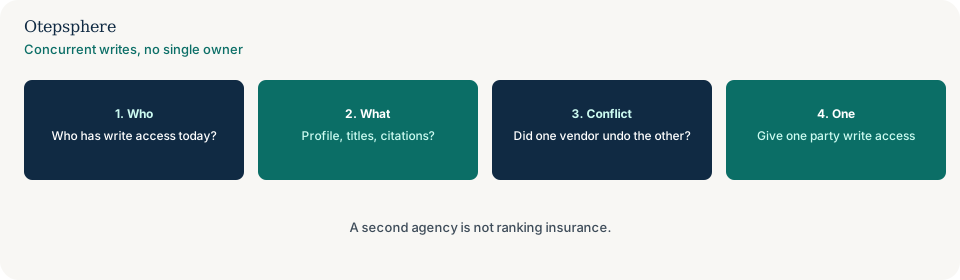
Who should have write access?
One party for the Business Profile, one party for production website SEO fields — they may be the same person. Everyone else can have read-only or request access.
Representation guidelines still expect accurate, consistent public facts. Source: Guidelines for representing your business on Google. A second writer is not ranking insurance. Do not add another listing so each vendor “has something to edit.”
How do you stop the next undo?
Write access plus a change log: who changed hours, titles or citations, and when. Website and listing each need a place to record the edit.
Use the website change log and website and profile teams falling out of sync once only one writer remains. Unused recommendations from either vendor are an implementation gap, not a reason to keep two writers.
Concurrent-vendor decision table
| What you see | What it usually means | Decision | What not to assume |
|---|---|---|---|
| Hours or titles flip twice a week | Two writers on one asset | Remove write access from one party | That a second agency is ranking insurance |
| One vendor is leaving | Handover | Use the agency-handover guide | That keeping both logins is safer |
| Doorway pages already live | Inherited harm | Use the recovery guide | That two writers will clean it faster |
| Site and listing disagree after each vendor | Two teams, two notes | Use the site-versus-profile sync guide | That a third vendor will reconcile them |
What should I not do?
Action checklist
- Export who can edit CMS, Search Console, Analytics and the listing.
- Ask each vendor for this month’s changes.
- Give one party write access; convert the other to read-only.
- Start a change log for the next edit.
- If one vendor is leaving, switch to handover.
- If harmful work already shipped, switch to recovery.
When professional help makes sense
Help is useful when both vendors still bill for the same listing and nobody will drop write access. It cannot promise that a single writer will raise rankings.
Sources and further reading
- Google Business Profile Help: Guidelines for representing your business on Google
- Google Search Central: SEO starter guide
Two vendors undoing each other on the same listing?
Otepsphere can put one writer on each asset — without treating a second agency as ranking insurance.
Contact OtepspherePublished by Otepsphere
Published by Otepsphere, founded by Joseph Enmanuel. Learn about Otepsphere and its approach to local SEO.