Why are fake positives still a problem?
High stars do not make fake engagement allowed. Content that was posted to manipulate a rating can still violate Maps policy and can still mislead customers.
A previous vendor may have sold “review packages,” used multiple accounts, or written the text themselves. The listing can look healthy while the business is exposed to a restriction. Google can restrict new reviews, unpublish existing ones, or show a warning when it finds policy violations by the business. Source: Business Profile restrictions for policy violations.
How is this different from malicious reviews?
Incoming fake or abusive reviews are often negative and aimed at the business. Inherited fake positives were added to inflate the rating, usually by someone the business paid or authorised.
Both can be policy-violating. The evidence, the vendor conversation, and the temptation to “replace” the stars are different. Reporting a competitor attack and handling a genuine complaint cluster is covered in what a business can do about fake or malicious Google reviews and how to respond to a sudden spike in negative reviews. This page is the handover: stop the vendor practice, document it, report violating items, rebuild with real customers.
Stop
Is anyone still posting? Revoke access. Stop paying for “review packages.”Policy
Does it match fake engagement? Paid reviews, multiple accounts, or content at one person’s request are prohibited.Report
Flag even when the rating is five stars Google removes content that violates policy, not only negative comments.Yes
Watch for a review restriction Appeal through the official process. Do not create a replacement profile.Next
Do not buy replacements That repeats the same violation.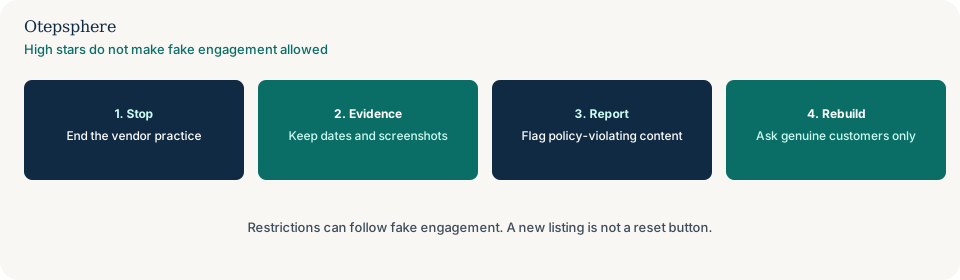
What does Google prohibit?
Fake engagement, paid reviews, and content posted from multiple accounts at one person’s request are prohibited on Google’s current Maps user-generated content policy.
The same page covers incentives, conflict of interest, on-premises pressure, review quotas, and requesting specific review content. Five stars do not create an exception. Source: Prohibited and restricted content. How to flag content is in Google’s reporting help: Report a review.
What should you stop immediately?
End any remaining review-buying, revoke access for people who should not manage the listing, and stop paying for “ratings growth” packages.
Agency handover should already have put the business as primary owner. If the vendor still has manager access, remove it after you control ownership. That sequence is in how to change Local SEO agency without losing access. Keep screenshots of invoices or chat that describe review posting. Do not publish those files in a review reply.
Should you report five-star content?
Yes, if it appears to violate policy. Google’s tools are for policy-violating content, not only for one-star attacks.
Report item by item. Do not write a public reply that calls named people frauds. Google decides what to remove. Do not assume every five-star review from the agency period is fake — some customers may have posted honestly in the same window. The reporting process for incoming abuse is also on fake or malicious Google reviews; use it for classification, then apply it to positives that look fabricated.
What if Google restricts the profile?
Follow the official restriction notice and appeal path. Do not create a replacement Business Profile to collect a “clean” rating.
A new listing is not a reset button and can create a duplicate-profile problem. If reviews later vanish after a restriction or reinstatement, use why Google reviews disappear or stop showing. Rebuild with genuine customers only: how to get more Google reviews ethically.
Inherited fake-positive decision table
| What you see | What it usually means | Decision | What not to assume |
|---|---|---|---|
| Vendor invoices for “review packages” | Likely fake engagement | Stop payment and access; keep evidence; report violating posts | That high stars make the practice allowed |
| Generic five-star text, no visit details, clustered dates | Possible coordinated posts | Report those items; leave genuine-looking reviews unless they also violate policy | That Google will remove every review from that year |
| Restriction email after you take over | Google may have found a policy issue | Appeal through the official process; do not open a second listing | That a consultant can guarantee reinstatement |
| Plan to buy “better” reviews to look natural | Repeating the violation | Do not. Ask real customers ethically instead | That replacements will hide the history |
What should I not do?
Action checklist
- Revoke vendor access once the business is primary owner. Stop any remaining paid review work.
- Save private screenshots, dates, Maps URLs and any written description of the old practice.
- Report reviews that appear to be fake engagement, including five-star posts.
- Watch for a restriction notice. Appeal only through Google’s official path if one exists.
- Start an ethical request process for real customers. No incentives, gating or insider reviews.
- If reviews disappear after a restriction or merge, follow the missing-review checks.
When professional help makes sense
Help is useful when ownership, evidence and a restriction notice are tangled, or when you cannot tell which reviews look fabricated versus genuine. It cannot guarantee that Google will remove inherited posts, and it will not replace them with bought ratings.
Sources and further reading
- Maps User Generated Content Policy: Prohibited and restricted content
- Google Business Profile Help: Report a review
- Google Business Profile Help: Business Profile restrictions for policy violations
- Maps User Generated Content Policy: Report or fix content
A previous agency left fake five-star reviews?
Otepsphere can help separate inherited fake engagement from genuine customer reviews and set a policy-safe rebuild — without promising that Google will delete specific posts.
Contact OtepspherePublished by Otepsphere
Published by Otepsphere, founded by Joseph Enmanuel. Learn about Otepsphere and its approach to local SEO.