What does an uneven review count mean?
It means one Business Profile has accumulated far more public reviews than other locations in the same brand, usually because demand, staff habits or the request URL are concentrated there.
Google does not publish a rule that review counts must be similar across a chain. A quiet clinic with fewer appointments will not match a flagship that sees walk-ins all day. The useful question is whether the quiet site is failing to ask genuine customers, or whether every request is still landing on the busy listing.
Is this a ranking penalty?
No published Google document treats an uneven review count between branches as a local ranking penalty.
Local results consider relevance, distance and prominence. Prominence can include review information, but Google does not document a quota that each location must hit relative to its siblings. Source: Tips to improve your local ranking on Google. Do not invent a “review gap penalty.” A customer who opens a listing with two old reviews and a sibling with two hundred recent ones may still choose the busy shop. That is a trust decision, covered in whether old reviews with few recent ones matter.
Demand
Does this site see fewer customers? Review volume follows visits and jobs completed, not a brand average.Staff
Who asks, and for which listing? One receptionist with one QR code will fill one profile.Link
Is the URL location-specific? Test each Get more reviews link while signed out.Yes
Give each site its own request path No incentives. No on-site pressure. Same policy at every branch.Next
Do not buy reviews for quiet sites Fake engagement is prohibited even if the stars look helpful.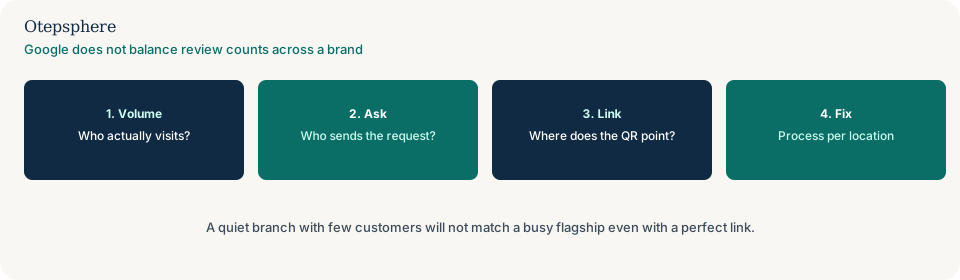
Could request routing be the cause?
Yes. A single shared request link or QR is a common reason quiet locations stay empty.
If every receipt, SMS and “review us” poster uses the flagship URL, almost every completed experience will credit one profile. That is a process problem, not a Maps glitch. Test each location’s official Get more reviews link. The routing process before the customer posts is why customers are sent to the wrong location when asked for a review. How to create that link is in how to get more Google reviews ethically. If the URL itself does not open a review form, diagnose it on why a Google review request link is not working.
Staff who only ask at the busiest till produce the same skew. Google’s policy also forbids review quotas for staff and on-premises pressure. Equalising volume is not an excuse to run a quota at the quiet site. Source: Prohibited and restricted content.
How is this different from a misposted review?
Uneven volume is a count problem across locations. A misposted review is one customer’s text sitting on the wrong genuine listing.
Both can happen at once: a shared QR fills Location A and occasionally dumps Location B’s customers there too. Treat the misposted item with what to do when customers review the wrong location. Do not merge two live branches to average the numbers. Google’s merge help is for profiles that represent the same business. Source: Resolve duplicate profiles and ownership issues.
What should each location actually do?
Give each site its own official request path, ask genuine customers after a completed visit, and keep the same ethical rules at every branch.
Print the correct QR at that site. Train that team to send only their listing’s link. Do not buy reviews for the quiet location, and do not ask staff or family to fill the gap. Insider reviews are a conflict-of-interest problem: whether employees, friends or family may review on Google.
Uneven-volume decision table
| What you see | What it usually means | Decision | What not to assume |
|---|---|---|---|
| Busy site, many visits; quiet site, few visits | Review volume follows customers | Ask at the quiet site after real jobs; accept a lower count if demand is lower | That Google owes every branch the same total |
| Every QR and SMS opens the flagship listing | Shared request routing | Issue a Get more reviews link per location and replace shared materials | That Maps is “stealing” reviews from the quiet shop |
| Quiet-site customers appear on the busy listing | Wrong-location posts | Fix routing; reply on the listing where the review sits | That merging the two shops will share the rating fairly |
| Quiet site never asks anyone | No process | Start an ethical request after completed work, with no incentives or quotas | That a one-week review blast is a safe catch-up |
What should I not do?
Action checklist
- Compare completed jobs or visits per location with review counts. Note sites that never ask.
- Test every Get more reviews URL and printed QR while signed out. Replace any that point at another branch.
- Give each location its own official link and a simple after-visit ask — same rules, no incentives.
- If reviews are landing on the wrong genuine shop, fix that as a mispost, not as a merge.
- Do not run a coordinated burst that looks like unusual review volume.
- Reply on each listing with facts that are true for that site.
When professional help makes sense
Help is useful when many locations share one request path, when staff cannot tell which profile a QR opens, or when duplicate listings sit beside real branches. It cannot equalise review counts across a brand, and it cannot promise that a quieter shop will match a busier one.
Sources and further reading
- Google Business Profile Help: Tips to improve your local ranking on Google
- Google Business Profile Help: Create a Google link or QR code to request reviews
- Maps User Generated Content Policy: Prohibited and restricted content
- Google Business Profile Help: Resolve duplicate profiles and ownership issues
One location collecting almost every review?
Otepsphere can check request links, location setup and staff process across a chain — a diagnosis of routing and volume, not a promise to even out ratings.
Contact OtepspherePublished by Otepsphere
Published by Otepsphere, founded by Joseph Enmanuel. Learn about Otepsphere and its approach to local SEO.