Does recency actually matter?
Yes, as a customer decision. People use dates to judge whether the business still operates as the older reviews describe.
A high average built in 2018 does not tell someone whether the current team, hours or quality still match. Google also notes that a mix of positive and negative reviews can feel more trustworthy than a perfect score. That is a best-practice comment about how people read listings, not a ranking formula. Source: Tips to get more reviews.
Is recency a Google ranking factor?
Google does not document review recency as a separate local ranking lever.
Local ranking guidance names relevance, distance and prominence. Prominence can include review information. That is not the same as a published “freshness score” for review dates. Source: Tips to improve your local ranking on Google. Treat stale dates as a trust and process problem first. Do not rebuild the listing around a recency myth.
Customer
Do recent visitors see only 2019 reviews? People use dates to decide whether the business still operates as described.Rank
Is recency a Google ranking factor? Google documents prominence including reviews. It does not document recency as a separate local ranking lever.Spike
Would a burst look unusual? Rating manipulation includes unusual volumes or patterns of contributions.Yes
Ask real customers again Official link, no incentives, no gating, no on-site pressure.Next
Do not delete old reviews You cannot edit customer text. History stays unless Google removes policy-violating content.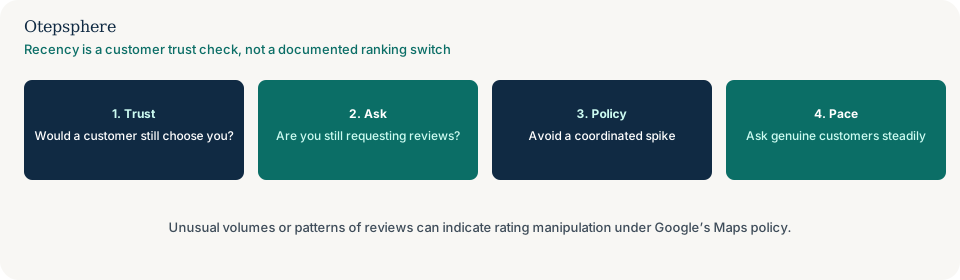
Why is a sudden burst risky?
Unusual volumes or patterns of reviews can indicate rating manipulation under Google’s Maps policy.
A week of dozens of five-star posts after years of silence can look coordinated even if some customers are real. Fake engagement, paid reviews, and content posted from multiple accounts at one person’s request are prohibited. Source: Prohibited and restricted content. Restart asking at a pace that matches real completed work. Do not buy a package to fill the gap. Inherited fake positives from a previous vendor are a different cleanup: what to do if a previous SEO agency added fake positive reviews.
How should you start asking again?
Use the official Get more reviews link, ask after a genuine completed experience, and apply the same ask whether you expect a high rating or not.
Google allows merchants to solicit genuine, unbiased reviews without incentives or attempts to influence the rating or contents. Do not gate the request so only happy customers see the Google link. Do not pressure people on the premises. The full ethical process is in how to get more Google reviews ethically. If the link itself fails, start with why a Google review request link is not working.
What if recent reviews were posted but vanished?
Treat that as a missing-review diagnosis, not as proof that old reviews “expired.”
New reviews can be delayed for policy review. Restrictions can hide reviews. Merges can take time to display combined ratings. Those paths are in why Google reviews disappear or stop showing. You cannot edit or delete a customer’s words to make the listing look newer.
Stale-review decision table
| What you see | What it usually means | Decision | What not to assume |
|---|---|---|---|
| Many reviews, newest is years old, you stopped asking | Process stopped | Restart ethical requests after real jobs, at a steady pace | That Google ranks you down solely for old dates |
| Customers say they posted last month; nothing public | Delay, restriction or wrong listing | Follow missing-review checks; test the request URL | That old reviews expired and knocked the new ones off |
| Plan to post 50 reviews in seven days | Unusual volume pattern | Do not. Ask as work completes. No paid packages | That a burst “resets freshness” safely |
| High average, all from one year, then silence | Customer trust gap | Keep the history; add genuine new reviews over time | That deleting old reviews is possible or useful |
What should I not do?
Action checklist
- Read the listing as a new customer. Note the date of the newest public review.
- Confirm you still have a working official Get more reviews link for this location.
- Ask after completed work, without incentives, gating or on-site pressure.
- Keep the pace tied to real volume. Do not manufacture a short burst.
- If recent posts vanished, use the missing-review checks before assuming the listing is “stale only.”
- Reply to new reviews, including mixed ones. Do not try to edit customer text.
When professional help makes sense
Help is useful when you cannot tell whether reviews stopped because nobody asks, the link is wrong, or a restriction is blocking new posts. It cannot make old reviews look recent, and it cannot promise that restarting requests will change rankings on a timetable.
Sources and further reading
- Google Business Profile Help: Tips to get more reviews
- Google Business Profile Help: Tips to improve your local ranking on Google
- Maps User Generated Content Policy: Prohibited and restricted content
- Google Business Profile Help: Create a Google link or QR code to request reviews
Plenty of old reviews, almost nothing recent?
Otepsphere can help separate a stopped request process from a broken link or a restriction — without a recency ranking claim or a burst campaign.
Contact OtepspherePublished by Otepsphere
Published by Otepsphere, founded by Joseph Enmanuel. Learn about Otepsphere and its approach to local SEO.