Can a business rank in a city where it has no physical address?
Yes, a business can appear for some searches associated with a nearby city without having a street address there, but that is not a promise of Map Pack placement in that city.
Organic Search ranks website pages. A page that honestly explains how you serve people from that city — travel time, parking, which services you honour, whether you visit them — can be relevant when someone searches with that place name. Google Maps and the local pack rank eligible Business Profiles using relevance, distance and prominence. Google currently describes those local results as based mainly on relevance, distance and popularity. Distance is measured from the searcher, or from what Google knows about their location, to the businesses it is considering. A listing based in the next city can still appear, especially when it is more relevant or better known, but geography is not optional. Source: Tips to improve your local ranking on Google.
This is a different problem from ranking across several suburbs you already serve from one real base, and a different problem from measuring a geo-grid. Those jobs are covered in how to rank in multiple suburbs without doorway pages and why local rankings change by location. Ranking for an explicit city name while disappearing on “near me” is a third diagnosis: why city keywords and near-me searches diverge.
Does Google Maps distance matter?
Yes. Distance is one of the three factors Google documents for local results on Maps and Search.
Google’s current wording is that distance refers to how far each business is from the customer who is searching, and that if the customer does not share where they are, Google uses what it knows about their location. Relevance is how well the profile matches the search. Prominence is how well-known the business is, including signals such as links and reviews. Google also states there is no way to request or pay for a better local ranking. Source: Tips to improve your local ranking on Google.
What that means in practice: a clinic five kilometres outside a city centre can still appear for people in that city. A clinic fifty kilometres away is competing against businesses that are closer. Strong relevance and prominence can offset some distance. They do not delete distance.
Does adding a city to my service area make me rank there?
No. Adding a city to your Google Business Profile service area does not control ranking radius and does not place you in that city on the map.
Service areas describe where you will travel to customers. Google’s representation guidelines allow a service-area business one profile for the central office or location with a designated service area. They also say the overall service area should not extend farther than about two hours of driving time from where the business is based, with larger areas only where they are appropriate. That is an eligibility and representation rule, not a ranking switch. Oversized areas you will not honour can create policy and customer-trust problems. Detail is in Google Business Profile for service-area businesses. Source: Guidelines for representing your business on Google.
Do I need an office in the target city?
No. You do not need a second office merely because customers in a nearby city search for your service.
You need an office in that city only if you actually operate a customer-facing location there that meets Google’s current eligibility rules: a real place your staff occupy during stated hours, with permanent signage if you show the address. Opening a second genuine branch is a business decision. It can change Maps geography because you then have a real listing at a new address. It is not required for every nearby-city marketing goal. Multi-location structure is covered in Local SEO for multi-location businesses.
Can I rent a virtual office?
No. A virtual office used as a fake storefront is not eligible for a Google Business Profile.
Google currently says that if a business rents a physical mailing address but does not operate out of that location — also known as a virtual office — that location is not eligible. P.O. boxes and remote mailboxes are also not acceptable addresses. Service-area businesses cannot list a “virtual” office unless that office is staffed during business hours. Source: Guidelines for representing your business on Google.
Can I use a coworking location?
Only when the coworking space is a genuine staffed office that meets Google’s current eligibility requirements, not when it is a mail-drop or an unused desk used as a pin.
Google currently says businesses cannot list an office at a co-working space unless that office maintains clear signage, receives customers at the location during business hours, and is staffed during business hours by your business staff. If those conditions are not true, do not create a listing there. Source: Guidelines for representing your business on Google. For the full coworking diagnosis — mailbox versus staffed office, building reception versus your own staff, and duplicate risk — see whether a business can use a coworking space address for Google Business Profile.
Should I create a location page for the nearby city?
Create a page only when the business genuinely serves that market and the URL can provide useful city-specific information a customer can act on.
A page may make sense when you regularly serve people from that city, you can say what is true about travel, parking, coverage, appointments or on-site visits, and the copy would not be the same paragraph with the city name swapped. A page does not make sense when its only job is to rank for “[service] [city]” with no operational difference. Decision rules for when a place deserves a URL are in when you should create location pages for Local SEO and how to rank in multiple suburbs without doorway pages.
What if customers regularly travel from that city to my business?
If people already travel to you, emphasise the real destination: how to get there, parking, hours, and why the trip is worth it, rather than inventing a closer address.
Organic pages, the existing Business Profile, directions, and honest travel notes help that journey. Maps will still compare your real pin with businesses inside the city. That is expected. Do not hide the true address to look closer.
What if we travel to customers there?
If you travel to customers in that city, represent the business as a service-area operation from the real base, with a service area you actually honour.
Hide the address when Google’s current service-area rules say you should. Keep one profile for that base unless you have a second staffed location with its own service area. Website coverage copy should match the same geography. See Local SEO for service-area businesses.
Organic local visibility vs Maps visibility
| Question | Organic Search | Google Maps / local pack |
|---|---|---|
| What is being ranked? | Website URLs | Eligible Business Profiles |
| Can you appear without an address in that city? | Sometimes, if a page is relevant and useful | Sometimes, but distance from the real listing still matters |
| Does a service-area setting create a pin there? | No | No |
| Does a city page create Maps ranking? | It may support website relevance | It does not move the listing’s coordinates |
| What Google documents for local results | Useful, indexable pages; spam policies still apply | Relevance, distance and prominence / popularity |
| Guarantee? | None | None |
Nearby city visibility checklist
Starting point
Real business The organisation actually exists and occupies a genuine location.Where you are
Physical location The verified address customers can use, or the real base of a service-area business.Where you want customers
Nearby target city A market you serve or want to reach without inventing a second address.Website surface
Organic Search Pages can be relevant for a nearby city without a Maps pin there.Maps surface
Maps visibility Distance from the real listing still matters. Service areas do not override geography.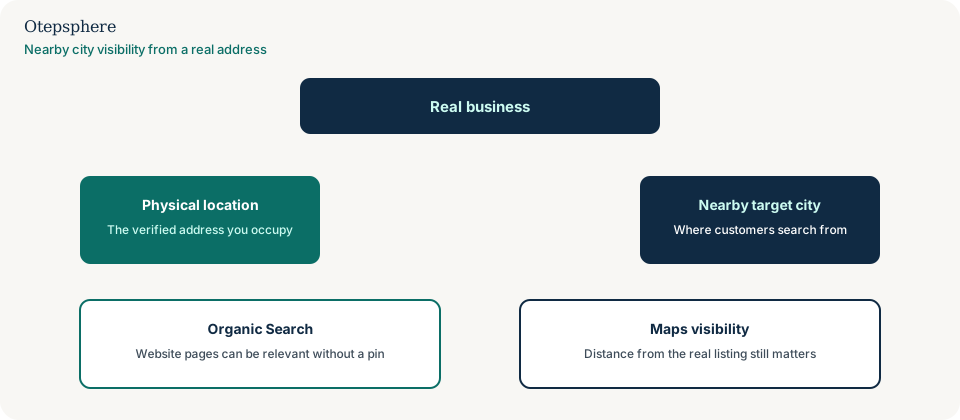
- The public address or hidden service-area base matches a place you actually operate.
- You have measured Maps results from the target city, not only from your own street.
- Organic queries with the city name land on a page that tells the truth about travel or coverage.
- Service areas, if used, match driving reality and current Google guidelines.
- No second profile exists for a virtual office, mailbox or unused coworking desk.
- Any city page would still be useful if it received no search traffic.
What not to assume
Do not assume a nearby-city page will produce a Map Pack slot. Do not assume adding every surrounding town to the service area expands ranking radius. Do not assume organic strength and Maps strength move together. Do not assume a competitor who appears closer has a legitimate address — that is a spam-reporting question, not a reason to copy them.
What not to do
Practical action plan
- Write one sentence: we visit them, they visit us, or both, and name the real base.
- Inspect the live Business Profile against Google’s current representation guidelines.
- Search the same query from the target city and from your address; record Maps and organic separately.
- Improve the real listing and the website pages that already describe the journey or coverage.
- Add a city page only if unique, true local information exists.
- Re-measure. Do not stack a second pin while you wait.
When professional help makes sense
Help is useful when a previous vendor already created extra pins, when organic and Maps results disagree in ways that are hard to read, or when a genuine second site is being considered. Nobody can guarantee ranking in a city you do not occupy.
Sources and further reading
- Google Business Profile Help: Tips to improve your local ranking on Google
- Google Business Profile Help: Guidelines for representing your business on Google
- Google Search Central: Spam policies
Trying to reach customers in a nearby city without creating fake locations?
Otepsphere can review your service areas, website structure and geographic visibility to identify legitimate opportunities for reaching nearby customers.
Contact OtepspherePublished by Otepsphere
Published by Otepsphere, founded by Joseph Enmanuel. Learn about Otepsphere and its approach to local SEO.