What does this problem actually mean?
It means the site publishes a location-style URL for a place the business does not actually serve, so the page claims coverage, a premises or a local team that is not true.
Wanting to be found by people in a neighbouring town is a real marketing aim. Inventing a city page — or a pin — for a place you never visit is a different decision. The first test is operational: would you take that job on ordinary terms, from a real base, without pretending to occupy the searcher’s town?
Is this the same as ranking nearby without a fake address?
No. Honest nearby visibility explains where you actually work from and who you will travel to. Unserved-area pages claim a place you do not cover.
A useful site can still help people in an adjacent city without a second address. That path is whether a business can rank in a nearby city without an address there. Targeting several real suburbs you do serve, without a thin page per postcode, is how to rank in multiple suburbs without doorway pages. This article is about pages that name places you do not serve.
Truth
Do you actually serve it? Premises, travel radius or a documented visit pattern — not a keyword.Nearby
Want visibility next door? That is a different article: nearby city without a fake location.Spam
Many similar city shells? Doorway and scaled content policies apply when pages exist to rank, not to help.Yes
Remove or rewrite honestly Say where you work. Do not invent a shopfront.Next
Align GBP service areas The profile and the website should describe the same coverage.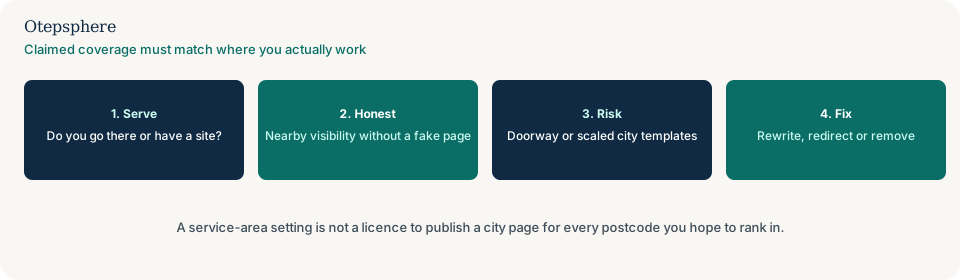
How does this resemble doorway abuse?
Doorway abuse, in Google’s spam policies, includes pages created to rank for similar queries and funnel people onward, and pages targeted at specific regions or cities that send users to one real destination.
A folder of “plumber in [town]” URLs for towns you never attend, each swapping the place name and linking to the same booking form, matches that pattern more closely than a single honest coverage page. Google’s examples include multiple pages targeted at specific regions or cities that funnel users to one page, and substantially similar pages that sit closer to search results than a clearly defined, browseable site. Source: Google Search spam policies (doorway abuse).
How does this resemble scaled content abuse?
Scaled content abuse is many pages generated primarily to manipulate rankings, with little original value for users, however those pages were produced.
City-name templates at volume — including pages for places you do not serve — can fit that description even if a person clicked “publish.” Google’s examples include generating many pages without adding value, and creating many pages whose content makes little sense to a reader but contains search keywords. Source: the same spam policies (scaled content abuse). Cleaning up thin city sets you already published is a separate workflow: whether you should delete thin or duplicate city pages.
Should I create a Business Profile for that city?
No. Do not create a fake location or a pin for a place you do not occupy. Service-area coverage is not a second listing in every town you hope to rank in.
Google’s representation guidelines require a real, customer-facing location when you show an address. Service-area businesses use one profile for the real base and a designated service area — not a profile per hoped-for city. Virtual offices and mailboxes used only to appear closer are not a Maps shortcut. See Google Business Profile for service-area businesses and Guidelines for representing your business on Google.
What should happen to those pages?
Remove or rewrite them so the site only claims coverage you can defend. Do not leave a live location URL that would send a crew somewhere you never go.
If the place is inside a genuine service area, say that on a real hub or location page that names the base and the travel policy — do not keep a fake premises page. If you never serve that place, consolidate, redirect to the honest coverage URL, or return 404 or 410. Do not 301 the whole set to the homepage as a bulk habit.
Served versus claimed diagnostic table
| What the URL claims | What is actually true | Usual next step | What not to assume |
|---|---|---|---|
| Premises, team and hours in that city | No site there | Remove or 404/410; do not add a fake GBP pin | That a city page substitutes for a real location |
| We serve that postcode | Staff never travel there | Rewrite coverage or remove the URL | That ranking there is worth a misleading page |
| We serve that postcode | You do travel there from a real base | Honest service-area language on a real page, not a fake shopfront | That you need one URL per town you drive through |
| Nearby city visibility | Customers travel to you, or you travel to them, without a second address | Useful site copy; no invented pin | That Maps distance will ignore your real address |
What should I not do?
Action checklist
- Inventory location and city URLs. Mark served, occasionally served, and never served.
- Compare each URL to how jobs are actually booked and dispatched.
- Remove or rewrite pages that invent a premises or coverage you cannot defend.
- Align the Business Profile: one real base, honest service area, no fake locations.
- Point internal links at remaining useful coverage or location pages.
- Re-check Search Console for the retired URLs. Cleanup is not a ranking guarantee.
When professional help makes sense
Help is useful when a vendor left a city-page factory for places the business never visits, when fake pins exist, or when doorway-like templates overlap with genuine multi-location pages. Reviewing coverage honesty does not guarantee visibility in those towns.
Sources and further reading
- Google Search Central: Spam policies (doorway abuse and scaled content abuse)
- Google Business Profile: Guidelines for representing your business on Google
- Google Search Central: Creating helpful, reliable, people-first content
City pages for places you never visit?
Otepsphere can review which location URLs claim coverage you cannot defend, and what to keep, rewrite or remove — without treating nearby Maps visibility as a licence to invent a premises.
Contact OtepspherePublished by Otepsphere
Published by Otepsphere, founded by Joseph Enmanuel. Learn about Otepsphere and its approach to local SEO.