What does this destination choice mean?
It means the Business Profile website field — and often the action links — send customers to a URL that is not about the shop they selected on Maps.
Typical pattern: every verified location uses brand.com, so a customer looking for parking at the second clinic lands on a national homepage. The button works. The destination is wrong. Whether that location needs its own URL at all is a related but different check: whether every business location needs its own website URL. Directory destinations for franchise listings are a separate field: whether franchise citations should link to the corporate homepage or the local branch page.
Is this the same as a missing website button?
No. A missing, pending or rejected website or booking link is a verification, format or crawler problem.
Diagnose that on why a Google Business Profile website or booking link is missing or not working. This page assumes the link can publish and asks where it should point.
URL
Does this location have a page? A real branch usually needs a representative URL, not only the corporate homepage.Match
Would a visitor think this is the shop they selected? Hours, address and services must be true for this listing.Field
Is the website field the homepage? That is a destination choice, not a ranking bonus for either pattern.Yes
Use the location URL in the website field Booking and other action links should complete the action for this site.Next
If the button never shows, stop here That is a missing or rejected link problem, not this destination check.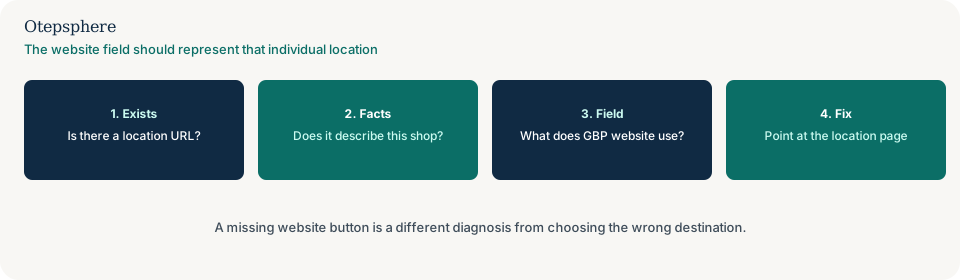
What does Google ask for?
Google currently says to provide a website that represents your individual business location, and that multi-location action links must lead to a website for a specific location rather than a general landing page or another location’s page.
Sources: Guidelines for representing your business on Google and Business links policies and guidelines. That is representation and customer completion, not a documented ranking bonus for a URL pattern.
When is the homepage acceptable?
The homepage can be acceptable when there is only one location, and that homepage is clearly about that place.
A single clinic whose homepage lists that address, those hours and that phone is representing the individual location. A multi-location brand whose homepage is a city chooser is not representing any one shop. If the location page is thin or untrue, fix the page before you point Maps at it: why a location page fails to prove you operate there.
When should you use a location URL?
Use a location URL when more than one shop exists, or when the homepage cannot show this site’s address, hours and services without mixing other branches.
Point the website field at that URL once it is live and accurate. If the new shop is on Maps but still missing from the site, publish the page first: why a new location is on Google but missing from the company website.
Destination decision table
| What you see | What it usually means | Decision | What not to assume |
|---|---|---|---|
| One location; homepage is about that shop | Homepage represents the location | The homepage can stay as the website field | That you still need a second URL for “SEO” |
| Several locations; every listing uses brand.com | Generic landing page | Point each profile at that location’s URL | That Google ranks the homepage higher for every suburb |
| Website button missing or rejected | Link verification or eligibility | Use the missing-link diagnosis first | That changing homepage versus location page will restore the button |
| Location URL exists but is a cloned template | Poor destination | Fix the page facts, then point Maps at it | That any location path is automatically compliant |
What should I not do?
Action checklist
- List each live Business Profile and the URL currently in the website field.
- For each, open that URL as a customer. Does it describe this shop?
- If a true location URL exists, put it in the website field and align action links.
- If no location URL exists, decide whether the location needs one before editing Maps.
- If the button will not publish, follow the missing-link checks instead.
- Re-check the public listing. There is no published ranking timetable for the edit.
When professional help makes sense
Help is useful when dozens of locations still share one homepage, or when location URLs exist but action links still complete the booking on a national hub. It cannot guarantee Google will prefer a URL in local results.
Sources and further reading
- Google Business Profile Help: Guidelines for representing your business on Google
- Google Business Profile Help: Business links policies and guidelines
Every Google listing still sending people to the corporate homepage?
Otepsphere can map which URL each profile should use — a destination review, not a ranking promise.
Contact OtepspherePublished by Otepsphere
Published by Otepsphere, founded by Joseph Enmanuel. Learn about Otepsphere and its approach to local SEO.