What does this problem actually mean?
It means a service URL is still a live search result after the business stopped providing that service, so people can still arrive at an offer that is no longer true.
Ranking here is a Search Console and customer-honesty problem, not a reason to leave the page unchanged. A page that still looks bookable when the work is gone wastes the click and trains people not to trust the rest of the site.
Is this the same as closing a location or fixing 404s with backlinks?
No. This is one service URL that still ranks while the offer is retired. Closing a premises, and cleaning up dead URLs that already 404, are different jobs.
Closing a branch — profile status, remaining locations, citations — is covered in how to close one location without creating Local SEO problems. Old paths that already return 404 and still attract links are covered in what to do with old local URLs that still have backlinks. Stay on this article when the service page is still indexed, still ranking, and still readable as a current offer.
Live
Is the offer still true? If you stopped Invisalign, the page must not still invite bookings.Map
Closest current service? Redirect only when the destination still helps that visitor.Tell
Need an explanation URL? A short “we no longer offer this” page can be the honest document.Yes
One hop to the final URL Collapse chains. Do not dump traffic on the homepage.Next
Update nav, sitemaps, GBP Internal links should not keep advertising the old service.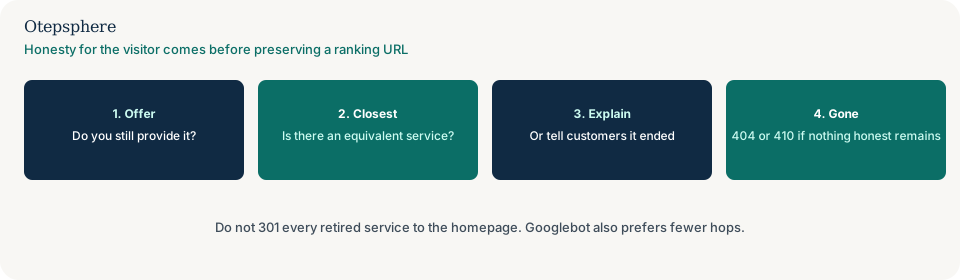
How do I confirm it still earns queries?
Confirm it in Search Console on that URL, not from a single incognito screenshot.
Open the Performance report, filter to the retired service URL, and note queries, impressions and clicks. If the URL still appears for the old service name, people are still being sent to it. Indexed but unused is a different diagnosis: why a service page is indexed but not ranking for the service.
When should I keep the URL?
Keep it only when the page can stay useful without pretending the discontinued service is still for sale.
That usually means rewriting the heading and first screen so a visitor sees that the service has stopped, what replaced it if anything, and how to enquire about current work. Leaving the old “book this service” language in place is not keeping the URL honestly.
When should I redirect it?
Redirect when a live page is the same job for that visitor — the renamed service, the closest current service they would actually book, or the page that now explains that work.
Use a server-side permanent redirect (301 or 308) in one hop to that equivalent URL. Google’s site-move guidance is to redirect each old URL to its new equivalent and to avoid chaining hops; point at the final page directly rather than through leftover CMS paths. Do not treat the homepage as the default destination for every expired service URL. Sources: Site moves with URL changes and Redirects and Google Search.
When should I keep an honest “no longer offered” page?
Keep a short, true retirement page when people still search the old name, there is no equivalent live service, and you would rather explain the change than send them elsewhere or drop them on a 404.
The page should say the service has stopped, whether a related service exists, and how to contact you. It should not keep a booking form for work you will refuse. That is content usefulness, not a ranking tactic. People-first guidance asks whether the page helps the person who would use it. Source: Creating helpful, reliable, people-first content.
When should I return 404 or 410?
Return 404 or 410 when there is no honest replacement and a live page would only mislead.
Google documents 404 and 410 as the outcome for removed content with no equivalent. A custom not-found page can still help people; it must return 404, not 200. Redirecting a retired service URL to an unrelated page — especially the homepage — can be treated as a soft 404 because the destination is not a continuation of the source. Sources: How HTTP status codes affect Google's crawlers and Troubleshoot crawling errors.
Retired service URL decision table
| Situation | Honest outcome | HTTP / page | Avoid |
|---|---|---|---|
| Service renamed or merged into current work | Closest live service page that actually replaces it | One-hop 301/308 | Chain through old folders or dump to Home |
| Service stopped; related service still exists | Redirect if the visitor’s job is the same; otherwise a short retirement note plus a link | 301/308 or a rewritten 200 page | Leaving a live “book now” for the old service |
| Service stopped; people still search the old name; no equivalent | Honest “no longer offered” page that says what changed | 200 with truthful copy | Pretending you still deliver it to keep the ranking |
| Service gone; no useful next step | Remove the document | 404 or 410 | Soft 404 (200 that reads as gone) or homepage redirect |
What should I not do?
Action checklist
- Confirm the service is stopped, renamed or merged. Write that down before changing the URL.
- Pull queries, impressions and clicks for that URL in Search Console.
- Choose one outcome: keep and rewrite, one-hop redirect to the closest current service, honest retirement page, or 404/410.
- Update navigation, internal links, ads and any Business Profile service text that still names the old offer.
- Inspect the old URL after the change. Confirm the status code and the destination if you redirected.
- Re-measure Performance on the old URL and the destination. There is no published ranking timetable.
When professional help makes sense
Help is useful when several retired service URLs still rank, when homepage dumps already exist, or when Search Console, the live page and the booking system disagree about what is still offered. Mapping those URLs does not guarantee that rankings will stay.
Sources and further reading
- Google Search Central: Site moves with URL changes
- Google Search Central: Redirects and Google Search
- Google Search Central: Troubleshoot crawling errors
- Google Crawling Infrastructure: How HTTP status codes affect Google's crawlers
- Google Search Central: Creating helpful, reliable, people-first content
Retired service URLs still ranking for work you no longer do?
Otepsphere can review whether those URLs should stay as honest retirement pages, redirect to the closest current service, or return 404 or 410 — without promising that rankings will be kept.
Contact OtepspherePublished by Otepsphere
Published by Otepsphere, founded by Joseph Enmanuel. Learn about Otepsphere and its approach to local SEO.