What does a mixed-entity answer mean?
It means a generated answer combined facts from two real businesses or two of your branches as if they were one.
Typical pattern: Monday hours from the high-street shop and the phone from the retail-park branch, or a competitor with a similar name folded into your paragraph.
Is this an incorrectly merged profile?
Only if Maps itself combined two listings. That is an operations and appeal path on Google’s side.
Use what to do if Google merged your profile with another business when the pack is already one pin. This page is the AI sentence while the profiles still look separate.
Is this the wrong business on brand search?
Related, but that guide is the classic results pack showing another company.
Work through why Google shows the wrong business for a brand search when the blue links are wrong. Stay here when the generative paragraph blended identities.
Collision
What did the answer blend? Hours from branch A, the phone from branch B, or a competitor with a similar name.Branch
Does each location have distinct public facts? Shared templates and one phone for every shop are common retrieval traps.Namesake
Is a different company in the mix? A branded-search collision on classic results is a sibling diagnosis.Yes
Google merging two profiles is a different process Use the incorrect-merge guide when Maps itself combined two businesses.Next
Separate facts; do not treat entity SEO as a lever Corroboration helps people and systems recognise the shop. It is not a guaranteed ranking factor.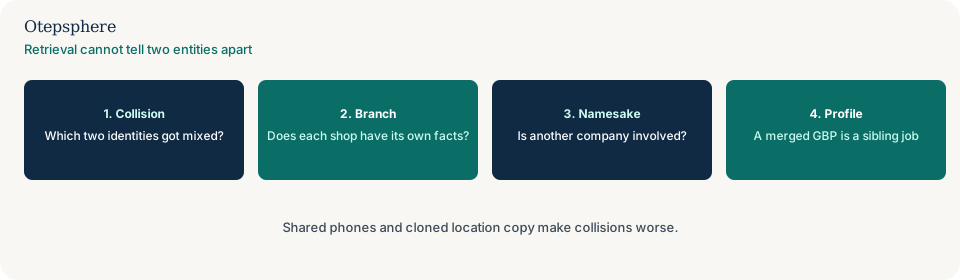
Is this entity SEO theory?
No. That page explains how corroboration helps systems recognise a business. It is not this collision diagnosis.
Read entity SEO for local businesses for the concept. Shared phones and cloned location templates make collisions worse: whether one phone number for every location creates problems and why shared templates show the wrong hours or services.
How do you separate the facts?
Give each real location its own accurate page, phone where you can, and profile. Do not treat “entity SEO” as a ranking switch.
Google’s representation guidelines still require each listing to describe that business. Source: Guidelines for representing your business on Google. Generative features retrieve from ordinary indexed pages. Source: Optimizing for generative AI features.
Collision decision table
| What you see | What it usually means | Decision | What not to assume |
|---|---|---|---|
| AI mixes two of your branches | Shared NAP or cloned copy | Separate pages, hours and phones | That one homepage should describe every shop |
| AI folds in a namesake company | Name collision in retrieval | Strengthen distinct facts; check brand search | That you should rename to match them |
| Maps already shows one combined pin | Profile merge | Use the merge guide | That this page is the appeal |
| You want the theory of corroboration | Entity-SEO explainer | Use that guide | That entity language guarantees rankings |
What should I not do?
Action checklist
- Write down which two identities were blended.
- Confirm whether Maps still shows separate profiles.
- Give each real location distinct public facts and a representative URL.
- If Google merged the listings, switch guides.
- If classic brand search shows the wrong company, switch guides.
- Do not invent a listing to train the model.
When professional help makes sense
Help is useful for groups with cloned location templates and one national number on every citation. It cannot force a chat product to keep two entities apart, and it cannot promise a clean Overview for each branch.
Sources and further reading
- Google Business Profile Help: Guidelines for representing your business on Google
- Google Search Central: Optimizing your website for generative AI features on Google Search
- Google Search Central: Creating helpful, reliable, people-first content
AI blending two branches or a namesake into one answer?
Otepsphere can separate each location’s public facts — without treating entity language as a ranking switch.
Contact OtepspherePublished by Otepsphere
Published by Otepsphere, founded by Joseph Enmanuel. Learn about Otepsphere and its approach to local SEO.