What does a shared number mean?
It means every location page, locator row and Business Profile publishes the same phone number by design — usually a national helpline, a booking desk, or the headquarters line.
Callers then depend on a human or IVR to guess which shop they meant. That is a routing and representation problem. It is not evidence that Google “penalises” shared numbers. Google has not published a ranking factor for unique local phone numbers. The same shared line also prevents crediting a shop for the call: why leads cannot be attributed to individual business locations.
Is this the same as inconsistent NAP?
No. Inconsistent NAP is when sources disagree: the website says one number, Maps another, a directory a third.
Diagnose disagreement on why business information is inconsistent online. This page is when you chose one number on purpose. Hours and services inherited from headquarters are a different CMS problem: why shared location templates show the wrong services or hours.
Ring
Does the caller reach this shop’s staff? A national queue that cannot identify the branch is a customer problem first.List
Is every profile using the same helpline? That weakens the public evidence that listings are separate places.Track
Do Maps, the site and ads show three numbers? That is inconsistent NAP, not a ranking tactic.Yes
Use a location-connecting number where possible Keep tracking numbers consistent on the surfaces customers see.Next
If Google shows a number you never entered, stop here That is a source-conflict diagnosis, not a shared-helpline policy.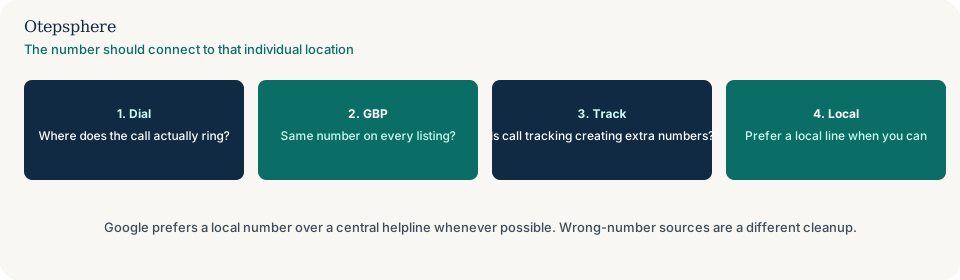
What does Google ask for?
Provide a phone number that connects to your individual business location, or a website that represents that location. Prefer a local number over a central helpline whenever possible. You must have direct control of the number. Do not redirect or refer callers to other businesses.
Source: Guidelines for representing your business on Google. That is a representation rule for the listing, not a published local-ranking formula.
When does it create customer problems?
When the person who answers cannot complete the job for that shop — book that room, confirm those hours, or speak to staff who are actually there.
Typical failures: the helpline quotes headquarters hours; the transfer drops; after-hours callers reach a shop that is closed while another is open. Review requests that send people to the wrong Maps listing are a related routing failure: why customers are sent to the wrong location when asked for a review.
When is a central number still reasonable?
When the business truly has one phone job — a single booking desk that can complete the action for every location — and the Maps listing still represents that location honestly in every other field.
Even then, put the shop’s own number on the location URL if staff there actually answer it. Keep the helpline on a contact page labelled as a helpline. Do not put a tracking number on the Business Profile that you do not control.
Phone-number decision table
| What you see | What it usually means | Decision | What not to assume |
|---|---|---|---|
| Every Maps listing shows the same helpline; shops have their own lines | Intentional shared number | Put the shop line on the profile when staff there answer it | That a unique number is a documented ranking boost |
| Website, Maps and directories show three different numbers | Inconsistent NAP | Use the inconsistent-information playbook | That this page’s shared-helpline advice applies |
| Call from Maps; IVR cannot identify the shop | Customer routing failure | Use a location number, or an IVR that asks for the suburb first | That Google will “know” which shop they meant |
| Tracking numbers on listings you do not control | Guideline conflict | Use a number you control that reaches that location | That call tracking on Maps is required for Local SEO |
What should I not do?
Action checklist
- Call each listing’s published number as a customer. Note whether you reach that shop.
- If staff at the shop answer a local line, put that line on the profile and location URL.
- Label any remaining helpline as a helpline, not as the shop number.
- If sources disagree, stop and use the inconsistent-information guide.
- Confirm you control the number on the Business Profile.
- Do not change numbers as a ranking experiment. Re-check routing after the change.
When professional help makes sense
Help is useful when a call centre, several PBX numbers and Maps all disagree about who should answer. It cannot promise that unique local numbers will change rankings, and it cannot make Google prefer a tracking number you do not control.
Sources and further reading
- Google Business Profile Help: Guidelines for representing your business on Google
- Google Business Profile Help: Add your phone number
One helpline on every location listing?
Otepsphere can help decide which number belongs on each profile so callers reach the right shop — without treating unique numbers as a ranking lever.
Contact OtepspherePublished by Otepsphere
Published by Otepsphere, founded by Joseph Enmanuel. Learn about Otepsphere and its approach to local SEO.