Why is Google Business Profile attribution difficult?
Google Business Profile attribution is difficult because many customer actions never become website sessions, and website sessions still do not prove a sale.
People call, message, request directions or book without loading your site. People who do click through may arrive with a Google referrer that looks like other Search traffic. Call-only visits, branded type-ins after seeing Maps, and later conversions on another device are easy to miss. Treat every number as a partial view. The wider lead question is in how to know if Local SEO is generating leads and how to measure Local SEO. If published numbers go through a tracking platform, treat that as a contact-information governance job first: call tracking numbers and Local SEO.
What can GBP itself report?
Google Business Profile performance reports views, searches and actions on Search and Maps, including website clicks and call-button clicks, where those metrics are available.
Google currently documents views, searches, and actions such as calls (call-button clicks) and website clicks. Direction requests, messages, bookings and menus can appear depending on the business and product surface. Performance data can include organic Search and Google Ads together. Insights are not available for every profile. These metrics stop at the profile. They do not tell you whether a form was submitted or a job was booked. Source: Understand your Business Profile performance and insights.
Google Analytics can also show aggregated Business Profile interaction metrics when a property is linked, as a separate report collection. That still is not the same as tagged website-session attribution. Source: Connect Google Business Profile to Google Analytics.
What can GA4 measure after someone reaches the website?
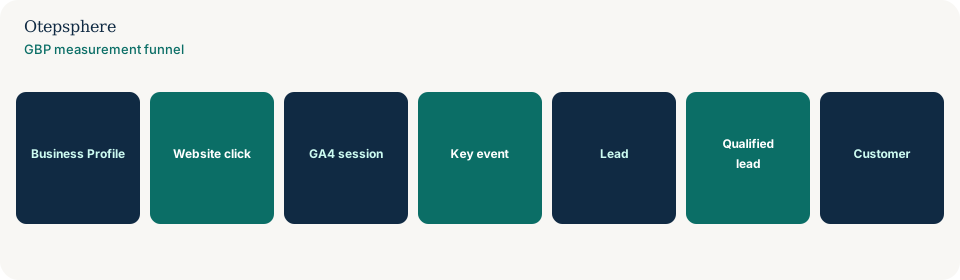
After someone reaches the website, GA4 can measure the session, the landing page, events you collect, and any of those events you mark as key events.
It can show source, medium, campaign and default channel group when the click carries enough information. It cannot see a call that never loaded the site. It cannot see whether a lead later became a paying customer unless you join another system.
What are UTM parameters?
UTM parameters are query-string values added to a URL so Google Analytics can record the source, medium and campaign of a click.
Google documents these among others:
utm_source— the referrer or platform, for example google.utm_medium— the marketing medium, for example email or organic.utm_campaign— the campaign name.
Google recommends setting utm_source, utm_medium and utm_campaign when
you add parameters. Values are case-sensitive. Source:
URL builders: Collect campaign data with custom URLs.
How should GBP UTMs interact with GA4 default channel groups?
Choose UTM values that keep Business Profile website clicks classifiable, instead of inventing a medium that GA4 leaves Unassigned.
GA4’s default channel group cannot be edited. Organic Search is defined as source matching Analytics’ search-site
list, or medium exactly matching organic. Referral is medium matching referral,
app or link. Unassigned is anything that matches no channel rule. Source:
Default channel group.
Trade-offs:
- Recommended default:
utm_source=google_business_profileandutm_medium=organic. Mediumorganickeeps the session in Organic Search. Source lets you isolate GBP in Explorations. Organic Search will include these clicks plus other organic Search. - If you need a separate row in standard channel reports: create a custom channel group. Do not
use
utm_medium=gbporutm_medium=mapsunless you accept Unassigned in the default group. - Avoid:
utm_medium=cpcor other paid patterns. That can classify unpaid profile clicks as Paid Search.
Untagged profile clicks may still appear as google / organic from a Search or Maps referrer. Tagging is for consistency, not perfect capture.
Example GBP tracking URL
An illustrative website link for a single-location profile, using the convention above, is:
https://www.example.com/contact/?utm_source=google_business_profile&utm_medium=organic&utm_campaign=gbp_website
Replace the host and path with the real destination customers should use. Do not copy this onto a page that cannot receive the enquiry. Use lowercase consistently. This is an example, not a Google-mandated string.
Should different GBP locations use different campaign values?
Yes, when you need to tell locations apart in reports. Keep utm_source and
utm_medium stable, and vary utm_campaign or utm_content by location.
Example campaign values: gbp_sydney, gbp_manchester. Changing source or medium per
branch fragments default channel grouping.
How should multi-location businesses track links?
Each location profile should use a destination URL for that location, with a campaign or content value that names the location, and the same source/medium convention across the set.
Google’s business-link policy already requires multi-location action links to lead to a specific location rather than a general landing page. Tracking parameters should not become an excuse to point every pin at the national homepage. Reporting that averages all branches hides the weak one. See Local SEO reporting.
How should booking links be tracked?
Put campaign parameters on the booking URL stored on the profile only when the destination still lets the customer complete the booking and still meets Google’s link rules.
If the booker is a third-party domain, you may not see the full journey in your GA4 property. Count booking clicks in Business Profile performance, then reconcile completed bookings in the booking tool. Do not break a working booking URL by inserting parameters the booking app rejects.
How should calls be measured?
Measure calls as three different things: Business Profile call-button clicks, website click-to-call events, and connected conversations in a call-tracking or telephony system.
GBP “calls” are button clicks, not proof the phone rang or a job was booked. Website click-to-call can be a GA4 event. Calls that never load the site will not appear as sessions. Replacing the profile phone with a tracking number can conflict with Google’s rule that the number must be under the direct control of the business — check current representation guidelines before doing that. Source: Guidelines for representing your business on Google.
What is a key event / conversion in current GA4 terminology?
In current Google Analytics 4 terminology, a key event is an event that measures an action particularly important to the success of the business. “Conversion” is used when that event is also used with Google Ads.
You create or identify an event, then mark it as a key event. Google Ads conversions are a separate, linked construct. For Local SEO reporting, mark form submits, confirmed booking events and click-to-call as key events if those actions matter. Do not mark every page view. If one enquiry creates two key events, see why GA4 is counting the same Local SEO lead more than once. If the CRM is fuller than GA4, see why GA4 reports fewer leads than the CRM. Source: About key events and Conversions vs. key events.
How can leads be connected with CRM outcomes?
Connect leads to CRM outcomes by passing a lead identifier from the form or booking tool into the CRM, then reporting won work there — not by treating GA4 revenue as complete.
GA4 can show that a session from a tagged GBP link triggered a generate_lead event. The CRM can show whether that enquiry was qualified and paid. Offline jobs, cash jobs and phone-only customers will still sit outside GA4. Say so in the report.
GBP Measurement Funnel
What not to assume
Do not assume website clicks equal leads. Do not assume call-button clicks equal conversations. Do not assume default channel group will isolate GBP unless you designed the UTMs for that. Do not assume linking GBP to GA4 replaces tagged landing URLs.
What not to do
Practical action plan
- Write the destination URL customers should use from the profile.
- Add
utm_source=google_business_profile,utm_medium=organic, and a stable campaign name. - Vary campaign or content by location if you have more than one profile.
- Mark enquiry events as key events. Keep call and booking systems in the same monthly report.
- Compare GBP website clicks with tagged sessions. The gap is expected. If stakeholders still treat GBP, GA4 and Search Console as one number, use why those reports do not match.
- Join CRM outcomes where you can, and label everything else as incomplete attribution.
When professional help makes sense
Help is useful when several locations share one GA4 property, when booking tools sit on another domain, or when reports disagree with the diary. It cannot produce perfect attribution.
Sources and further reading
- Google Analytics Help: URL builders / UTM parameters
- Google Analytics Help: Default channel group
- Google Analytics Help: About key events
- Google Analytics Help: Conversions vs. key events
- Google Business Profile Help: Performance and insights
- Google Analytics Help: Connect Google Business Profile to Google Analytics
Can't tell whether Google Business Profile is producing customers?
Otepsphere can review your GBP links, GA4 measurement and lead journey so reporting goes beyond rankings and website clicks.
Contact OtepspherePublished by Otepsphere
Published by Otepsphere, founded by Joseph Enmanuel. Learn about Otepsphere and its approach to local SEO.