What is a call-tracking number?
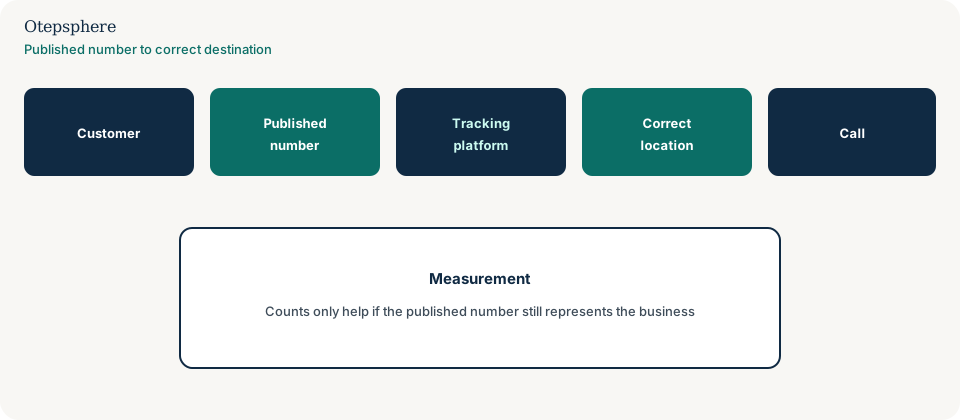
A call-tracking number is a telephone number published so that inbound calls can be attributed to a channel, campaign or landing page, usually by forwarding to the real business line.
The customer still expects to reach the business they saw. The tracking layer is operational infrastructure. It is not a Google ranking feature.
Why do businesses use call tracking?
Businesses use it to learn which pages, ads or profiles generate phone enquiries, especially when forms and chats do not capture the full lead picture.
That measurement job is separate from counting Google Business Profile call clicks, which is diagnosed in GBP call clicks versus actual calls. Tracking numbers can create the gap that article describes; they are not the same topic.
Does Google prohibit tracking numbers?
Google’s current Business Profile guidelines do not explicitly prohibit call-tracking numbers. They do set rules for what a published phone number must do.
Google currently requires a phone number that connects to the individual business location, prefers a local number instead of a central call-centre helpline whenever possible, requires the number to be under the direct control of the business, forbids numbers that redirect or refer users to phone numbers other than those of the actual business, allows additional phone numbers on Business Profile and other local surfaces, and forbids premium-rate numbers. Google also currently says you can add up to two additional numbers besides the primary number. None of those sentences is a published “tracking numbers are banned” rule. Source: Guidelines for representing your business on Google and Add your phone number.
What can go wrong?
Problems appear when the published number no longer represents the business the customer thinks they are calling.
- Inconsistent public numbers across the profile, website and listings, so people cannot tell which is real.
- Wrong destination: the forward points at a closed line, a different branch, or a leftover campaign.
- Expired tracking numbers after a contract ends, leaving dead click-to-call.
- Location routing errors in multi-location pools.
- Loss of measurement when the vendor account is inaccessible.
- A number owned by a former agency, so the business cannot port or update it.
- A call centre answering for several businesses, which conflicts with “connects to your individual business location” and the preference against a central helpline.
Which number should customers see?
Customers should see a number that reaches this business, at this location where a location-specific listing exists, and that the business can still control if the tracking vendor changes.
Google currently prefers a local number over a central helpline whenever possible and requires direct control. A practical pattern many teams use is: keep a number the business controls as the durable public identity, and treat tracking as forwarding or as an additional number rather than as the only way a customer can ever reach you. Google does not publish that pattern as a ranking tactic; it follows from the contact-information rules above.
What happens when an agency owns the tracking number?
If the vendor or agency account owns the number, losing that relationship can take the public phone number with it.
Inventory who can log in, who the carrier bills, and whether the number can be ported. Account control belongs in the Local SEO account ownership checklist. Do not wait until the contract ends to discover the Maps number is not yours.
How should multi-location tracking numbers be managed?
Each customer-facing location should publish a number that reaches that location’s operation, not a pool that dumps every suburb into one national queue unless that is truly how the business serves people.
Shared numbers across branches create attribution noise and can conflict with location-specific contact rules. See shared phone numbers across multiple locations and multi-location lead attribution problems.
Does NAP need to be character-for-character identical everywhere?
No. Treat identity and customer accessibility as the standard, not a folklore rule that every comma must match.
Google currently asks for accurate, complete business information and a number that connects to the business. Inconsistent public numbers still confuse customers and data sources. Character-level NAP matching is not a documented local ranking formula. Keep facts true and usable; do not delay a needed number change because a directory uses “St” instead of “Street”.
Call Tracking Governance Checklist
Call-tracking diagnostic table
| Situation | Policy-relevant question | Operational next step |
|---|---|---|
| Forwarding to this location’s line | Does it connect to the actual business? | Keep control of the number and test the forward |
| National call centre for many brands | Is this the individual location, or a helpline? | Use a location-appropriate number where possible |
| Agency-owned tracking DID | Is the number under business control? | Port or replace before the contract ends |
| GBP call clicks ≠ phone log | Measurement mismatch, not automatically a policy issue | Diagnose clicks versus answered calls separately |
What not to assume
Do not assume Google bans tracking numbers. Do not assume swapping a website DNI number damages Maps. Do not assume identical punctuation across citations is a ranking factor. Do not assume a tracking vendor’s “local SEO safe” claim is Google documentation.
What not to do
Practical action plan
- List every public number on the profile, website, schema and major listings.
- Call each one from a third-party phone. Record who answers and which location they represent.
- Confirm account ownership and portability.
- Align location-specific listings with numbers that reach those locations.
- Keep measurement, but do not sacrifice a reachable, business-controlled identity number.
When professional help makes sense
Help is useful when tracking, Maps and a PBX disagree, or when a former vendor still owns the public number. It cannot make Google treat a tracking number as a ranking advantage.
Sources and further reading
- Guidelines for representing your business on Google
- Google Business Profile Help: Add your phone number
- Google Business Profile Help: Edit your Business Profile
Using tracking numbers but unsure whether customers and reporting are reaching the right location?
Otepsphere can review the phone-number setup, Business Profiles and lead attribution without sacrificing business-data accuracy for tracking.
Contact OtepspherePublished by Otepsphere
Published by Otepsphere, founded by Joseph Enmanuel. Learn about Otepsphere and its approach to local SEO.