What does hub-and-spoke competition mean?
It means a regional URL (state, city network, “locations in the north”) and a genuine shop URL both compete for queries that should land on one premises.
The hub is useful when its job is navigation: pick a shop, compare hours, see the map of the network. It becomes a problem when it copies shop-level facts — address, booking, “visit us in [suburb]” — without being that shop.
Is this two locations competing?
No. Two real shops on one domain can both appear because searchers sit between them. That is geography plus page identity.
Diagnose that on why locations compete with each other in search. Extra hostnames covering the same brand are why local microsites compete with the main company website.
Hub
Is this a chooser for several real shops? A useful hub lists genuine locations with links. It is not a second homepage for one branch.Branch
Does each location URL describe that premises? Address, hours and services for that site belong here, not on the hub.Share
Does Search Console split the same query? Differentiate titles and openings, or consolidate if the jobs are identical.Yes
Hub for coverage; URL per real shop Internal links should send “this shop” queries to the branch.Next
Do not add a page per suburb you drive through That is the unserved-area and doorway cleanup.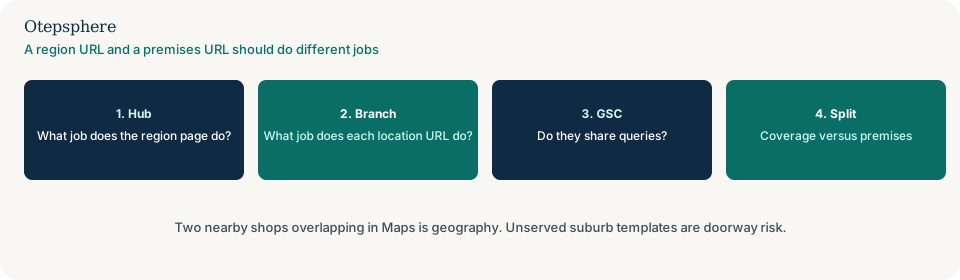
Is this unserved-suburb pages?
No. Unserved-suburb pages invent a URL for a place with no premises. A regional hub is a real page whose job should be the network, not a fake shop.
Keep those distinct: what happens when local pages target unserved areas and why ranking for every nearby suburb is a different problem.
What job should each URL have?
The location URL represents one premises. The regional URL helps someone choose among premises, or explains coverage where you have no shop.
Google’s people-first guidance still asks whether each URL is useful for a person, not whether every geographic word has a page. Source: Creating helpful, reliable, people-first content. A representative URL for a real shop is whether every location needs its own website URL.
How do you stop the hub stealing the shop?
Give the hub a navigation job: list shops with crawlable links, do not paste one shop’s NAP as if the hub were that shop, and do not target shop-plus-service titles on the hub.
If Search Console shows the hub winning a query that names a shop suburb, rewrite the hub title and lede so they describe the network. Point internal links that mention that suburb at the shop URL. Do not noindex the hub unless it has no remaining job.
Hub vs spoke decision table
| What Search Console shows | What it usually means | Decision | What not to assume |
|---|---|---|---|
| Shop-plus-service query lands on /locations/state | Hub copying shop intent | Rewrite the hub as a chooser; strengthen the shop URL | That deleting the hub will automatically rank the shop |
| Hub lists shops with HTML links; shop URLs win shop queries | Healthy hub and spoke | Keep both; do not add suburb copies | That the hub must also rank for every shop name |
| Two shop URLs swapping for a midpoint suburb | Two real locations | Use the locations-competing playbook, not this one | That a regional hub will settle which shop should rank |
| Hub is the only URL for a town with no shop | Coverage page, if honest | Say you travel there; do not invent a location URL | That a fake shop page will create Maps visibility |
What should I not do?
Action checklist
- List regional hubs and genuine location URLs. Write one job sentence for each.
- In Search Console, map shop-named queries to URL. Note hubs that win those queries.
- Rewrite hub titles and body so they help someone pick a shop, not impersonate one.
- Link from the hub to each shop with ordinary HTML. Point suburb mentions at the shop URL.
- Leave two-shop Maps overlap for the locations-competing guide.
- Re-measure after recrawl. There is no published ranking timetable.
When professional help makes sense
Help is useful when a CMS has auto-generated state, city and suburb hubs that all target the same services. It cannot promise that the shop URL will win those queries on a timetable.
Sources and further reading
- Google Search Central: Creating helpful, reliable, people-first content
- Google Search Central: Spam policies for Google web search
- Google Business Profile Help: Guidelines for representing your business on Google
Regional pages ranking instead of the shop pages?
Otepsphere can map which queries belong to the hub and which belong to a premises — without doorway suburb pages or a ranking promise.
Contact OtepspherePublished by Otepsphere
Published by Otepsphere, founded by Joseph Enmanuel. Learn about Otepsphere and its approach to local SEO.