What does microsite competition mean?
It means the brand operates more than one host — brand.com plus suburb.brand.com, brand-suburb.com, or a country shop domain — that all try to answer the same local search job.
Google then has several of your documents for one query. People-first guidance still asks whether each URL is useful, not whether every town has a hostname. Source: Creating helpful, reliable, people-first content.
Is this the same as locations competing?
No. Two shops on one domain can both appear because searchers sit between them. That is geography plus page identity.
Diagnose that on why locations compete with each other in search. This page is extra hosts covering the same brand.
Map
List brand.com plus every city or shop host Include subdomains and country ccTLDs used as shop sites.GSC
Which host receives the local query? Export the query. The winner may not be the host you intended.Overlap
Do both describe the same shop and job? If yes, consolidate or differentiate; do not add a third host.Yes
Keep one representative URL on the main domain Redirect leftover microsites when they are the same place.Next
If a franchisee owns the other site, switch playbooks That is independent ownership, not a brand microsite you control.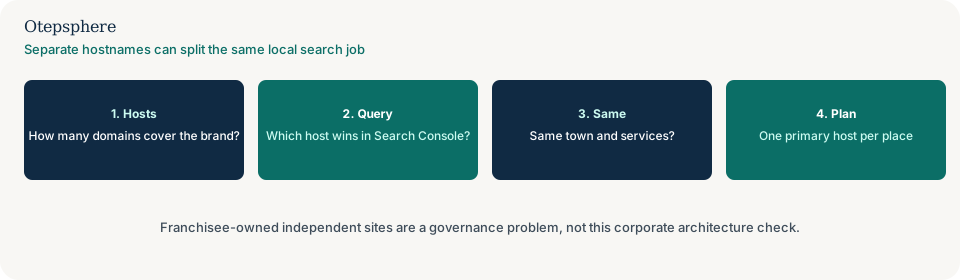
Is this the same as franchisee websites?
No. Brand-owned microsites are architecture you control. Franchisee sites are ownership and contract.
Use what to do when franchisees create their own local websites when you cannot 301 the other host. A regional hub on the same domain is a third pattern: why regional pages compete with individual location pages.
How do I see which host wins?
Export the query in Search Console and read which host and URL receive the impressions.
Filter to one service-plus-town query. Note whether brand.com/locations/… or a microsite wins. That mapping is the evidence. Do not invent a “microsite penalty.” Scaled, unhelpful city hosts can still conflict with spam policies on doorway-like patterns. Source: Spam policies for Google web search.
When should I consolidate to the main domain?
Consolidate when the microsite describes the same shop, the same services and the same customer as a URL you already have — or should have — on the main domain.
Prefer one representative path per real location: whether every business location needs its own website URL. Redirect the leftover host. Keep a separate host only when there is a genuine operational reason (a different legal brand, a different country site with different language and inventory), not because a vendor sold “local domains.”
Hostname decision table
| What Search Console shows | What it usually means | Decision | What not to assume |
|---|---|---|---|
| Same query, impressions split across brand.com and a city host | Two hosts, one job | Keep one representative URL; redirect the other if you control it | That a third city domain will “cover” leftovers |
| City host wins; it is a thin template | Weak document on a separate host | Move unique facts to the main-domain location URL, then redirect | That the host itself is a ranking asset |
| Different countries, languages and catalogues | Possibly distinct sites | Keep separate hosts; use hreflang and honest geo paths | That every extra host is a microsite problem |
| You do not control the other host | Franchisee or leftover vendor | Switch to the franchisee or recovery playbook | That a robots.txt on brand.com will hide their site |
What should I not do?
Action checklist
- Inventory brand hostnames, including forgotten subdomains and ccTLDs used as shop sites.
- In Search Console, map important local queries to host and URL.
- For overlapping hosts you control, pick one representative URL on the main domain and redirect.
- Point Business Profiles at the surviving URL. Update locators and ads.
- If you do not own the other host, stop and use the franchisee or legal path.
- Re-measure after recrawl. There is no published ranking timetable.
When professional help makes sense
Help is useful when many historic city hosts still resolve, or when Search Console and Maps disagree about which URL represents a shop. It cannot guarantee that one host will win the query.
Sources and further reading
- Google Search Central: Creating helpful, reliable, people-first content
- Google Search Central: Spam policies for Google web search
- Google Search Central: How to specify a canonical URL
City microsites splitting the same local queries?
Otepsphere can map which host Google associates with each local query before more domains are launched — not a ranking promise.
Contact OtepspherePublished by Otepsphere
Published by Otepsphere, founded by Joseph Enmanuel. Learn about Otepsphere and its approach to local SEO.