What does returning information mean?
It means you already corrected a listing, then the previous name, address or phone came back from a source you did not finish.
That is re-syndication, not proof Google “rejected” the cleanup.
Is this the first inconsistency check?
No. If you have never aligned the listings, start there.
Use why business information is inconsistent online. Come here only after a field you fixed reappears.
Spot
Which fact returned — address, phone or name? Date the recurrence. One field often points at one feeder.Feed
Which aggregator or leftover page still has the old NAP? Data providers and unsynced directories republish.Fix
Correct or close that source First-pass inconsistency is a different guide.Yes
Allow time for the feed to refresh Do not open a second listing to overwrite it.Next
Keep one public identity per location Duplicates make the old facts harder to kill.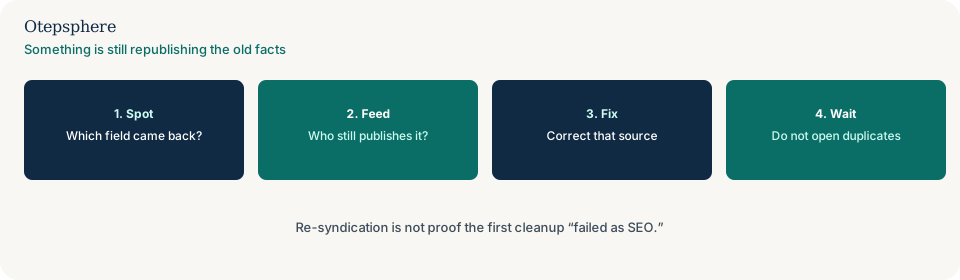
Is this a move or a rebrand?
Those playbooks update the identity once. They do not explain a later bounce-back.
A premises change is how to handle Local SEO when the business moves. A name change is how to rebrand without losing Local SEO visibility. After those edits revert, this page applies.
Where does the old fact get republished?
Common feeders: a data aggregator that still has the old row; a franchise headquarters export; a leftover location URL; a second Google profile; a PDF or footer you never changed.
Google can take facts from more than the listing you edit. Representation still has to be accurate on Google. Source: Guidelines for representing your business on Google.
How do you stop the feed?
Correct or close the source that still publishes the old NAP, then wait for dependents to refresh. Do not open a duplicate listing to fight the feed.
If the reverting field is a directory category, also see why directories list the company in the wrong category.
Reversion decision table
| What you see | What it usually means | Decision | What not to assume |
|---|---|---|---|
| Phone reverts a week after edit | A feeder still has the old number | Find and correct that source | That Google “likes” the old number better |
| You never finished the first cleanup | First-pass inconsistency | Use the inconsistency guide | That this reversion playbook is first |
| A second Maps listing still shows the old address | Duplicate profile | Use the duplicate-profile guide; do not add a third | That more listings will overwrite the old one |
| Only one obscure directory bounced back | Local cache | Re-edit that record; wait a refresh cycle | That you must rebuild every citation |
What should I not do?
Action checklist
- Write the field, the date you fixed it, and the date it returned.
- Search the old NAP string. Note which domains still publish it.
- Correct or close the strongest feeder first.
- If you never aligned listings, switch to first-pass inconsistency.
- If a second Google profile exists, treat that as a duplicate.
- Wait a refresh cycle before you declare the feed dead.
When professional help makes sense
Help is useful when a headquarters file and three aggregators disagree after a move. It cannot make every dependent refresh on a date, and it cannot promise rankings from a stable NAP.
Sources and further reading
- Google Business Profile Help: Guidelines for representing your business on Google
- Google Business Profile Help: Update your business information
Old address or phone still coming back after cleanup?
Otepsphere can find the source still feeding the old NAP — without opening duplicate listings to fight it.
Contact OtepspherePublished by Otepsphere
Published by Otepsphere, founded by Joseph Enmanuel. Learn about Otepsphere and its approach to local SEO.