Should schema match visible page information?
Yes. LocalBusiness structured data should describe the same facts a person can read on the page.
Google’s general structured-data guidelines say structured data must be a true representation of the page content, and not to mark up content that is not visible to readers. If JSON-LD describes a performer, the HTML body must describe that same performer — the same principle applies to a local business. Sources: General structured data guidelines and Intro to structured data.
Should schema match GBP exactly?
Factual business information should describe the same real entity, but platform formats do not need to be character-for-character identical.
“12 High Street” and “12 High St” can be the same address. “12 High Street” and a different suburb cannot. Hours that use a different convention can still describe the same opening times. Hours that list Saturday open on the page and Saturday closed on the profile are a conflict. Entity consistency is entity SEO for local businesses. Public NAP drift is inconsistent business information online.
Why can schema become outdated?
Markup often lives in a different place from the visible contact block.
- A CMS template that prints a global NAP into every location page.
- Old hard-coded JSON-LD left in a header after a move or rebrand.
- A plugin or tag-manager container with a stale variable.
- A rebrand that updated headings but not the script.
- A business move that updated the footer and not the schema.
- Separate website and profile teams editing different records.
Google’s JavaScript structured-data guidance also warns that duplicating information in Tag Manager increases the risk of a mismatch with page content. Source: Generate structured data with JavaScript.
What fields should I compare?
Compare the facts that identify the location, not every optional property.
- Name
- Address, including unit and locality
- Phone
- URL
- Hours
- Location identity — which branch the page is about
LocalBusiness documentation says you can add the markup to any page, though it often belongs on a page that contains information about the business, and that required properties must be present for rich-result eligibility. Eligibility is not a ranking guarantee. Source: Local business structured data.
Could incorrect structured data confuse systems?
It can create inconsistent machine-readable information. That is a data-consistency problem.
Do not claim a direct ranking penalty. Google can ignore markup that does not follow the guidelines, and policy-violating structured data can affect rich-result eligibility. Search features that consume structured data are not guaranteed. Treat conflicting hours or a leftover former address in JSON-LD as inaccurate information about the page, not as a secret ranking exploit.
What if the website and GBP teams are out of sync?
Give them one source of truth. The markup should copy from the same record as the visible page and the profile.
That operating problem is when website and Google Business Profile teams are out of sync.
What if schema vanished completely?
That is a different diagnosis. The template or plugin stopped printing markup.
Continue with why LocalBusiness schema disappeared after a template update. A page that still has JSON-LD with the wrong suburb is this page’s problem, not a missing-script problem.
Business Information Consistency Matrix
Visible page
What customers can read Name, address, phone, hours and URL on the page itself.Business Profile
Same real entity Platform formats can differ slightly. Conflicting suburbs or numbers cannot.LocalBusiness schema
Must match visible facts Google’s structured-data guidelines require a true representation of the page.Citations
Same organisation High-impact listings should not advertise a different phone or address.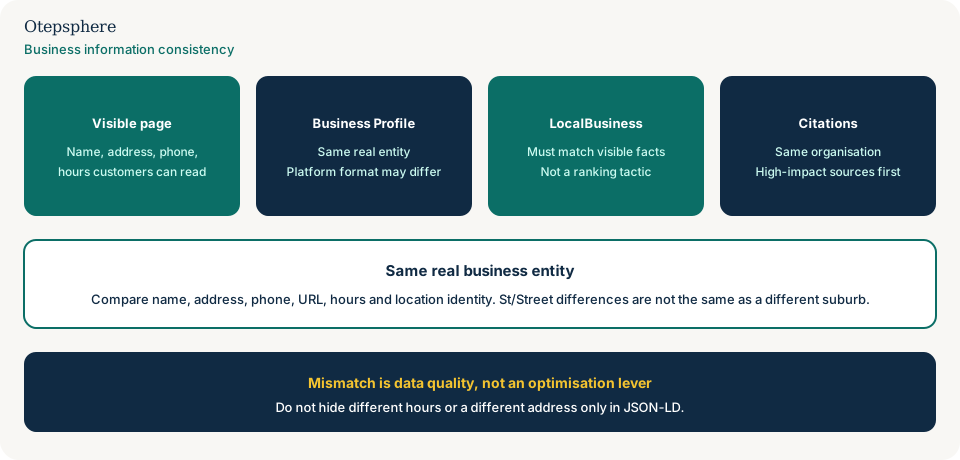
| Field | Visible page | LocalBusiness schema | Business Profile | Issue? |
|---|---|---|---|---|
| Name | ||||
| Address | ||||
| Phone | ||||
| URL | ||||
| Hours | ||||
| Location identity |
All four surfaces should describe the same real business entity. Citations belong in the same comparison when a directory still advertises last year’s number. A technical audit that includes markup is part of a Local SEO audit.
What not to assume
- That extra keywords in schema will rank the page.
- That Street versus St is the same class of error as a different town.
- That matching GBP character-for-character is required.
- That missing rich results mean the markup is wrong — that has its own guide.
What not to do
- Do not hide a different address only in JSON-LD.
- Do not add a second LocalBusiness block that conflicts with the first.
- Do not restore vanished markup by pasting last year’s hours from memory.
- Do not treat this as the same job as markup that disappeared.
Practical options
- Fill the comparison table from the live page, the rendered JSON-LD and the profile.
- Decide which record is the source of truth.
- Update visible content and markup together.
- Remove hard-coded leftovers in themes, plugins and Tag Manager.
- Validate syntax. Do not expect a rich result.
When professional help makes sense
Help is useful when a multi-location template prints one branch’s NAP on every page, or when Tag Manager and the theme both emit markup. Nobody should promise that correcting JSON-LD will move Maps rankings.
Sources and further reading
- Google Search Central: General structured data guidelines
- Google Search Central: Local business structured data
- Google Search Central: Intro to structured data
Website, GBP and structured data telling different versions of the business?
Otepsphere can audit the entity information across the site's visible content, structured data and major local profiles.
Contact OtepspherePublished by Otepsphere
Published by Otepsphere, founded by Joseph Enmanuel. Learn about Otepsphere and its approach to local SEO.