What does this problem actually mean?
Google is seeing several URLs for what is substantially the same location or service document, because query strings create extra addresses without creating extra useful pages.
That is a different starting symptom from Search Console reporting a Google-selected canonical on a location cluster. The cluster diagnosis is why Google chose a different canonical for a location page. This page is about how filters and parameters generate the copies.
Pattern
Same local content, extra query string Filters, UTMs, sessions and map coordinates can mint unlimited URLs.Tracking
UTM and click IDs Canonicalise to the clean location or service URL. Do not list parameter copies in the sitemap.State
Sort, session, print, map pins These rarely deserve their own index entry. Point signals at the representative page.Filters that change content
Keep, noindex or reduce crawling A useful filtered view is uncommon on local sites. Empty filter results are a soft-404 risk.Align
Canonical, internal links, sitemap Every signal should name the clean URL you want Google to treat as canonical.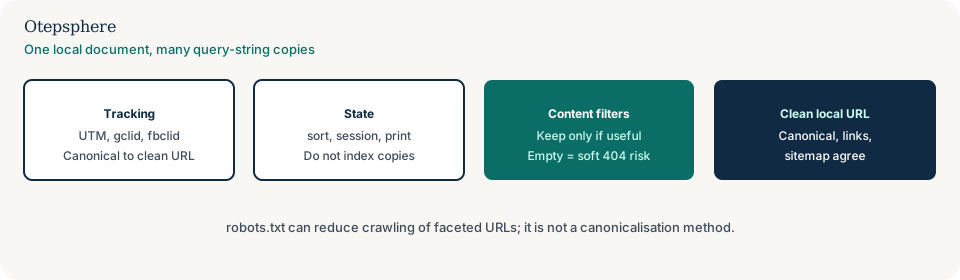
Why do local sites mint so many URLs?
Store locators append coordinates and filters. Service catalogues add sort and facet parameters. Analytics appends UTM values. Session IDs still appear on older platforms. Each combination can be crawled if linked.
Faceted navigation and session identifiers are documented as URL types that often duplicate content and can waste crawl attention. Source: Troubleshoot crawling errors (managing inventory / faceted navigation).
How do I confirm duplicates?
Compare primary content with parameters stripped. If the location name, services and body are the same, you have a duplicate cluster, not a new local page.
In Search Console, inspect both URLs. Note user-declared and Google-selected canonicals. Check whether parameter URLs appear in the Pages report as crawled, duplicate, or soft 404 empty filters.
Parameter intent matrix
| Parameter type | Changes useful content? | Preferred handling | Local example |
|---|---|---|---|
| Tracking (UTM, gclid, fbclid) | No | Canonical to clean URL; do not sitemap copies | Location page shared in a campaign |
| Session or print | No | Canonical to clean URL; avoid linking them | Printer-friendly location sheet |
| Sort / view | Usually no | Canonical to default view | Location list sorted by name |
| Map coordinates | Rarely | Do not index pin-state URLs; link real location pages | Locator ?lat=&lng= |
| Facet that empties the list | Empty state | 404, noindex, or do not generate the URL | Service filter with zero branches |
| Facet with unique useful results | Sometimes | Only if it is a real landing page worth ranking | Uncommon on local service sites |
How should canonicals and links work?
Redirects, rel=canonical and sitemap inclusion are the documented preference signals, in roughly that order of strength. Combine them so they name the same clean URL.
Use absolute canonical URLs. Link internally to the clean location or service URL, not to a tracking copy. Google does not recommend robots.txt as a canonicalisation method. Source: How to specify a canonical URL. Parameters stored as the website on a directory listing are whether tracking parameters and URL variations are creating citation consistency problems.
When should I reduce crawling?
If faceted URLs are infinite and useless, reducing crawl with robots.txt can protect capacity — while understanding that disallowed URLs can still appear in results if linked.
Empty filter URLs that 200 with “no results” are a soft 404 risk: why Google treats a local page as a soft 404. Locator UIs that never expose clean hrefs are a crawl problem: why Google cannot crawl a store locator.
What should I not do?
Action checklist
- Inventory parameter patterns on location, service and locator URLs.
- Classify each as tracking, state, empty filter or genuinely useful facet.
- Set self-canonicals on clean URLs and parameter canonicals pointing to them.
- Remove parameter URLs from sitemaps and from internal navigation.
- Stop generating empty filter URLs, or give them 404/noindex.
- Re-inspect a sample in Search Console after recrawl.
When professional help makes sense
Help is useful when a locator or faceted catalogue creates thousands of near-duplicate local URLs, or when canonicals, sitemaps and internal links disagree. Canonical hints do not guarantee Google will pick your preferred URL.
Sources and further reading
Filter and tracking URLs multiplying your location pages?
Otepsphere can separate tracking parameters from filters that change content, then align canonicals, links and sitemaps to the clean local URLs you want Google to treat as representative.
Contact OtepspherePublished by Otepsphere
Published by Otepsphere, founded by Joseph Enmanuel. Learn about Otepsphere and its approach to local SEO.