What do citation URL variants mean?
They mean two listings for the same shop point at strings that look like different websites — http versus https, www, a trailing slash, or a UTM query.
Customers still arrive, but the stored destination no longer matches the page you treat as representative.
Is this on-site parameter duplicates?
No. That guide is your own site indexing many filter or session URLs as extra documents.
Use why filter and parameter URLs create duplicate local pages for crawlable faceted URLs. This page is what directories save as the website field.
Compare
Does the citation URL match the canonical location page? www, slash, http and UTM all count as a different stored string.UTM
Is the extra query only for tracking? Those strings do not belong in the directory record.Clean
Save the parameter-free representative URL Tag ads or GBP campaign links elsewhere if you need measurement.Yes
Indexed filter URLs are a different problem On-site parameter duplicates have their own guide.Next
Do not treat UTM as a ranking factor Consistency for the visitor is the job.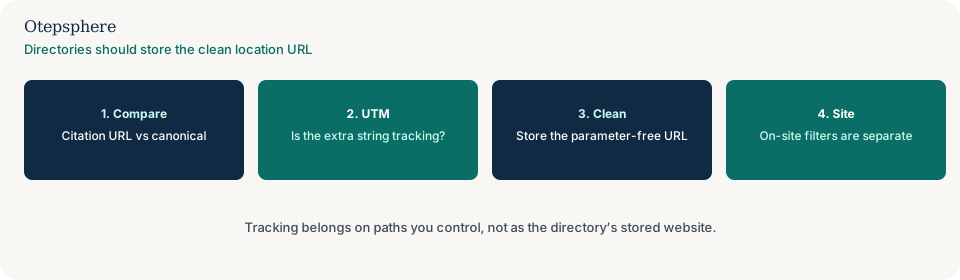
Is this the franchise homepage problem?
Only if the stored host is the corporate homepage. Parameters on an otherwise correct location URL are this page.
Homepage versus location destinations are whether franchise citations should link to the homepage or the branch page.
What URL should citations store?
The clean, canonical location or contact URL — one host, https, no campaign query — that represents that shop.
Google’s duplicate-URL help is about consolidating variants you control with canonicals and redirects. Source: How to specify a canonical URL. A directory will not read your rel=canonical; it stores whatever string you submitted.
Where should tracking live instead?
On ads, email, or a tagged path you control — not as the permanent website field on a citation.
Google Business Profile campaign parameters for Analytics are how to track Google Business Profile traffic and leads in GA4. Do not copy those query strings into Apple, Bing or a local directory.
URL decision table
| What you see | What it usually means | Decision | What not to assume |
|---|---|---|---|
| Directory URL has utm_source=citation | Tracking stored as the destination | Replace with the clean canonical | That UTM on a directory is a ranking tactic |
| http and www variants across listings | Host inconsistency | Save one https URL everywhere | That Google needs every variant listed |
| Your store locator creates ?lat= URLs | On-site parameters | Use the duplicate-parameter guide | That this citation page is the fix |
| Citation opens the brand homepage | Wrong page, not just UTM | Use the franchise destination guide | That stripping UTM is enough |
What should I not do?
Action checklist
- Write the one URL you want every location citation to use.
- Export directory website fields. Flag query strings and host variants.
- Edit records you control. Request the rest.
- Keep GBP campaign tags on the profile link if you use them — not on Apple or Bing.
- If the site indexes filter URLs, switch guides.
- Do not invent a new parameter scheme for citations.
When professional help makes sense
Help is useful when a vendor’s citation tool writes a different UTM into every row. It cannot make every directory accept a clean URL, and it cannot promise rankings from a tidied string.
Sources and further reading
- Google Search Central: How to specify a canonical URL with rel="canonical" and other methods
- Google Business Profile Help: Guidelines for representing your business on Google
Directories still storing UTM and extra URL variants?
Otepsphere can standardise citation destinations to one clean location URL — without treating parameters as a ranking lever.
Contact OtepspherePublished by Otepsphere
Published by Otepsphere, founded by Joseph Enmanuel. Learn about Otepsphere and its approach to local SEO.