Is the query actually commercial?
Not always. A phrase the business treats as a “money keyword” can still be informational in the live results.
Inspect the current Search page. If most results are how-to articles, definitions and comparisons, Google is treating the query as a learning job. A service page that only says “we offer this in this city” may be a weaker match than a guide that answers the question. Google’s people-first guidance currently asks whether content helps people, rather than whether it was created mainly to rank. Source: Creating helpful, reliable, people-first content.
This is not the same problem as two service pages competing for the same commercial query. That conflict is page-to-page overlap among URLs with the same job. This conflict is informational intent versus commercial intent.
Do both pages target the same question?
If both titles ask the same question and both bodies answer it the same way, Google has less reason to treat them as different jobs.
A guide titled “What does root canal treatment involve?” and a service page titled “Root canal treatment in [city]” can coexist when one explains the procedure and the other helps a patient book it. They collide when the service page is a shorter copy of the article, or the article is a thinly rewritten service pitch. Map the query to one primary URL in local keyword mapping.
Does the informational page internally link to the service page?
If the article ranks and never sends the reader to the booking page, the site is teaching without a commercial next step.
Use a natural, descriptive link when the reader is ready to enquire. Do not dump identical sitewide links that ignore context. Internal linking should show how topics relate, which is covered in internal linking for Local SEO.
Is the service page sufficiently useful?
A thin service page will often lose to a thorough article for mixed or informational queries, even when the business wants the commercial URL to win.
Check whether the service page explains who the service is for, what happens next, location and access, hours or appointment rules, and how to contact the right place. Google currently describes useful content as content created for people first. Padding the service page with the article’s text is not the same as making it useful. Source: Creating helpful, reliable, people-first content.
Are title and headings making the purpose clear?
Titles and H1s should tell a reader — and a search system — whether the page is a guide or a service offer.
If both say “Emergency plumber” with no distinction, the roles blur. Prefer “How to stop a burst pipe overnight” on the article and “Emergency plumbing in [suburb], 24-hour call-out” on the service page when those are the true jobs. Do not keyword-stuff either heading.
Is the informational page receiving more internal links?
Yes, that can happen. Blogs often collect links from every new post while a service page sits in a footer.
Count unique internal links to each URL, including navigation, body links and related-resource blocks. If the article is treated as the hub, Search may keep choosing it. Strengthen links to the service page from relevant location and service templates, not from every unrelated blog post.
Is the service page indexed?
If the service page is not indexed, it cannot outrank anything. Confirm coverage in Search Console before blaming the article.
Check robots, noindex, canonicals, login walls and whether Google selected a different canonical. Indexed but not ranking is a different diagnosis, covered in why a service page is indexed but not ranking.
Should the informational article be redirected?
Not automatically. Redirect when the article has no remaining job and the service page is the genuine replacement.
If the article still helps people understand the problem, keep it and send qualified readers to the service page. Redirecting a useful guide into a thin brochure can remove the URL that currently matches the query without making the service page a better answer.
Should the article be noindexed?
Not automatically. Noindex is for pages you do not want in Search, not for pages that rank “too well”.
Use noindex when the article is duplicate, outdated, or should not compete because it has no unique purpose. Do not noindex a helpful guide solely so a weaker service page might inherit impressions. Google currently treats noindex as a way to keep a URL out of Search, not as a ranking-transfer tool.
When should two pages be consolidated?
Consolidate only when both pages genuinely satisfy the same intent and neither needs to exist as a separate useful URL.
If they share the same question, the same reader, and overlapping content, pick the stronger URL, merge unique facts, and redirect the duplicate. If one is a guide and one is a booking page, differentiate them instead. Local content roles are also discussed in local content strategy and local on-page SEO.
Search Intent Diagnostic Matrix
Start
Query Inspect the live results, not the keyword you hoped to own.Learn
Informational intent? The searcher wants to understand, compare or diagnose.Hire
Commercial intent? The searcher wants to book, buy or contact a provider.Both
Mixed intent? Results include guides and service pages.Outcome
Appropriate page Keep a guide, a service page, or both with distinct roles.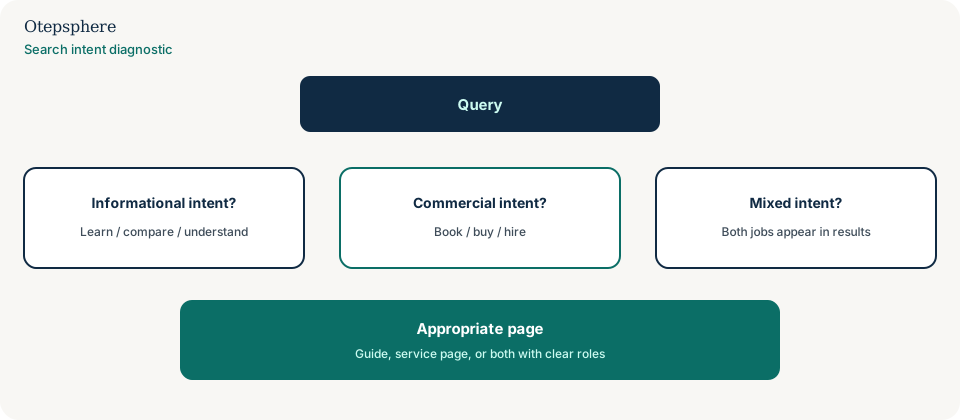
Intent diagnostic table
| Live-result pattern | Likely intent | Usual page role | First move |
|---|---|---|---|
| Mostly guides and explainers | Informational | Article or resource | Keep the guide; link to the service page |
| Mostly local businesses and booking pages | Commercial | Service page | Make the service page the clearer match |
| Mix of guides and providers | Mixed | Both, with distinct jobs | Differentiate titles, content and links |
| Two of your URLs answering the same question | Duplicate job | One surviving URL | Consolidate, then redirect |
What not to assume
Do not assume every money keyword belongs to the service page. Do not assume the ranking article is cannibalising a stronger commercial URL. Do not assume a redirect will transfer the ranking. Do not assume noindex is a gentle ranking switch.
What not to do
Practical action plan
- Capture the query and classify the live results as informational, commercial or mixed.
- Compare titles, H1s and unique content on both URLs.
- Confirm the service page is indexed and is the canonical Google selected.
- Add contextual links from the guide to the service page where the reader is ready to act.
- Improve the service page’s usefulness if the query is commercial or mixed.
- Consolidate only when both pages do the same job.
When professional help makes sense
Help is useful when several guides and service URLs overlap, or when a team is about to redirect ranking content without an intent review. It cannot assign a keyword to the service page.
Sources and further reading
- Google Search Central: Creating helpful, reliable, people-first content
- Google Search Central: Search Essentials
- Google Search Central: How to specify a canonical URL
- Google Search Central: How Search works
Helpful content ranking while your service page remains invisible?
Otepsphere can review the query intent, page roles, internal links and content architecture before URLs are merged or redirected.
Contact OtepspherePublished by Otepsphere
Published by Otepsphere, founded by Joseph Enmanuel. Learn about Otepsphere and its approach to local SEO.