Can I add “Plumber Sydney” to my company name?
Only if that is genuinely the established business name — the name used consistently on signage, stationery, the website and with customers.
If the business is called Harbour Pipeworks and someone wants the profile to read “Harbour Pipeworks Plumber Sydney”, that extra service and city are not the name. Google’s naming table treats service or product information and location information as details that must not be added unless they are part of the real-world representation. Documented examples treat “Midas Auto Service Experts” and “Holiday Inn (I-93 at Exit 2)” as not acceptable, while “Midas” and “Holiday Inn Salem” are acceptable where those strings are the actual names. Source: Guidelines for representing your business on Google.
Does adding keywords improve rankings?
Do not treat keyword-stuffed names as a ranking tactic. Google does not document extra cities or services in the name field as a local ranking method.
Local results are described in terms of relevance, distance and prominence. The name should identify the business. Putting a service in the category and on the website is the documented place for that information. Choosing categories and completing the rest of the profile is Google Business Profile optimisation, not a licence to rewrite the legal or trading name.
Why are competitors doing it?
Policy violations can exist even if Google has not removed them yet.
A stuffed name on a neighbouring listing is not proof that the practice is allowed. It may be unreviewed, recently edited, or still in the queue for quality systems. Reporting misleading names is a Maps quality issue, covered in what to do about Google Maps spam from competitors. A competitor ranking higher can have many causes that are not the stuffed name: why a competitor ranks higher on Google Maps.
Should I copy a competitor doing it?
No. Copying a policy-violating name does not make the name accurate, and it can create the same enforcement risk for your profile.
If the competitor’s real-world brand genuinely includes a city or service, that is their name, not a tactic you can borrow. Your evidence is your signage and branding, not their listing.
Can unnecessary business-name information trigger enforcement?
Yes. Google currently says including unnecessary information in the business name is not permitted and could result in the suspension of the Business Profile.
That is a documented quality outcome, not a rumour. Name, category and address edits can also be rejected when they look like a significant misrepresentation. If a profile is already restricted, start with what to do if a Google Business Profile is suspended rather than adding more wording to the name. Sources: Guidelines for representing your business on Google and Overview of Google Business Profile policies.
What information belongs elsewhere?
Put each fact in the field Google provides for it.
| Information | Belongs in |
|---|---|
| City or suburb | Address, or service area if customers are not visiting |
| Service or product | Primary or additional category, services, description, website |
| Hours | Hours field, including special hours when needed |
| Phone | Phone field |
| Marketing tagline | Website or description, not the name — and descriptions have their own limits |
Google’s naming examples also reject store codes, trademark signs, fully capitalised words that are not the real brand, URLs, and containment phrases such as “inside” a shopping centre. Those details have other fields or should be omitted.
What if my real-world brand genuinely contains a city?
Document it accurately. If the established name includes a place, use that full name.
Google’s table treats “Holiday Inn Salem”, “Equinox SOHO” and “University of California Berkeley” as acceptable when those strings are the real names, and treats add-on location notes such as an exit number or “near SOHO” as not acceptable. The test is the real-world brand, not whether a city string might rank.
What evidence should support the real business name?
Use the same class of proof Google already names for real-world representation: storefront signage, stationery, website branding, and how customers know the business.
For legal terms or special characters, Google currently requires consistent real-world proof such as signage, business cards or invoices. A keyword-stuffed name will not become compliant because a landing page was rewritten to match it. If the public name itself is the dispute, use legal name versus trading name first.
Business Name Compliance Checklist
Yes
Use that name A genuine city or service that is part of the brand stays in the name.No
Do not add the keyword City belongs in address or service area. Service belongs in category, services or the website. Hours and phone have their own fields.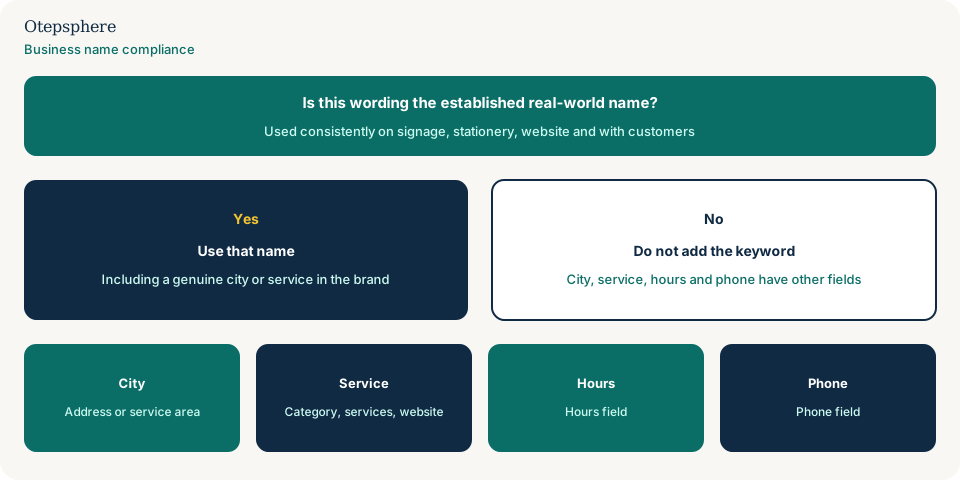
- Write the name exactly as customers encounter it on signage and stationery.
- If a city or service is not part of that name, remove it from the profile name.
- Put the city in the address or service-area fields.
- Put the service in category, services and the website.
- Do not copy a competitor’s stuffed name.
- Expect possible re-verification after a name edit.
What not to assume
- That an untouched competitor listing proves the practice is safe.
- That a stuffed name is why they rank.
- That Google “likes” extra keywords in the title of the profile.
- That this page is a substitute for completing categories, services and the website.
What not to do
- Do not add “best”, “cheap”, “24/7” or a suburb list to the name.
- Do not create a second profile to test a keyword-rich name.
- Do not change the name weekly to chase queries.
- Do not report a competitor solely because they rank higher.
Practical options
- Write the real-world name and the proposed stuffed name side by side.
- If they differ, keep the real-world name.
- Move the extra facts into the correct profile and website fields.
- If a competitor’s name looks fraudulent, document and report it through the documented Maps paths.
When professional help makes sense
Help is useful before a name edit on a listing that has already been suspended or repeatedly rejected. Nobody can promise that a compliant name will outrank a violating competitor.
Sources and further reading
- Google Business Profile Help: Guidelines for representing your business on Google
- Google Business Profile Help: Overview of policies
Unsure whether your Business Profile name complies with Google's rules?
Otepsphere can review the profile name against the business's real-world branding and website before unnecessary edits create additional risk.
Contact OtepspherePublished by Otepsphere
Published by Otepsphere, founded by Joseph Enmanuel. Learn about Otepsphere and its approach to local SEO.