Does GBP require the registered legal company name?
No. Google Business Profile does not currently require the registered legal company name as the profile name.
Google’s representation guidelines say the name should reflect the business’s real-world name, as used consistently on the storefront, website, stationery, and as known to customers. Edit help says to enter the name exactly as it appears on real-world signage, stationery and other branding. A company extract can prove who owns the business. It does not, by itself, decide the Maps name. Sources: Guidelines for representing your business on Google and Edit your Business Profile.
What does Google mean by real-world business name?
The real-world name is the public name customers already recognise from signage, paperwork and conversation — not a name invented for search.
Imagine a registered entity called ABC Holdings Pty Ltd and a customer-facing trading name of Sunrise Plumbing. If vans, invoices, the website heading and the shopfront all say Sunrise Plumbing, that is the name the profile should represent. ABC Holdings Pty Ltd remains the legal entity. It does not automatically become the Maps label. This example is illustrative. It is not a real company.
Google’s own naming example uses a coffee shop called Shelly’s Coffee, then puts the street, hours and category in other fields. The name field is for the business people ask for, not for a packed legal or marketing string.
What if the legal and trading names are the same?
Use that single name. There is no extra naming decision to make.
The remaining job is consistency: the website, the profile and important listings should not invent a second public name. If only punctuation or “and” versus “&” differs, treat that as a source-of-truth cleanup, not as two brands. Wider NAP drift is covered in inconsistent business information online.
What if “Ltd”, “LLC”, “Inc” or “Pty Ltd” is part of the legal name?
Google currently treats those legal terms as unnecessary unless real-world proof consistently shows them as part of the business name.
The naming table lists irrelevant legal terms such as LLC, LTD and INC among details that are not acceptable by default. Google’s documented examples treat “Re/Max, LLC” and “LAZ Parking Ltd” as not acceptable, and “Re/Max” and “LAZ Parking” as acceptable. To include special characters or legal terms, Google currently requires real-world proof — for example signage, business cards or invoices — that consistently displays those elements. Source: Guidelines for representing your business on Google.
If the shopfront says Sunrise Plumbing and only the ASIC or Companies House record says Sunrise Plumbing Pty Ltd, leave the suffix off the profile. If every customer-facing item includes the suffix, you can include it and should be ready to show that proof if Google asks.
What if signage uses a shortened business name?
Prefer the shortened name when that is how the business is consistently recognised in the real world.
A long legal string on the door and a short brand on every other surface is a conflict. Google asks for the name used consistently. If the painted sign, receipts and website all use the short form, the profile should not restore the long legal form “to be official.” If the short form is only an informal nickname that never appears on branding, do not invent it as the profile name.
What if the website uses another variation?
Treat the mismatch as an entity-consistency problem. Pick the real-world name, then align the site heading, contact block and profile to that name.
A homepage that says one brand while the profile says the legal entity teaches customers and systems two identities. Align the public name first. Then keep services, locations and citations attached to that one organisation, as described in entity SEO for local businesses.
What if a business recently rebranded?
A rebrand is a name change over time. Legal versus trading name is a choice between two current names.
If the public brand has already changed, follow the rebrand sequence: decide whether Google’s documented rebrand criteria apply, update the existing profile when they do, and expect possible re-verification. That process is Local SEO after a business rebrand. Do not keep the old legal name on Maps solely because the company extract has not caught up, and do not keyword-stuff both names into one field.
Should citations use the legal name or customer-facing business name?
Prioritise truthful entity consistency. Public citations should usually use the same customer-facing name as the website and the Business Profile.
Some government or payment forms will still require the registered legal name. That is expected. It does not mean every directory should switch to the holding-company label. Use one internal record for the public trading name, and note the legal name where a form actually asks for it. Citation cleanup belongs in local citation management when the public record is split across both names.
Legal Name vs Trading Name Decision Matrix
Legal entity
Registration name May include Pty Ltd, LLC or a holding-company label customers never use.Trading name
Customer-facing brand The name on receipts, ads and how people ask for the business.Storefront and website
What people actually see Signage, stationery and the site heading are evidence of the real-world name.Recommended representation
The established public name Include legal suffixes only when real-world proof consistently shows them.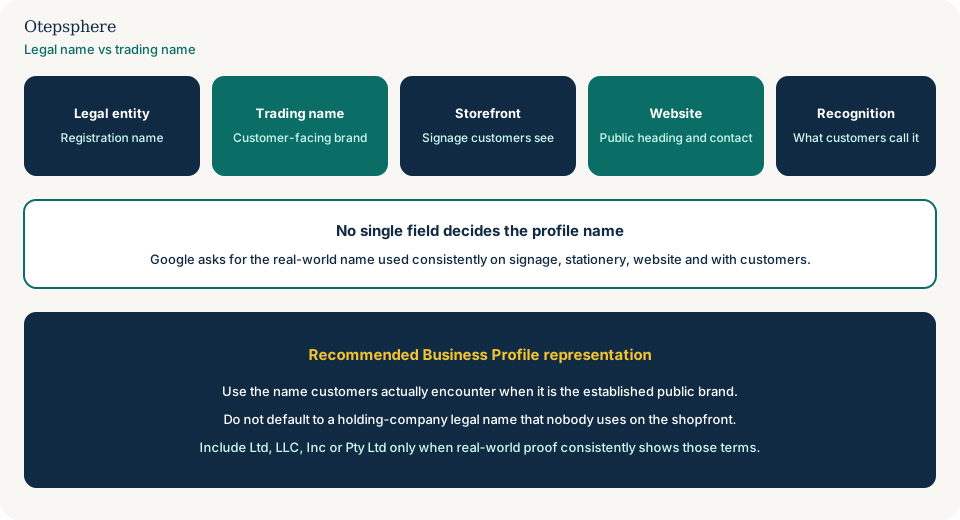
| Signal | What to write down | How it informs the profile |
|---|---|---|
| Legal entity name | Name on registration documents | Proves ownership. Does not automatically become the Maps name. |
| Trading name | Name used with customers and on invoices | Usually the strongest candidate when it is the established public brand. |
| Storefront / signage | Words on the door, vehicles or reception | Google currently treats real-world signage as naming evidence. |
| Website | Heading, logo text and contact block | Should match the name you intend customers to search. |
| Customer recognition | What people ask for and type | A name nobody uses is a poor profile name even if it is legally precise. |
| Recommended GBP representation | The consistent real-world name | Include legal suffixes only with consistent real-world proof. |
What not to assume
- That a company extract overrules the shopfront.
- That adding Pty Ltd or LLC makes the listing look more trustworthy to Google.
- That a website variation and a profile variation will “cover more keywords.”
- That this decision is the same job as a completed rebrand.
What not to do
- Do not put the legal name and the trading name in one profile field.
- Do not create a second profile so each name has a listing.
- Do not add a city or service to settle a naming argument.
- Do not change the name every time a director prefers the letterhead version.
Practical options and decision framework
- Write the legal name, trading name, signage name and website name on one page.
- Circle the name customers already use. That is the working profile name.
- Include a legal suffix only if the same materials consistently show it.
- Update the website and profile together, then important citations.
- If the public brand recently changed, switch to the rebrand sequence instead of this matrix.
- One public name is written down as the source of truth.
- Legal suffixes have either consistent proof or have been omitted.
- Website heading, profile name and high-impact listings match.
- No second profile exists for the unused legal string.
When professional help makes sense
Help is useful when a group structure, franchise agreement or recent rename has left three public names in circulation. Nobody can guarantee Google will accept a particular string, and a name edit after verification may require verification again.
Sources and further reading
- Google Business Profile Help: Guidelines for representing your business on Google
- Google Business Profile Help: Edit your Business Profile
Unsure which business name should represent your company online?
Otepsphere can review the real-world brand, website, Business Profile and external business references to identify where naming inconsistencies may exist.
Contact OtepspherePublished by Otepsphere
Published by Otepsphere, founded by Joseph Enmanuel. Learn about Otepsphere and its approach to local SEO.