What does spam inflation mean?
It means the lead KPI includes submissions that were never a customer — bots, scraped forms, or junk messages — so Local SEO looks busier than the business is.
Those rows can still appear in a GA4 key event if the thank-you or submit event fired. The ranking did not “create” them.
Is this the same as wrong-intent leads?
No. Wrong-intent leads are real people whose location, service or budget does not match what you offer.
Diagnose that on why Local SEO is bringing the wrong leads. Bots are not a keyword-mapping problem.
Shape
Do submissions look machine-written? Random strings, link spam and empty service fields are clues.Time
Is there a burst with no matching traffic? Overnight spikes without Maps or Search sessions are suspect.Source
Is GA4 attributing them to organic or GBP? Spam can still steal the Local SEO channel in reports.Yes
Filter them out of the lead KPI Keep a spam bucket. Do not “optimise” for it.Next
Real people with the wrong need are different That is unqualified intent, not bots.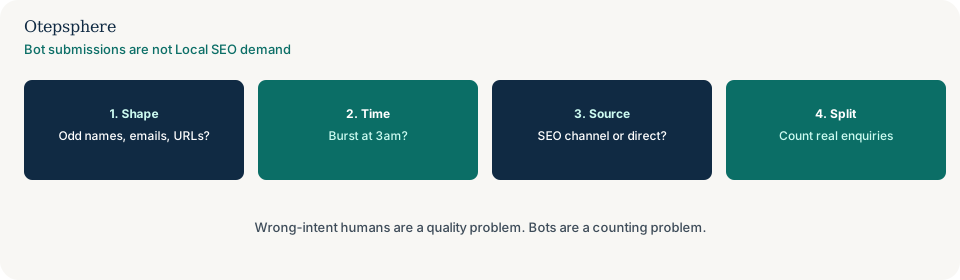
Is this “is Local SEO generating leads”?
No. That guide asks whether visibility is producing qualified business outcomes at all.
Use whether Local SEO is generating leads after you have a clean count. Spam in the numerator will fake a yes.
Is this GA4 double counting?
No. Double counting is one genuine submit recorded twice. Spam is many fake submits, each often counted once.
Use why GA4 is counting the same lead more than once. A real person submitted and nobody received the message is why location page contact forms are not delivering leads.
How should you count after you filter?
Keep a spam bucket and a real-enquiry bucket. Report Local SEO against the real bucket only.
Do not delete evidence until you have a sample. Honeypot fields, time-to-submit checks and a confirmed thank-you that bots skip all reduce volume. They are operations, not a ranking tactic. People-first pages still matter so humans can complete a real form: Creating helpful, reliable, people-first content.
Spam decision table
| What you see | What it usually means | Decision | What not to assume |
|---|---|---|---|
| Overnight burst; gibberish names | Bots | Filter from the KPI; harden the form | That Maps visibility spiked |
| Human questions for a service you do not offer | Wrong intent | Use the wrong-leads guide | That this spam page applies |
| One person; two GA4 events | Duplicate tags | Use the double-counting guide | That they are two spam bots |
| Spam attributed to organic in GA4 | Channel theft | Exclude those rows from organic lead reports | That Search Console clicks must match the spam |
What should I not do?
Action checklist
- Sample recent form rows. Mark spam, wrong-intent humans and genuine enquiries.
- Rebuild the Local SEO lead KPI on genuine enquiries only.
- If one genuine row appears twice in GA4, switch to double counting.
- If the humans are real but unfit, switch to wrong-intent leads.
- Harden the form. Re-check that real customers can still submit.
- Do not use spam volume as evidence that rankings improved.
When professional help makes sense
Help is useful when a CRM, GA4 and the inbox each include a different mix of junk. It cannot promise that a cleaner form will increase rankings, and it cannot make Google ignore bot traffic in every report.
Sources and further reading
- Google Search Central: Creating helpful, reliable, people-first content
- Google Analytics Help: [GA4] Key events
Lead reports still mixing bots with real Local SEO enquiries?
Otepsphere can help split spam from genuine enquiries so Local SEO is judged on real demand — not an inflated form count.
Contact OtepspherePublished by Otepsphere
Published by Otepsphere, founded by Joseph Enmanuel. Learn about Otepsphere and its approach to local SEO.