What does Google count as directions?
Directions are how many people asked for directions to your business. Google has adjusted unique counting for multiple taps, cancelled requests and spam.
Source: Understand your Business Profile performance and insights. Asking for a route is not a verified store visit.
Is this GBP versus GA4 versus Search Console?
Partly related, and still a different job. Those products disagree because they count different interactions.
The three-product map is why GBP, GA4 and Search Console numbers disagree. This page is only directions versus arrival.
Tap
What does Google count as directions? People who asked for directions to the business.Route
Did that become an actual journey? Cancelled and unused routes still may have been requested.Door
Do you have an arrival signal? Till, booking or a store-visit product is a different dataset.Yes
Report directions as intent, not visits Do not treat the metric as a ranking or footfall guarantee.Next
Call taps are a sibling metric Calls are also button clicks, not answered conversations.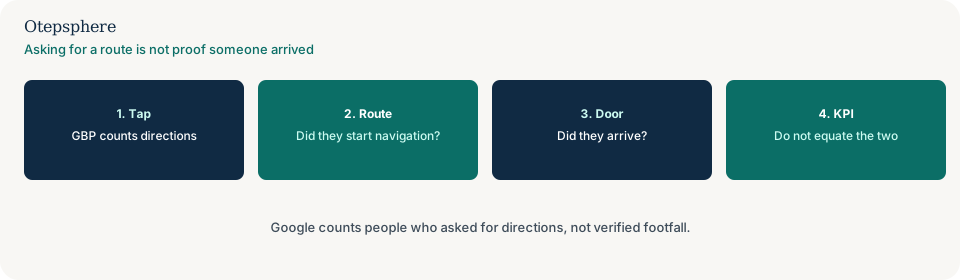
Is this the same as call taps?
No. Calls are taps on the call button. Directions are taps that request a route. Both are listing actions.
Calls versus the phone log is why GBP call clicks do not match actual phone calls.
Is this Maps visibility?
No. Visibility is whether the business appears for a query from a point. Directions are an action after someone already opened the listing.
Geographic appearance is how to measure Google Maps visibility.
How would you know they arrived?
A till, booking, door counter, or a store-visit measurement product — none of which is the GBP directions metric.
Google does not document directions as proof of footfall. Do not treat a directions spike as a ranking win or as customers in the shop. Whether Local SEO produced qualified outcomes is whether Local SEO is generating leads.
Directions decision table
| What you see | What it usually means | Decision | What not to assume |
|---|---|---|---|
| Directions 200; till transactions 40 | Intent without arrival | Report both; do not equate them | That 160 people “should have” visited |
| Directions up; rankings unchanged | More listing actions | Keep directions as an action KPI | That Google paid you a ranking bonus |
| You compared directions to GA4 sessions | Different products | Use the three-product guide | That directions must equal website visits |
| Service-area business with hidden address | Directions may not apply the same way | Do not force a visit metric you cannot observe | That you need fake store visits |
What should I not do?
Action checklist
- Export GBP directions for a closed date range. Label them as route requests.
- If you have till or booking counts, chart them on a second line.
- Do not present a ratio as Google’s conversion rate.
- If the argument is calls, switch guides. If it is three Google products, switch guides.
- Keep Maps visibility as a third report, not a substitute for arrival.
- Do not change the listing to chase directions as if they were visits.
When professional help makes sense
Help is useful when a franchise report already labels directions as “store visits.” It cannot turn route requests into footfall, and it cannot promise that more directions will follow a ranking change.
Sources and further reading
- Google Business Profile Help: Understand your Business Profile performance and insights
- Google Business Profile Help: Tips to improve your local ranking on Google
Directions still being reported as customers in the shop?
Otepsphere can separate route requests from arrival so Local SEO reports stop treating a Maps tap as a visit — without a footfall guarantee.
Contact OtepspherePublished by Otepsphere
Published by Otepsphere, founded by Joseph Enmanuel. Learn about Otepsphere and its approach to local SEO.