What does LocalBusiness structured data actually do?
It tells Google, in a standard format, facts about the business described on that page — such as name, address, phone and hours — so Search can understand the content more explicitly.
Google’s Local business structured data documentation says Search results may display a Knowledge Panel with business details, and that users searching for a type of business may see a carousel in some cases. “May” is the documented word. Markup describes the page. It does not operate Maps ranking.
Google also says structured data should describe content that is visible to the user, and that you should not add markup about information that is not visible even if it is accurate. Source: Introduction to structured data.
Is LocalBusiness schema a ranking factor?
Google does not document LocalBusiness markup as a confirmed direct ranking factor.
Treat it as a way to describe visible business information. Useful pages, accurate facts and a crawlable site still do the organic work. See entity SEO for local businesses and local on-page SEO for the content and identity work markup cannot replace.
Does valid schema guarantee a rich result?
No. Google does not guarantee display of supported rich-result features.
The LocalBusiness documentation states that you must follow the guidelines to be eligible to appear in local business rich results, and the troubleshooting section repeats that Google does not guarantee features that consume structured data will show up. Eligibility is not a switch.
Why does Rich Results Test say valid but nothing appears?
Because technical validity is not the same as Search presentation.
The Rich Results Test can confirm that required properties parse. It cannot promise a Knowledge Panel, a carousel, stars or a Map Pack. The page still has to be indexed. Google still decides whether a feature is useful for that query. A restaurant carousel is separately documented as limited access.
Can businesses markup their own reviews for star ratings?
Not for a self-serving star feature. Google’s review snippet guidelines currently say that if the entity being reviewed controls the reviews about itself, pages that use LocalBusiness or other Organization markup are ineligible for the star review feature.
That includes reviews placed directly in your structured data or through an embedded third-party widget, such as a Google Business reviews or Facebook reviews widget on your own site. AggregateRating and review properties in the LocalBusiness documentation are recommended only for sites that capture reviews about other local businesses. Source: Review snippet structured data.
What fields should LocalBusiness markup contain?
The fields that are accurate and visible on the page, starting with Google’s required properties: name and address.
Recommended properties in the current LocalBusiness documentation include geo coordinates, opening hours, telephone, url, priceRange, menu for food establishments, and department where relevant. Do not reproduce every schema.org property. Extra fields that are not on the page violate the “visible content” rule. Use the most specific LocalBusiness subtype when it is true, such as Dentist or Plumber rather than a generic type if that matches the page.
Can inaccurate schema hurt trust?
Yes, because structured data that contradicts the page is misleading, and Google’s guidelines require markup to match visible content.
Wrong hours, an old address, or a phone number that belongs to another branch create a second, machine-readable version of a lie. That is an entity and trust problem, not a clever rich-result tactic. Spammy structured data can also be ignored after a manual action.
What if schema disappeared after an update?
Then diagnose the template, CMS or plugin — not Search as if it “turned off” your rich result.
Theme updates, tag-manager changes and duplicate JSON-LD blocks are common. If markup vanished after a redesign or deploy, start with Local SEO after a website redesign rather than treating Search as if it turned off a rich result. This page is for markup that is still valid and still not producing a special appearance.
Structured data expectation matrix
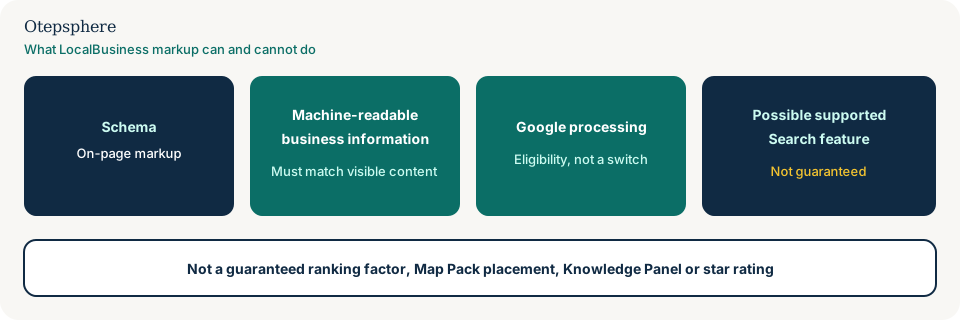
What not to assume
- That valid JSON-LD will create Map Pack rankings.
- That stars will appear because you embedded your Google reviews.
- That more schema.org properties are always better.
- That a Knowledge Panel is owed to any business with LocalBusiness markup.
What not to do
- Do not add hidden NAP in JSON-LD that the page does not show.
- Do not mark up your own testimonials as Review snippet stars.
- Do not copy another location’s address into every page’s schema.
- Do not treat Rich Results Test as a ranking report.
Practical action plan
- List the Search feature you expected. Check whether Google documents it for this page type.
- Confirm the JSON-LD matches visible name, address, phone, hours and URL.
- Remove self-serving review markup if it is there for stars on your own entity.
- Inspect the live URL in Search Console, not only the testing tool.
- Keep schema as an accuracy layer. Improve the page itself if organic visibility is the real goal.
When professional help makes sense
Help is useful when several templates emit conflicting LocalBusiness graphs, or when a developer was told that schema would “get rich snippets.” It cannot guarantee a rich result, a Knowledge Panel or Map Pack placement.
Sources and further reading
- Google Search Central: Local business structured data
- Google Search Central: Introduction to structured data
- Google Search Central: Review snippet structured data
- Google Search Central: General structured data guidelines
Schema validates but you're unsure whether it is helping?
Otepsphere can review the implementation, visible business information and structured-data consistency without treating schema as a guaranteed ranking shortcut.
Contact OtepspherePublished by Otepsphere
Published by Otepsphere, founded by Joseph Enmanuel. Learn about Otepsphere and its approach to local SEO.