Why can Google look strong and the rest look weak?
Because the people who post on Google Maps are not always the people who post on a booking site, a Facebook recommendation thread, a regulator, or a news story.
Each system has its own sign-in, moderation and audience. A dentist can have a high Google average from local patients and a cluster of complaints on a national forum that Google never shows. Neither number is fake by default. They are different samples.
What are the main reputation surfaces?
Google Search and Maps, other review or booking directories, social comments and groups, and news or official notices.
Map them separately. A 4.8 on Google is not a score for Facebook. A news item will not be fixed by a Maps average. Inconsistent name, address and phone across the web is a listings problem, not a star problem: inconsistent business information online.
Else
Is another site where people complain? Booking platforms, industry registers and Facebook reviews are separate systems.News
Is the damage a story, not a star? A news item will not be fixed by a Maps average.Yes
Respond on the surface customers are using Google replies on Google. Other sites have their own tools.Next
Do not treat Google as the whole brand Measure each channel. Do not invent a single “online reputation score.”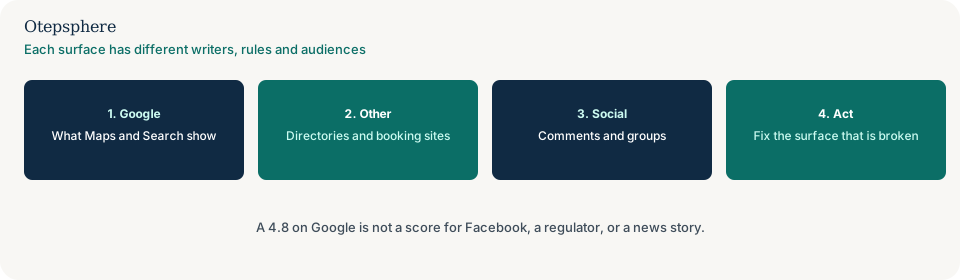
What does a Google rating actually represent?
It represents reviews left on that Business Profile under Google’s Maps rules, by people signed in to a Google Account.
Prominence in local results can include review information. That still does not make the Google average a summary of every comment on the internet. Source: Tips to improve your local ranking on Google. Google also notes that a mix of ratings can feel more trustworthy than a perfect score. Source: Tips to get more reviews.
Where should you act first?
On the surface that is actually changing customer behaviour, using that platform’s reply and report tools.
If Maps is healthy and Facebook comments are where people decide, answer there. If a booking platform is the complaint channel, use that platform. Do not try to “balance” another site by inflating Google. Fake engagement on Google is still prohibited. Source: Prohibited and restricted content. Ethical Google requests remain: how to get more Google reviews ethically.
When is the Google side the real problem?
When the Google listing itself has policy-violating reviews, a restriction, missing reviews, or competitor spam — even if another site looks worse.
Diagnose Google on its own terms: fake or malicious Google reviews, a sudden negative-review spike, and competitor spam on Google Maps. Do not ignore a Maps problem because a directory looks uglier.
Surface decision table
| What you see | What it usually means | Decision | What not to assume |
|---|---|---|---|
| High Google average; harsh comments on another site | Different audiences and rules | Respond on that site; keep Google ethical; do not buy Maps reviews as offset | That the Google number is the whole brand |
| News story or regulator notice | Public record, not a star average | Legal and communications advice as needed; Maps replies cannot unpublish news | That more five-star Google reviews will bury it |
| Google looks healthy; NAP is wrong elsewhere | Listings consistency | Fix name, address and phone where you control them | That stars fix a wrong address |
| Google is the complaint channel after all | Maps-side incident or process gap | Use the matching Google review diagnostic; do not only polish other sites | That a strong directory score substitutes for Maps |
What should I not do?
Action checklist
- List the surfaces where customers actually comment: Google, other directories, social, news.
- Note which surface is changing enquiries this month. Act there first with that platform’s tools.
- Keep Google requests ethical. Do not use Maps to compensate for another site.
- If Google itself has fake, missing or spam issues, follow the matching diagnostic on this site.
- Align name, address and phone on listings you control.
- Measure each channel separately. Do not average them into one invented score.
When professional help makes sense
Help is useful when several platforms are noisy at once and you cannot tell which one is costing customers, or when Google and listings data disagree. It cannot collapse every website into one rating, and it cannot remove a news story by changing a Google average.
Sources and further reading
- Google Business Profile Help: Tips to improve your local ranking on Google
- Google Business Profile Help: Tips to get more reviews
- Maps User Generated Content Policy: Prohibited and restricted content
Google looks strong but reputation elsewhere does not?
Otepsphere can help map which surface is actually affecting customers and what a policy-safe Google process looks like — without treating Maps stars as the whole story.
Contact OtepspherePublished by Otepsphere
Published by Otepsphere, founded by Joseph Enmanuel. Learn about Otepsphere and its approach to local SEO.