Is it normal for directories to rank?
Yes. Third-party sites can rank like any other eligible web result when they match the query and are available to Search.
Google Search currently crawls, indexes and ranks pages. It does not publish a rule that an official domain must outrank a directory. A well-known directory page with clear NAP, reviews and inbound links can be a stronger match than a slow, vague or unindexed company page. Source: How Search works.
This is not the same job as citation management, which is about consistent public business facts. A directory can be accurate and still outrank you.
Is the official website indexed?
If the official URL is not indexed, a directory is not “stealing” the ranking. Search cannot show a page it has not selected for the index.
Use Search Console URL Inspection. Check robots, noindex, canonicals, soft 404s, crawl blocks and whether Google chose a different canonical. Fix accessibility before comparing authority.
Is the query actually branded?
If the searcher typed the business name, a directory above the official site is a different problem from a generic “plumber [city]” result.
Branded queries often show the company site, Maps listing and sometimes a knowledge panel. If another company’s site or a similarly named listing appears, start with why the wrong business shows for a brand search. If the query is not branded, “official website” is not a ranking entitlement.
Does Google clearly understand which site is official?
Not always. Search systems infer the organisation from public information; they do not take the homepage’s word alone.
Align the legal and trading name, website, Business Profile, and consistent public references. Entity clarity is the subject of entity SEO for local businesses. Unlinked mentions that never point to you make directories look like the public record. Those are covered in unlinked brand mentions.
Does the business page clearly state its identity?
If the ranking candidate is a homepage that never states the trading name, services, location and how to contact the business, a directory profile can be the clearer page.
Check the official URL for:
- The name customers actually use.
- The services offered, in language a person would search.
- The location or service area that is true.
- Working contact information.
- About or organisation information that matches other public sources.
Inconsistent facts across the web are a separate but related issue in inconsistent business information online.
Does the directory have stronger links or relevance?
It might. Many directories collect links, reviews and structured business facts that a new or thin company site has not earned yet.
Google currently discusses links among the signals Search uses to understand which pages are useful, without publishing a local-pack formula. Observe who links to the directory page versus the official URL. Improve the official site’s usefulness and genuine references rather than copying directory boilerplate. Local link building is the long-term version of that work. Source: How Search works.
Are important local sites linking only to the directory?
Yes, that happens. A council, newspaper or partner page may use the directory URL because it was easy to find.
Where you have a legitimate relationship, ask for a link to the official site. Do not demand removal of the directory mention. Treat this as entity and link clarity, not as a reason to delete a useful listing. See local link building and inconsistent business information online.
Should I try to remove directory listings?
No, not as the default fix. A legitimate directory listing may help customers and keep public facts consistent.
Remove or correct a listing only when it is inaccurate, duplicate, for a closed location, or created without a real business relationship. Deleting a useful, accurate profile does not promote the official site.
Can citation cleanup fix rankings automatically?
No. Cleaning NAP records can reduce confusion. It does not automatically make the official website outrank a directory.
Citation work and organic ranking are related through entity consistency, not through a published ranking switch. Do the cleanup when facts are wrong. Still improve the official page’s match for the query.
Official Website vs Directory Diagnostic
Entity
Business entity The organisation customers need to identify correctly.Owned
Official website and GBP The sources the business should keep accurate and useful.Third-party
Directories and mentions Independent pages that can also rank and corroborate facts.Search
Search understanding Which URL ranks is a match for the query, not a certificate of official status.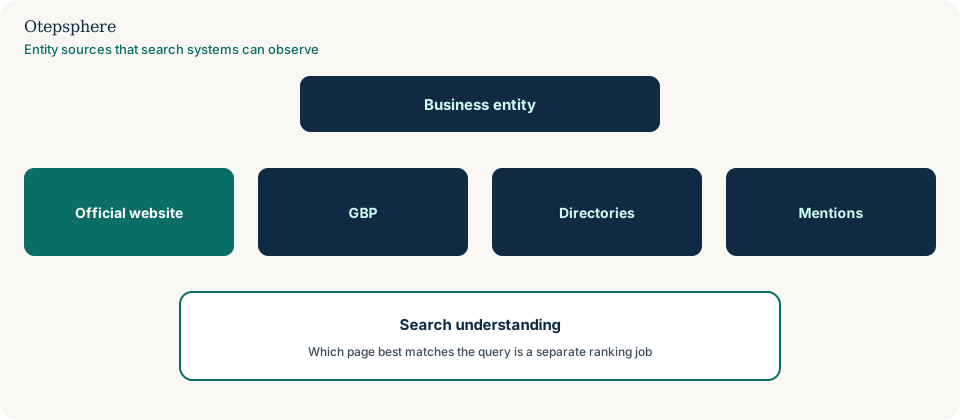
Directory versus official-site checklist
| Check | If yes | If no |
|---|---|---|
| Official URL indexed? | Compare relevance and links | Fix crawl, index and canonical issues first |
| Query branded? | Treat as entity identification | Treat as ordinary web ranking |
| Official page states identity clearly? | Look at links and usefulness | Fix name, services, location and contact facts |
| Directory facts accurate? | Leave the listing; strengthen the site | Correct the record; do not expect an automatic rank swap |
What not to assume
Do not assume Google reserved organic #1 for official domains. Do not assume citation software will outrank a directory. Do not assume the directory is spam because it ranks. Do not assume a Knowledge Panel means the website will win every related query.
What not to do
Practical action plan
- Confirm the official URL is indexable and is the canonical Google selected.
- Classify the query as branded or non-branded.
- Make the intended page state name, services, location and contact information clearly.
- Compare inbound links and on-page usefulness with the ranking directory URL.
- Correct inaccurate listings; keep accurate ones.
- Request genuine links to the official site where you have a real relationship.
When professional help makes sense
Help is useful when directories outrank the official site across branded and non-branded queries, or when entity confusion involves similarly named businesses. It cannot suppress a legitimate third-party page.
Sources and further reading
- Google Search Central: How Search works
- Google Search Central: Search Essentials
- Creating helpful, reliable, people-first content
- Guidelines for representing your business on Google
Third-party sites consistently outranking your own business website?
Otepsphere can review the official site's relevance, technical condition, entity signals and external references to identify where it is being outperformed.
Contact OtepspherePublished by Otepsphere
Published by Otepsphere, founded by Joseph Enmanuel. Learn about Otepsphere and its approach to local SEO.