What does this problem actually mean?
Searchers in one country or language are being shown a local page built for a different market — wrong currency, wrong phone, wrong address, or the wrong language — because that is the version Google associated with the query.
That is not the same as two location pages competing inside one country: why business locations can compete with each other in Google Search. It is also not a Google-selected canonical within one language cluster, though untranslated copies can become duplicates: why Google chose a different canonical for a location page.
Observe
Which URL ranks there? Search Console country and page reports beat a VPN screenshot as evidence.Language
Google detects the page language hreflang tells Google about variants. It does not replace language detection on the page itself.Annotations
Reciprocal hreflang cluster Missing return links, bad codes or one-way tags can be ignored.Geo
ccTLD, folders, auto-redirects IP or language redirects that send Googlebot to one country hide the others.Content
Untranslated “local” copies Near-identical English across country folders can be treated as duplicates of one version.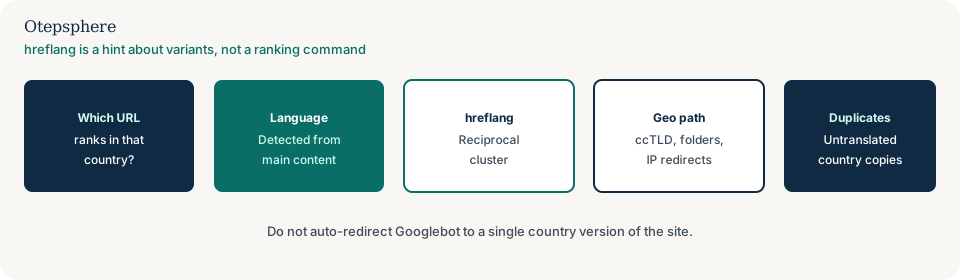
Why can the wrong version rank?
Google may still find language variants without annotations, but mixed or missing hreflang, untranslated country folders, ccTLD versus subdirectory confusion, and IP-based redirects commonly send the wrong document.
Localized versions are only considered duplicates if the main content remains untranslated. Source: Tell Google about localized versions of your page.
How do I confirm which URL wins?
Use Search Console performance broken down by country and page. A VPN screenshot is a clue, not a measurement system.
Inspect both the intended local URL and the URL that actually ranks. Compare language of the main content, hreflang return links, canonicals and whether a redirect fires for Googlebot.
Does Google use hreflang to detect language?
No. Google uses algorithms to determine the page language. hreflang tells Google that pages are localized variations of the same content. The HTML lang attribute is also not what Google uses for that detection.
If the Australian and UK location pages are both US English with a city name swapped, annotations will not invent a language difference that is not on the page. Source: the localized-versions documentation above.
Is the hreflang cluster valid?
Each language version must list itself and the others. Return links must be reciprocal or the annotations can be ignored. Use ISO language codes and optional ISO region codes; region-only codes are invalid.
x-default is for unmatched languages, often a selector page. Do not combine hreflang with unrelated
link attributes on the same tag. Methods (HTML, HTTP header, sitemap) are equivalent; pick one you can
maintain. Source: the same documentation, including troubleshooting for missing return links and bad codes
such as using UK instead of GB.
Are country sites or folders sending mixed signals?
ccTLDs are a strong geographic hint. Subdirectories on a generic TLD rely more on content, hreflang and links. Canonicals should stay inside the same language where possible.
Google prefers HTTPS and, for canonicalisation, URLs that sit in a reciprocal hreflang cluster over a similar URL left out of the cluster. Conflicting canonicals and hreflang make the wrong country page easier to pick. Source: Specify a canonical URL.
Are auto-redirects trapping the crawler?
Redirecting every visitor — including Googlebot — to one country site hides the other versions. Googlebot generally crawls from the United States and should be able to reach each locale URL directly.
Offer a country selector instead of a forced IP redirect for crawlers. If you must redirect users, do not
prevent Google from fetching /uk/ and /au/ as separate URLs.
Locale diagnostic table
| Symptom | Likely cause | What to verify | What not to assume |
|---|---|---|---|
| US page ranks in the UK | Stronger US domain, missing GB annotations, or untranslated duplicate | Reciprocal en-GB / en-US hreflang and distinct local facts | That HTML lang="en-GB" forces the result |
| English page ranks for a non-English query | Translated version not found or not in the cluster | That the translated URL is crawlable and linked back | That hreflang overrides language detection |
| Only one country site is indexed | IP or language redirect | Fetch each locale URL as Googlebot without a bounce | That Search Console geotargeting still exists as a switch |
| Country folders treated as duplicates | Main content untranslated | Unique local information per market, not a city-name swap | That more hreflang tags will invent uniqueness |
What should I not do?
Action checklist
- Record which URL ranks in the affected country using Search Console, not only a VPN.
- Confirm the intended page’s main content is in the right language and has real local facts.
- Validate reciprocal hreflang with correct language and optional region codes.
- Let Googlebot fetch each locale URL without an IP bounce.
- Align canonicals inside the same language version.
- Differentiate untranslated country copies or stop presenting them as separate documents.
When professional help makes sense
Help is useful when several country sites share a CMS, when hreflang is generated incorrectly at scale, or when a CDN redirect sends all crawlers to one market. Correct annotations do not guarantee the intended URL will rank.
Sources and further reading
- Google Search Central: Localized versions of your pages
- Google Search Central: Specify a canonical URL
The wrong country or language version of a local page is winning in Search?
Otepsphere can compare the ranking URL with the intended locale page, check reciprocal hreflang and crawler redirects, and separate untranslated duplicates from a genuine localisation gap — without guaranteeing which version Google will show.
Contact OtepspherePublished by Otepsphere
Published by Otepsphere, founded by Joseph Enmanuel. Learn about Otepsphere and its approach to local SEO.